Applications Library • Retail

Blanched kernels for retail baking

A detailed, procurement-ready guide to blanched hazelnut kernels used in retail baking — covering which formats work best, how to specify size and cut tolerances, what drives flavor and shelf stability, and how to choose packaging that protects aroma from factory to shelf.

Back to applications

Best for: biscuits & cookies, cake mixes, muffins, brownie inclusions, pastry fillings, granola toppings, and “bake-at-home” retail kits where light color and clean flavor are required.

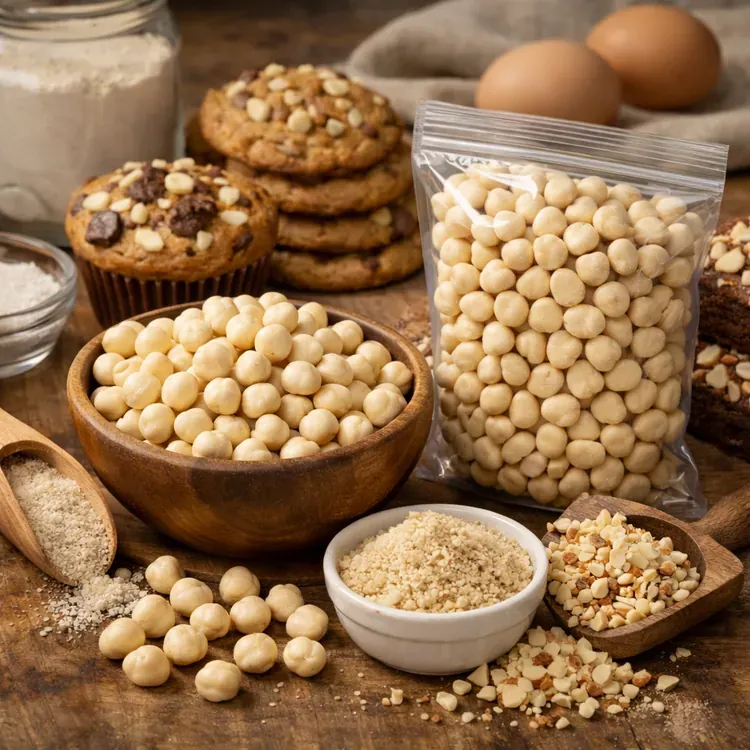
Blanched kernels for retail baking illustration

Where it fits

Blanched hazelnut kernels are chosen when retail baking products need a clean, uniform appearance (skin removed), a balanced sweetness, and a stable inclusion that performs reliably through mixing, depositing, baking and distribution. Compared with natural kernels, blanching helps meet light color targets and reduces visible speckling, which is especially important for vanilla, white chocolate, and “golden crumb” bakery profiles.

In production, the main drivers are flavor consistency, particle control, and shelf stability. Retail distribution is unforgiving: products may sit in ambient conditions, face temperature swings during transport, and remain on shelves for weeks or months. That’s why most procurement teams define not only the kernel grade, but also the oxygen-protection plan, defect tolerances, and documentation flow for each lot.

We support manufacturers and retail brands by aligning the hazelnut format and processing level to your line: whole blanched kernels for on-site roasting or decoration, calibrated cuts for accurate dosing, and meal/flour for homogeneous mixes where a consistent nut note is needed across every bite. When your product calls for deeper aroma, we can align a roast profile (light/medium) and packaging that preserves volatile notes.

Export-ready documentation Lot traceability Custom cuts Bulk & retail options Shelf-life protection

What “good” looks like in retail baking

A strong retail baking spec usually reads like a process document: it defines the product form, size grade, cut tolerance, sensory target (color + aroma), packaging barrier requirements, and the minimum batch paperwork needed for receiving and QA release.

  • Uniform appearance: blanch quality matched to your color target.
  • Consistent dosing: stable size distribution and low fines for cut products.
  • Predictable flavor: aligned roast (if used), plus oxygen protection.
  • Stable crunch & texture: moisture managed from packing to bakery line.
  • Traceability: clear lot coding and shipment-level documentation.
Recommended formats

Typical starting points for pilot trials and scale-up. We adapt kernel size, cut tolerance, roast target (if applicable), and packaging barrier to your process and distribution model.

  • Blanched whole kernels — for in-house roasting, decoration, or hand-crafted inclusions.
  • Blanched diced / chopped — controlled inclusion size for automated dosing and even distribution.
  • Blanched sliced — topping and decoration for pastries, cakes and premium retail SKUs.
  • Hazelnut meal / flour — for batters, cookie doughs, and mixes needing a uniform nut profile.
  • Hazelnut paste — for fillings and spreads requiring homogeneous texture and consistent aroma.
  • Hazelnut oil — niche use for aroma and mouthfeel in select bakery formulations.

Technical considerations

Key variables that affect throughput, sensory performance, and shelf-life — especially in retail environments where oxygen, time and temperature swings can degrade aroma.

  • Oxidation protection: oxygen-barrier liners, vacuum or MAP; controlled headspace where required.
  • Size distribution: aligned grade and tolerance to prevent over/under dosing.
  • Fines & dust control: managed for cleaner hoppers, stable flow and consistent inclusion visuals.
  • Moisture management: protects crunch, reduces clumping, and supports stable texture in mixes.
  • Defect control: sorting strategy aligned to your product’s visible inclusion expectations.
  • Lot documentation: COA flow, traceability and release routine that fits your QA system.

Packaging approach

Packaging is a performance tool. The goal is to protect aroma compounds and the nut’s fat profile from oxygen, light and heat, while keeping handling efficient for your warehouse and production line.

Typical solutions include high-barrier liners inside export cartons, vacuum for sensitive cuts, or MAP when extended shelf-life and aroma retention are critical. Case weight and pallet pattern are aligned to sea, road or air freight.

See bulk supply details →

How blanching and format choice affect the final product

Blanching removes the skin to deliver a cleaner look and a milder, more controlled sensory profile. For retail baking, the biggest practical benefit is appearance consistency across batches and seasons. However, blanching also changes how kernels interact with heat: blanched kernels can brown differently during baking, and cut surfaces expose more area to oxygen—making packaging and storage discipline especially important.

Choosing the right format is usually a balance between processing efficiency and consumer experience: whole kernels give a premium bite, calibrated dices deliver uniform distribution, and meal/flour improves homogeneity in doughs and mixes. For each format, the spec should define what matters most: size grade, tolerance, fines, moisture target, and oxygen-protection plan.

Common retail baking use cases

  • Cookie & biscuit inclusions: diced or chopped for even distribution and predictable bite.
  • Muffins & cakes: chopped/sliced for visual appeal; flour for subtle nut note without visible pieces.
  • Pastry toppings: sliced kernels with controlled thickness and low breakage.
  • Fillings: paste for smooth texture; fine meal for structured “nutty” fillings.
  • Retail mixes: flour/meal for consistent flavor in each pack; kernels for premium “add-in” pouches.

Typical specification markers

Below is a practical checklist used by procurement and QA teams. We align each item to your destination market, customer requirements, and the processing level you need (whole, cut, roasted, meal/flour, paste).

Parameter How we align it
Product form Whole, diced/chopped, sliced, meal/flour, paste — matched to your application and dosing method
Kernel size grade Defined grade selection for consistent yield and appearance
Cut tolerance Controlled cut bands; aligned to your inclusion visuals and process capability
Fines / dust Screening and calibration to manage flowability, hopper performance and pack aesthetics
Moisture Controlled to your target range to protect crunch and reduce clumping risk
Sensory target Light color (blanch quality) and aroma profile aligned to your product style
Defect sorting Screened and optically sorted where required; approach matched to visible inclusion expectations
Micro profile Aligned to customer specifications and destination requirements; documentation supplied per lot
Aflatoxin Managed through risk-based sourcing, partner controls and defined release procedures
Packaging barrier High-barrier liners, vacuum or MAP based on format sensitivity and shelf-life goals
Traceability Lot coding, batch documentation and COA flow aligned to your QA intake process
Logistics Pallet pattern, case weights and shipping mode (sea/road/air) aligned to handling and destination

Final target values depend on product form and customer requirements. We share lot documentation with each shipment and align release procedures to your receiving workflow.

Sizing & dosing guidance

Retail baking lines often run at high speed, so stable size distribution matters as much as nominal size. The right format reduces line stops, supports consistent pack visuals, and improves consumer perception.

  • Whole kernels: ideal for premium bite, but require careful control for uniform roast/bake outcomes.
  • Diced/chopped: best for automated dosing and even distribution in cookies and mixes.
  • Sliced: decorative; more fragile — packaging and handling are critical to reduce breakage.
  • Meal/flour: reduces visible variability and delivers consistent flavor in each portion.

Shelf-life protection

Hazelnuts have a valuable fat profile — and oxygen is the enemy. Protection strategy depends on surface area: cuts and meal oxidize faster than whole kernels, so barrier choices should scale with sensitivity.

  • Oxygen barrier: liners and films selected to reduce oxidative rancidity risk.
  • Headspace control: vacuum or MAP for high-sensitivity formats.
  • Temperature discipline: aligned to season and route to preserve aroma.
  • Stock rotation: clear lot coding supports FIFO and consistent finished product.

QA & documentation flow

Efficient receiving is a competitive advantage. Clear documents reduce hold time and ensure consistent release decisions across lots.

  • COA and lot identifiers aligned to your PO and receiving labels.
  • Defined sampling and retention approach (customer-led or jointly agreed).
  • Specification alignment for destination market and private label needs.
  • Consistent packing list / invoice / export documentation pack.

Packaging options by format

A packaging plan should reflect the sensitivity of each format. Whole kernels are relatively robust, while diced/sliced and meal/flour expose more surface area and may require stronger oxygen protection. We match packaging to your handling (warehouse automation, manual picking, or co-manufacturing transfers) and your distribution reality (ambient retail, export sea freight, or mixed routes).

Typical approaches

  • Whole blanched kernels: high-barrier liner inside export cartons; optional vacuum for extended storage.
  • Diced / chopped / sliced: higher barrier film, tighter headspace control; vacuum/MAP when needed.
  • Meal / flour: barrier packaging to reduce aroma loss; careful moisture management to prevent caking.
  • Paste: oxygen protection and temperature discipline are critical; packaging chosen for clean handling and dosing.

If you’re launching a new retail SKU, we can structure a simple “spec ladder”: a baseline pack for trials and an optimized pack for full scale once shelf-life, aroma retention and logistics are validated.

FAQ

Which hazelnut format is most common for retail baking with blanched kernels?

Most programs start with blanched whole kernels (premium bite, flexible roasting options) or calibrated diced/chopped formats (best for automated dosing). Teams then fine-tune kernel size, cut tolerance, roast target (if applicable), and packaging barrier based on shelf-life and finished-product visuals.

How do you control particle size and dust for consistent dosing?

We align the product to a defined size band and manage fines via screening and calibration. For diced/chopped formats, we can agree tolerance ranges that match your dosing equipment and inclusion look, helping you reduce variability in portioning and minimizing dust-related handling issues.

What packaging is best for protecting flavor during storage and distribution?

Oxygen protection is usually the priority. Depending on sensitivity and route, options include high-barrier liners, vacuum, or MAP. Cuts and meal/flour typically require stronger protection than whole kernels. We also align case size and palletization to reduce transit damage and support warehouse efficiency.

Do you support long-term supply programs for retail brands and co-manufacturers?

Yes. We can structure annual or multi-shipment programs with consistent specifications, traceable lots, and a documentation pack that fits your QA release workflow. Forecast-based planning helps stabilize availability and supports consistent finished-product performance across the season.

Next step

Share your target retail product (or recipe context), desired format, expected annual volume, and destination country. We’ll propose suitable grades, cut tolerances, packaging barrier options, and a shipment plan aligned to your shelf-life goals.

  • For trials: recommend a practical starting spec and pack that keeps procurement simple.
  • For scale-up: align tolerances, documentation flow and packaging to reduce receiving and production friction.
  • For retail: emphasize aroma protection and consistent inclusion visuals across lots.
Review products