Natural kernels
Raw kernels aligned to caliber, moisture and defect targets for roasting lines, inclusions and repacking.
View details →Kernels, controlled cuts, meal/flour, paste and oil — supplied with specification discipline, packaging options, and export-ready documentation. Choose the format that fits your process (dosing, mixing, grinding, enrobing, filling, roasting).
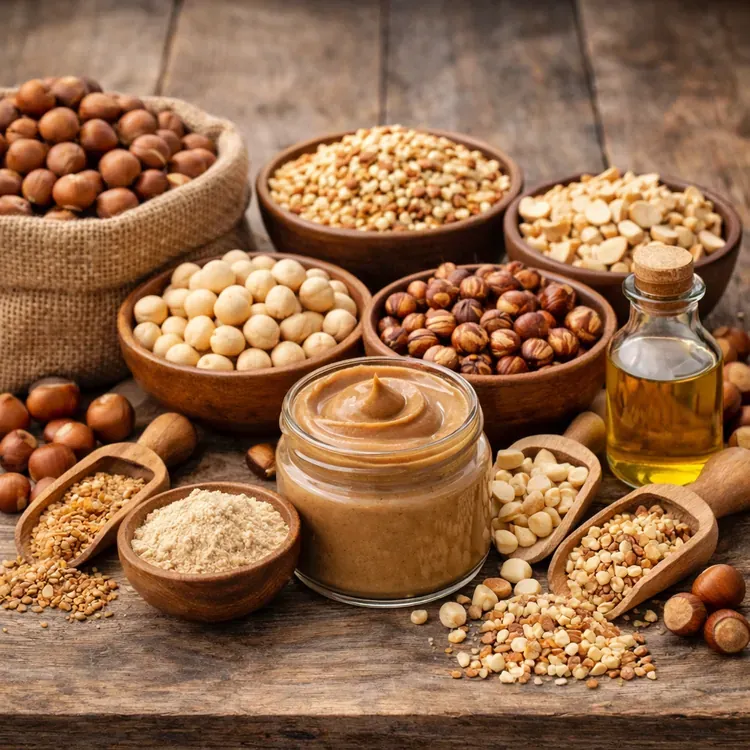
Our portfolio covers Turkey-origin hazelnuts and hazelnut ingredients commonly used in industrial confectionery, bakery, dairy/ice-cream, breakfast/cereals, beverage flavoring, and ingredient manufacturing. Formats can be aligned to your line constraints (sieving, dosing accuracy, melting behavior, viscosity, mouthfeel and shelf-stability).
If you already have an internal specification sheet, send it. We will map it to the appropriate format, processing route, packaging, and QC checkpoints (incoming → in-process → pre-shipment).
Each format has its own specification levers, packaging options and industrial use-cases.
Raw kernels aligned to caliber, moisture and defect targets for roasting lines, inclusions and repacking.
View details →Skin-reduced kernels for clean color targets, smooth textures and premium visual appearance in enrobed products.
View details →Roast profiles tuned to aroma, color and crunch for inclusions, toppings and snack applications.
View details →Controlled particle sizes and thickness for consistent dosing, low fines, and stable dispersion.
View details →Particle-controlled meal and flour for gluten-free baking, fillings, and texture management.
View details →Homogeneous paste for spreads, praline systems, fillings and high-shear mixing lines.
View details →Cold-pressed and culinary-grade oil options for flavor-carrying, gourmet applications and blends.
View details →The ranges below reflect common export-ready spec “dials” in Turkey’s industrial supply chain. Final limits, tolerances and test plans are confirmed per contract and destination market.
Tip: If your line is sensitive to fines, breakage or oil separation, share your process details (feeder type, shear, temperature profile). We can tune cut distributions, roast depth and packaging barriers.
| Format | Common size / fineness | Moisture (typ.) | Skin / appearance targets | Typical industrial packaging |
|---|---|---|---|---|
| Natural kernels | Calibrated kernels (e.g., 9–16 mm; and 16 mm+ lots) | Aligned to contract (often ≤6% for kernels) | Natural skin; defect/breakage limits defined per grade | Lined sacks or cartons; vacuum/barrier bags; big bags for bulk programs |
| Blanched kernels | 9–16 mm classes (e.g., 9–11, 11–13, 12–14, 13–15, 14–16) | Typically ~3–5% (varies by processor and blanch method) | Low residual skin; clean color for dragée/enrobing and light fillings | Sacks/kraft bags; vacuum (5–25 kg); retail packs on request |
| Roasted kernels | 9–16 mm classes; roast depth defined by color/aroma | Often 0.8–3% for roasted products (crunch-focused) | Skin levels can be specified; uniform roast color reduces batch-to-batch variation | Barrier/vacuum bags; sacks or cartons; big bags for industrial lines |
| Diced / chopped | 1–12 mm cuts (e.g., 1–3, 2–4, 3–5, 4–8, 8–12) and custom bands | Blanched diced often ~4–5%; roasted diced often 0.8–3% | Skin levels can be set (e.g., 5–20% or higher for roasted “with skin” styles) | Sacks/kraft bags; vacuum/barrier bags; big bags where applicable |
| Sliced | Thickness bands like 0.7–1.0 mm, 0.8–1.2 mm, 1.0–1.2 mm, 1.0–1.5 mm | Natural sliced often ~4–6%; blanched sliced often ~4–5% | Natural or blanched appearance; high surface area requires strong barrier packaging | Polylined cartons (often 10–20 kg); barrier packs on request |
| Meal / flour | 0–1.5 / 0–2 / 0–3 mm (and tighter PSD on request) | Natural meal often ~4.5–6%; roasted meal often 0.8–3% | Color and aroma vary with roast; fines control is critical for dosing consistency | Polylined sacks/jute/paper; vacuum/barrier bags for extended stability |
| Paste / puree | Fineness set by application (e.g., 20–40 micron; or 20–80µ by customer request) | Moisture controlled by process; paste stability is managed via roast and packaging oxygen barrier | Light/medium/dark roast paste available; viscosity tuned to pumping and depositor needs | Food-grade buckets; plastic/metal drums; IBC; bulk tanker programs |
| Praline paste | Very fine systems (e.g., <30 micron) with sugar; texture tailored to confectionery recipes | Controlled; water activity and crystallization behavior validated per formula | Color/flavor depend on caramelization and roast depth | Buckets and barrels (common), plus drums for larger users |
| Hazelnut oil | Cold-pressed / mechanically obtained | N/A | Clear, nutty profile; oxidation protection is packaging-dependent | Retail bottles; industrial packaging on request |
Industrial buyers typically specify a combination of physical, chemical and safety parameters — plus process controls that keep results stable across lots.
Caliber distribution, breakage %, fines %, cut/tolerance bands, skin %, roast color consistency, foreign matter control, and metal detection performance aligned to your risk assessment.
Moisture targets, oil separation behavior (paste), oxidation risk management via packaging and storage, and application-driven constraints (e.g., crunch vs. softness, viscosity window for pumping).
Microbiology, contaminant screening where relevant, traceability, and pre-shipment documentation aligned to destination requirements. Ask for your market-specific document pack (COA, packing list, etc.).
| Parameter | Example target (natural kernels) | Why it matters |
|---|---|---|
| Moisture | ≤ 6% (example export spec) | Impacts shelf-life, texture after roasting, and risk of quality drift in storage. |
| Broken kernels | ≤ 3% (example) | Controls fines generation, dosing accuracy, and appearance in premium inclusions. |
| Defects | ≤ 1.5% (example) | Reduces sensory variability and sorting losses on customer lines. |
| Foreign matter | ≤ 0.2% (example) | Key to food safety and line protection; supported by cleaning, sieving and detection steps. |
The example numeric targets above are commonly published for export-grade natural kernels; your final specification can be tighter or different depending on application, price tier, and destination.
Match the format to the process: inclusion integrity, dispersion, texture control, and cost-in-use efficiency.
| Industry | Common applications | Best-fit formats | Process notes |
|---|---|---|---|
| Confectionery | Tablets, pralines, bars, dragées, spreads | Roasted kernels, blanched kernels, diced/chopped, paste, praline paste | Control roast color/aroma; specify cut bands for depositor and enrober lines; paste fineness drives mouthfeel. |
| Bakery | Cookies, cakes, fillings, laminated dough toppings | Sliced, diced, meal/flour, roasted kernels | Thickness/size impacts bake stability and appearance; manage fines for uniform distribution. |
| Dairy & Ice cream | Inclusions, variegates, pastes, coated pieces | Diced, roasted kernels, paste | Moisture and roast affect crunch retention; paste viscosity matters for pumping and swirl definition. |
| Breakfast & cereals | Granola, muesli, coated clusters | Diced/chopped, sliced, roasted kernels | Target low fines for dust control; choose barrier packaging for high surface-area cuts. |
| Health / gluten-free | Flour replacement, protein/fat enrichment | Meal/flour, paste | PSD and moisture stability are key to consistent hydration and batter viscosity. |
| Gourmet / culinary | Salads, sauces, desserts, finishing oil | Roasted kernels, sliced, hazelnut oil | Oil packaging and oxidation control matter; choose roast profile for desired aromatic intensity. |
Tell us your feeder type (vibratory / auger / belt), sieve stack, target inclusion rate, and product hardness. We’ll propose a cut distribution and tolerance band to reduce downtime and weight drift.
Crunch retention depends on roast + moisture + barrier packaging. For ice cream and coated bars, consider low-moisture roasted formats and higher oxygen barrier packs.
Paste fineness (micron range) affects perceived smoothness and cocoa butter interactions. Define your target viscosity window and we’ll align roast, grind, and packaging.
Packaging is part of the specification. We align barrier level and pack size to oxidation risk, moisture sensitivity, and how fast you consume the lot after opening.
| Format group | Common industrial packs | Common retail / small packs | Notes |
|---|---|---|---|
| Kernels / cuts / meal | Lined cartons; polypropylene sacks; kraft bags; vacuum or aluminum barrier bags (with/without cartons); big bags for bulk programs | PP/PE packs; PET/HDPE/LDPE/PP packs; vacuum consumer packs on request | High surface-area products (sliced/meal) benefit from higher barrier packaging to slow oxidation. |
| Paste / puree | Food-grade buckets; plastic barrels and metal drums; IBC; bulk in tanker (program-based) | Consumer jars (private label program) | Define your receiving method (pails vs drums vs IBC) and mixing/pumping conditions. |
| Oil | Industrial formats on request | Glass bottles (e.g., 250 ml / 500 ml / 1 L) | Light/oxygen protection and temperature control are key to preserving aroma and vitamin E. |
Keep cool, dry and protected from odors. Reseal opened packs to reduce oxygen exposure. For pastes, avoid repeated temperature cycling to prevent texture drift.
Pallet patterns and liner selection are matched to sea/road freight requirements. We can plan container loading to minimize crush risk and keep lots separated for traceability.
Product specification sheet, COA, packing list, traceability and shipment documentation as required by destination markets.
Cold-pressed hazelnut oil is used as a gourmet finishing oil and as a flavor carrier in sauces and desserts. Below is an example nutrition panel commonly published for 100 mL and a 10 mL serving.
| Nutrient | Per 100 mL (example) | Per 10 mL serving (example) | Notes |
|---|---|---|---|
| Energy | 3429 kJ / 819 kcal | 343 kJ / 82 kcal | Typical for edible oils. |
| Fat | 91.0 g | 9.1 g | Total fat. |
| — Saturated | 7.0 g | 0.7 g | Lower than many solid fats. |
| — Monounsaturated | 73.1 g | 7.3 g | Oleic-acid rich profile. |
| — Polyunsaturated | 10.0 g | 1.0 g | Includes essential fats. |
| Vitamin E | 36.0 mg | 3.6 mg | Often a key label claim depending on regulations. |
Values vary by cultivar, harvest year and press conditions. Ask for the current batch COA / nutrition declaration for labeling.
Lined cartons and sacks, vacuum/barrier options where needed, and palletization for sea or road freight.
Bulk supply details →Shelf-ready cases, label compliance and barcode readiness for export markets (private label programs).
Retail programs →Guidance across industrial use-cases, from confectionery and bakery to culinary and ingredient manufacturing.
Browse applications →Yes. We can supply sliced, diced or chopped formats and align tolerance bands to your dosing equipment, sieve stack and finished-product texture targets.
Yes. Roasted and blanched formats are available. Roast profile (color/aroma/crunch) and blanch performance (residual skin) can be aligned to your application.
Industrial packs include lined cartons, jute/paper sacks, vacuum or aluminum barrier bags, big bags, and for pastes: buckets, drums, IBC and bulk tanker options. Retail/private label formats are also available.
On request we provide product specifications, COA, traceability and shipment documentation aligned to destination requirements.