Packaging fit
Pack material, barrier properties and sealing method aligned to shelf-life expectations, route conditions and your distribution model.
Turn Turkey-origin hazelnuts into shelf-ready retail products with packaging engineering, specification discipline and export documentation designed for repeat orders.
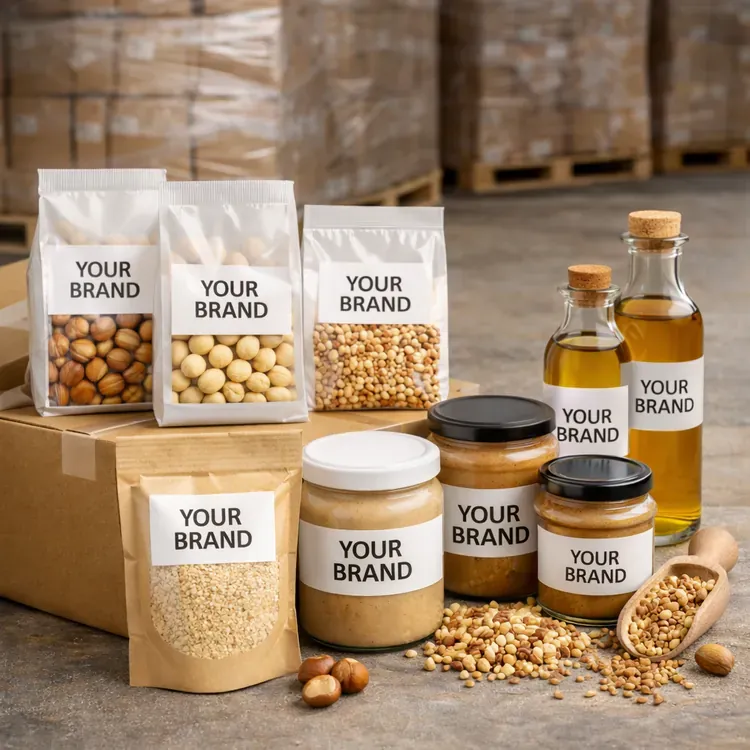
Retail success is built on three things: taste consistency, clean appearance, and packaging that protects the product through distribution. We structure private label programs so you can move from pilot to repeat shipments under the same specification.
If you already have a retailer or brand spec sheet (limits, tolerances, pack formats, label rules), send it—our role is to translate it into a stable, repeatable supply definition.
Pack material, barrier properties and sealing method aligned to shelf-life expectations, route conditions and your distribution model.
Artwork handoff built for speed: dielines, print specs, language blocks, allergen callouts and barcode placement—organized for approvals and reprints.
Pilot packs confirm taste/texture and shelf performance; scale shipments repeat the same specification with lot traceability and controlled packaging inputs.
The following product families cover most retail programs, from snack packs and baking ingredients to spread bases and oil lines. Industrial equivalents are available for food manufacturing programs.
| Retail product | Best for | What we control for | Common pack options |
|---|---|---|---|
| Natural kernels | Everyday & premium snack; home baking | Size calibration, defect control, clean appearance | 20–1000g bags; vacuum options for premium shelf-life |
| Roasted kernels | Aroma-forward snacking; topping mixes | Roast level, color, aroma stability, breakage control | 20–1000g bags; oxygen-control packing where applicable |
| Blanched kernels | Light-color baking; confectionery decoration | Skin removal, light color target, smooth mouthfeel | 20–1000g bags; vacuum options |
| Diced / chopped | Toppings; baking inclusions; granola blends | Cut size bands, dust control, skin % target | 100–1000g bags; vacuum options |
| Flour / meal | Gluten-free baking; mixes; keto recipes | Particle distribution, moisture stability, anti-caking behavior | 250–1000g bags; kraft bag options for some programs |
| Paste / puree | Spread bases; premium fillings; flavor blending | Texture (micron), roast profile, oil separation behavior | Retail jars or pails (program-based); foodservice formats on request |
| Hazelnut oil | Gourmet culinary; cosmetic blends | Oxidation protection, clarity/filtration approach, flavor carry | Glass bottles or food-grade drums/IBCs (channel-based) |
For many industrial-export programs, specifications are mapped to relevant Turkish standards (e.g., in-shell, natural kernels, processed hazelnuts) or directly to customer specifications. We use that same “standard + customer tolerance” approach for retail programs, so reorders stay consistent.
Hazelnuts are sensitive to oxygen exposure and handling damage. Packaging is not decoration—it is a technical tool that protects aroma, crunch and appearance. We build packaging definitions around your shelf-life target, route conditions and merchandising plan.
Many exporters run both industrial and retail packaging forms, such as 20–80kg jute, 25kg kraft, 500–1000kg big-bags, plus vacuum formats—helpful when you want a retail line and a foodservice line under one supplier program.
Retail programs usually require a simple consumer-facing label plus a procurement-grade technical spec behind the scenes. Below is a practical framework we can align to your standards and tolerance bands.
| Spec area | What gets defined | Why it matters |
|---|---|---|
| Identity | Origin, cultivar/region option, processing (natural/roasted/blanched), product code naming | Prevents “same name, different product” reorder drift |
| Physical | Kernel size bands (mm), cut size bands (mm), flour/meal particle band, breakage limits | Controls mouthfeel, visual appearance and consumer perception |
| Appearance | Color targets (especially blanched & roasted), skin % target where applicable, dust control | Consistency on-shelf and in recipes |
| Moisture stability | Moisture target ranges by format (kernels vs. flour/meal), storage guidance | Reduces rancidity risk and texture loss |
| Food safety | Micro plan, foreign material control, allergen statements, traceability rules | Retail compliance and consumer safety |
| Oxidation control | Packaging barrier, oxygen-control method, shelf-life testing plan | Protects aroma and flavor through export routes |
| Packaging spec | Material, thickness, seal design, case pack, pallet pattern, labeling and barcodes | Prevents transit damage and labeling issues at customs/DC |
Consistency is achieved through calibrated roasting profiles, mechanical skin removal/blanching, and systematic foreign material control using sorting and optical/laser selection steps—then packaging under a defined shelf-life protection method.
Below is a practical “menu” of packaging formats commonly used by Turkish hazelnut exporters for industrial and retail channels. We use these as building blocks and then align to your design, shelf-life and logistics targets.
| Channel | Format | Typical sizes | Notes |
|---|---|---|---|
| Retail | PET / HDPE / LDPE / PP bags | 20g to 1000g | Common for kernels, blanched, diced, meal/flour |
| Retail | PE vacuum bags | 250g / 500g / 1000g | Premium shelf-life option; reduces oxygen exposure |
| Industrial | Jute bag / kraft bag / big bag | 20–80kg; 25kg; 500–1000kg | Useful when pairing retail + foodservice/industrial programs |
| Industrial | Vacuum bags (industrial) | 5 / 10 / 12.5 / 20 / 25kg | Often used for kernels/cuts to protect quality pre-processing |
| Paste (industrial) | PP buckets / barrels / metal drums / IBC / tanker | 10kg; 30/60/200kg; 1000kg; tanker | Enables high-volume programs and stable dosing lines |
Need a specific pack style (stand-up pouch, zipper, window, gas flush, carton-ready display units)? Share your target and we’ll translate it into a technical packaging definition.
Private label projects move faster when label requirements are treated as a checklist, not an afterthought. We help you organize the required inputs so artwork approvals, reprints and country-specific variants stay controlled.
If you already have a label template from your retailer, we use it as the source of truth and align all downstream documents to the same identifiers.
Retail buyers need two layers of confidence: consumer-visible trust (clean product, stable taste) and procurement-grade verification (COA, traceability, controlled packing). We structure programs to support that workflow.
Each shipment is organized as lots with codes that link product, packaging run and documentation—so reorders match, and issues can be isolated fast.
We map your acceptance criteria into a test plan (physical + safety + stability), then deliver COA data in a buyer-friendly format.
Roast degree, cut size bands and packaging definitions are controlled so consumer experience stays consistent across repeat orders.
Many Turkish hazelnut processors operate under internationally recognized food safety systems (e.g., BRC-based programs) and align production to national standards or customer specifications. If you require specific certifications, share your checklist and we’ll build the program around it.
Retail packs fail most often in transit: crushing, heat exposure, condensation and poor pallet stability. We define logistics details early so your product arrives shelf-ready.
| Logistics area | What we define | Why it matters |
|---|---|---|
| Cartonization | Case count, inner protection, headspace control, carton strength | Prevents crushed retail packs and loose seals |
| Palletization | Pattern, height limits, corner protection, stretch wrap method | Stability during road/sea movement |
| Route conditions | Temperature sensitivity notes; storage instructions | Reduces rancidity risk and texture loss |
| Documentation | Commercial docs aligned to label IDs and case markings | Fewer customs delays and receiving errors |
If you run both retail and food manufacturing channels, we can structure a single program definition (same product/roast/cut) with different packaging outputs (retail bags + industrial sacks/big-bags/buckets).
We can align pack materials and sizes to your channel, including PET/HDPE/LDPE/PP bags and PE vacuum formats, plus jars/bottles for paste and oil programs. We’ll propose barriers and sealing methods based on your shelf-life and distribution needs.
Yes. Send your spec (or even a competitor label/pack target) and we will map the product definition, tolerances, packaging and documentation into a repeatable program. This includes roast level, cut size bands, color targets, packaging definition and lot coding.
We select barrier packaging and oxygen-control approaches (vacuum/MAP where applicable), define storage instructions, and align cartonization and palletization to your route. We also map stability needs into the program test plan.
Yes. A pilot run is the fastest way to lock taste profile, pack format, seal performance and label layout before scaling into repeat orders. Pilot results become the “frozen” reference for your program spec.
Tell us your target market, SKUs, pack sizes and expected volumes. We’ll respond with a spec-aligned program path, packaging options and export documentation checklist.