Applications Library • Bakery

Hazelnut cream for bakery injectors

A practical, procurement-ready guide to hazelnut cream engineered for bakery injection lines — covering injector-ready paste/cream formats, needle-friendly particle control, viscosity and backpressure stability, oxidation and oil separation management, and bulk packaging options for export logistics.

Back to applications
Hazelnut cream for bakery injectors illustration

Where it fits

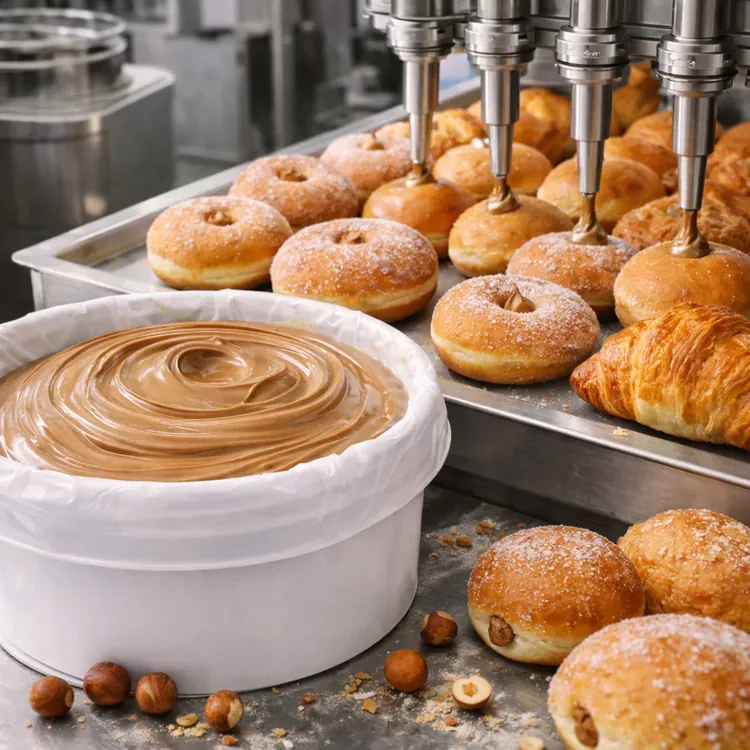
Bakery injectors require fillings that deliver repeatable dose weight, stable backpressure, and clean injection through needles or nozzles—often at high speed and over long runs. Hazelnut cream is widely used for injection into donuts, buns, croissants, sponge cakes, brioche-style products, and seasonal items where consistent internal distribution is critical.

Compared with general-purpose creams, injector applications place extra focus on low-grit particle control, viscosity stability across temperature, and storage robustness to reduce nozzle blockages, dripping, and rework. We support manufacturers by aligning the base hazelnut format, roast profile, and packaging to your specific injector setup.

Needle/nozzle-friendly specs Lot traceability Export-ready documentation Bulk & retail options
Recommended formats

Typical starting points for pilots and scale-up. For injector lines, smoothness and tolerance control usually matter more than using whole kernels.

  • Hazelnut paste / puree (smooth base for injector creams)
  • Praline-style paste (sweetened base; strong flavor and color direction)
  • Hazelnut meal / flour (only when needle/nozzle size allows and grit limits are met)

Technical considerations

The variables that most directly affect line stability and yield.

  • Particle profile aligned to needle/nozzle diameter to reduce blockages
  • Viscosity & backpressure stability across your operating temperature window
  • Start/stop behavior (reducing dripping and tailing at injection points)
  • Oil separation & oxidation control to preserve aroma and keep dosing consistent
  • Fat migration planning for soft baked goods and layered products

Packaging approach

We can supply sealed liners in cartons, pails, or drums, with palletization suited to sea, road, or air freight. Barrier packaging helps preserve aroma and stability.

Injector creams are sensitive to temperature and oxygen exposure. Controlled headspace, barrier liners, and temperature-aware logistics help keep viscosity consistent on arrival.

See bulk supply details →

Injector-ready performance checklist

A cream can taste excellent and still cause production losses if it is not tuned for injection equipment. In practice, injector-ready hazelnut cream typically targets: stable flow under shear, predictable pressure response, and a particle profile that remains safe across long runs.

  • Needle/nozzle compatibility: controlled particle distribution to avoid bridging or clogging.
  • Stable deposit weights: consistent viscosity reduces underfill/overfill variation and improves yield.
  • Clean injection points: start/stop behavior supports clean entry/exit and reduces surface smearing.
  • Storage stability: low oil separation keeps product uniform and reduces re-mixing burden.
  • Repeatable flavor & color: roast profile alignment minimizes re-setting of process parameters.

If you share injector type, needle/nozzle diameter, pump type, target injection weight, and expected product temperature, we can recommend a suitable base format and specification approach.

Key levers: particles, viscosity, and stability

For injector lines, these three factors are tightly linked. Aligning them together reduces downtime and keeps your filling experience consistent across shipments.

Lever Why it matters on injectors How we align it
Particle profile Prevents needle/nozzle clogging and reduces stoppages Defined tolerance bands; limits for coarse particles/fines
Viscosity & backpressure Controls injection weight accuracy and line speed Aligned to operating temperature window and equipment setup
Oxidation & oil separation Protects flavor and keeps product uniform for dosing Barrier packaging, headspace control, stability-focused handling guidance

Handling guidance for consistent injection

Hazelnut creams can change flow behavior with temperature shifts or extended storage. A few operational habits can noticeably improve stability:

  • Conditioning: bring product to a consistent processing temperature before production to avoid viscosity swings.
  • Gentle re-homogenization: if separation occurs, mix appropriately to restore uniformity without incorporating excess air.
  • Seal discipline: keep liners closed between uses to reduce oxygen exposure and flavor fade.
  • Allergen controls: plan segregation and cleaning protocols aligned to your plant’s requirements.

Typical specification markers

Below is a practical checklist used by procurement and QA teams for injector-focused hazelnut creams and bases. We align each item to your destination market, customer requirements, and injection setup (needle/nozzle size, pump type, and temperature conditions).

ParameterHow we align it
Particle profileDefined distribution aligned to needles/nozzles; limits for coarse particles and fines
Viscosity / flowAligned to your operating temperature window for stable injection weights
Roast profile / colorMatched to target flavor intensity and visual direction
MoistureControlled to support stability and consistent texture
Micro profileAligned to customer specifications and destination requirements
AflatoxinManaged through risk-based sourcing and partner controls
PackagingBarrier liners; sealed pails/drums; vacuum / MAP options where required
TraceabilityLot coding and documentation per shipment; COA flow

Final values depend on product form and customer requirements. We share lot documentation with each shipment.

FAQ

Which hazelnut format is most common for hazelnut cream used in bakery injectors?

Most bakery injector lines use smooth hazelnut paste (or praline-style paste) as the base, then adjust sweetness, fat phase, and viscosity to match needle/nozzle diameter and pump type. For injection, low-grit particle control is typically more important than using whole kernels.

What makes a hazelnut cream “injector-ready”?

Injector-ready cream typically means a controlled particle profile that won’t block needles, stable viscosity across the operating temperature window, predictable start/stop behavior to reduce dripping, and strong storage stability (low oil separation and oxidation protection).

Can you match a target viscosity and particle tolerance for our injector?

Yes. We align particle distribution and tolerance bands to your needle/nozzle size and filtration needs, and we support specification alignment so backpressure and deposit weights remain consistent across lots.

Do you support long-term supply programs?

Yes. We structure annual and multi-shipment programs with consistent specifications, batch documentation, lot traceability, and forecast-based planning so your injector settings remain stable across production runs.

Next step

Send your application (donut/bun/croissant/cake), injector model, needle/nozzle diameter, pump type, target injection weight, expected processing temperature, annual volume, and destination. We will propose suitable base formats (paste/praline), an injector-friendly particle specification, packaging options, and a shipment plan.

Review products