Applications Library • Bakery

Hazelnut flour for cookie dough stability

A detailed, procurement-ready guide to using hazelnut meal and flour to improve cookie dough stability — supporting consistent spread, texture, and shelf life through particle control, fat behavior management, moisture discipline, oxidation protection, allergen documentation, and export packaging.

Back to applications
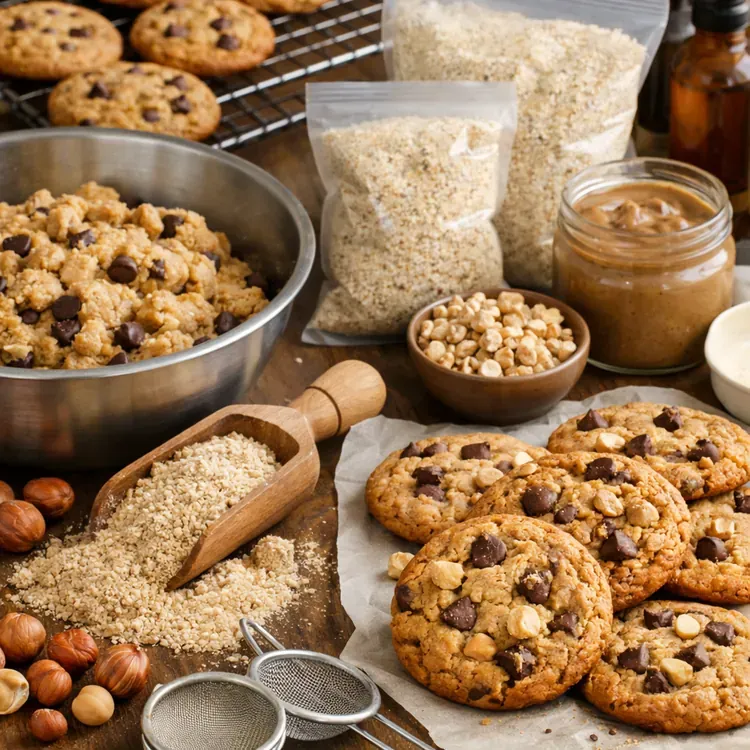
Hazelnut flour for cookie dough stability illustration

Where it fits

Cookie dough stability is about achieving the same bake result every time—regardless of production day, storage time, or distribution conditions. For industrial and high-volume bakeries, “stability” typically means consistent spread, height, surface appearance, and bite across long runs and across multiple lots of ingredients.

Hazelnut flour (and hazelnut meal) is used in cookie systems because it brings natural sweetness, aroma, and fat-driven tenderness, while also acting as a controllable dry solid that influences dough viscosity and water management. In practice, hazelnut ingredients help premiumize flavor and can support predictable texture—when the particle distribution and moisture are specified tightly.

In this application, the main procurement drivers are flavor consistency, particle control, and shelf stability. Because cookies are fat- and sugar-rich systems, stability issues commonly trace back to fat behavior (softening, migration), oxidation, and inconsistent grind distribution.

We support manufacturers by aligning the hazelnut format and processing level to your line: whole kernels for roasting/milling, blanched for light color targets, controlled cuts for inclusion dosing, and meal/flour for homogeneous mixes and repeatable dough rheology.

Export-ready documentation Lot traceability Particle control Bulk & retail options

Practical tip: if your target is stable spread, specify particle distribution and fines limits for hazelnut meal/flour. Cookie dough is sensitive to small shifts in fines that can change viscosity and bake geometry.
Recommended formats

Typical starting points for pilots and scale-up. We adapt roast level, grind distribution, cut tolerance, and packaging to your process and stability targets.

  • Hazelnut meal / flour — functional base for dough consistency
  • Diced / chopped — controlled inclusions for bite and appearance
  • Blanched kernels — cleaner color in light doughs
  • Roasted kernels — aroma-forward SKUs and darker dough profiles
  • Hazelnut oil — selective use in fat systems and aroma support (spec-driven)

Dough stability priorities

The variables that most commonly drive stability issues in chilled, frozen, and ambient cookie dough programs.

  • Spread control — viscosity and fat softening behavior during bake
  • Inclusion uniformity — controlled cuts reduce segregation and visual defects
  • Moisture discipline — prevents texture drift and sticky dough handling
  • Oxidation protection — reduces rancidity and aroma loss in storage
  • Roast alignment — consistent flavor and predictable browning notes

Packaging approach

We can supply lined cartons, vacuum or MAP options, and palletization suited to sea, road, or air freight.

For milled and roasted formats, oxygen protection and temperature discipline are key to preserving aroma and limiting oxidative notes over time.

  • High-barrier liners to limit oxygen and moisture ingress
  • Headspace control where applicable to protect aroma
  • Clean pallet patterns for efficient warehousing
See bulk supply details →

How hazelnut flour supports cookie dough stability

Cookie systems are governed by a balance between fat, sugar, water, and flour solids. When hazelnut meal/flour is added, it changes this balance by contributing fat and fine solids that influence viscosity, hydration rate, and how the dough transitions from “cold dough” to “baked cookie.”

  • Spread management: controlled particle distribution helps keep spread predictable, especially when dough warms slightly before baking.
  • Texture control: hazelnut fat supports tenderness and a rich bite; coarse meal can add “nutty” character, while finer flour supports a smoother crumb.
  • Freeze–thaw resilience (program-dependent): moisture and packaging controls help reduce texture drift and off-notes during extended frozen storage.
  • Flavor consistency: roast alignment and oxidation protection keep the aroma profile stable across shelf life.

If your current dough shows variable spread, cracking, or inconsistent color, the fastest diagnostic step is usually to review hazelnut particle distribution, moisture, and storage conditions for milled/roasted ingredients.

Particle size & inclusion control

A clear particle spec reduces run-to-run variability and improves visual uniformity.

  • Meal vs. flour: tune viscosity and final bite
  • Fines limit: reduces dusting and “tight” dough behavior
  • Overs limit: reduces gritty bite and uneven surface
  • Controlled cuts: consistent inclusion distribution and appearance

Fat behavior & migration

Cookies are fat-driven systems. Stability often depends on managing fat mobility and oxidation.

  • Fat migration: relevant for filled/layered or inclusion-heavy cookies
  • Oil separation risk: managed through grind selection and formulation pairing
  • Oxidation control: critical for roasted and milled formats
  • Temperature discipline: reduces flavor drift in storage

Moisture & handling

Moisture shifts can change dough stickiness, machinability, and baked texture.

  • Moisture targets aligned to your process (sheeting, wire-cut, depositor)
  • Anti-caking via barrier packaging for milled ingredients
  • Consistent storage to limit clumping and texture drift

Typical specification markers

Below is a practical checklist used by procurement and QA teams for hazelnut ingredients used in cookie dough stability programs (fresh, chilled, or frozen). We align each item to your destination market, product format, and processing level (raw, blanched, roasted, milled).

ParameterHow we align it
Particle sizeTarget range and tolerance bands aligned to your method (sieve / air-jet / laser)
Fines (dust)Defined limit to reduce dusting and stabilize dough viscosity
MoistureControlled to your target range and protected by liner/film selection
Cut size (inclusions)Controlled diced/chopped ranges for dosing and visual uniformity
Roast level / colorRoast profile aligned to your flavor target and baking temperature
Defect sortingScreened and optically sorted where required
Micro profileAligned to customer specifications and destination requirements
AflatoxinManaged through risk-based sourcing, testing plans, and partner controls
Oxidation protectionBarrier packaging + temperature discipline for milled/roasted formats
Allergen documentationAllergen statement and cross-contact controls for audits
PackagingBarrier liners / vacuum / MAP options and export cartons as required
TraceabilityLot coding and documentation package (COA flow) per shipment

Final values depend on product form and customer requirements. We share lot documentation and agreed verification points with each shipment.

Scale-up checklist for stable cookie dough programs

Cookie manufacturers often reduce variability by aligning specification and process steps early—especially when dough is frozen, exported, or stored for extended periods. Below is a practical map used by R&D, QA, and procurement teams.

1) Define stability targets

Clarify the bake outcome you need to hold constant.

  • Spread/diameter and thickness
  • Surface appearance (cracks, sheen)
  • Texture (chewy, crunchy, soft-baked)

2) Lock the hazelnut spec

Specify the parameters that drive repeatability in dough handling and baking.

  • Particle distribution & fines limit
  • Roast/color markers (if roasted)
  • Moisture and packaging barrier needs

3) Program supply & documentation

Confirm performance in trials, then scale with change control and traceability.

  • Pilot samples and line trials
  • COA flow and retention samples
  • Annual plans with forecast scheduling

If you share cookie type (wire-cut, deposited, sheeted), storage condition (fresh/chilled/frozen), and target spread, we can recommend a suitable hazelnut format and a spec structure that supports stable production outcomes.

FAQ

Which hazelnut format is most common for cookie dough stability projects?

Most customers use hazelnut meal/flour as the functional base to support consistent dough behavior and bake geometry, then add controlled chopped/diced inclusions for bite and appearance. Specs typically focus on particle distribution, fines limits, moisture, and oxygen-protective packaging for roasted or milled formats.

How does hazelnut flour influence cookie spread and texture?

Hazelnut flour contributes fat and fine solids that can increase tenderness and flavor while changing dough viscosity. Too many fines can tighten dough and increase dryness; overly coarse meal can increase spread variability and surface cracking. A controlled grind and moisture targets help maintain stable spread and a consistent bite.

Can you match a target particle size for hazelnut meal/flour or provide controlled cuts?

Yes. We can align a target particle range and tolerance bands, and we can supply controlled cuts (sliced, diced, chopped) with defined size ranges. This helps stabilize dosing, inclusion distribution, and finished cookie appearance.

Do you support long-term supply programs?

Yes. We structure annual and multi-shipment programs with consistent specifications, batch documentation, and forecast-based planning, and we support change control to manage crop and processing variability that can affect roast notes and dough behavior.

Next step

Send your cookie type, storage condition (fresh/chilled/frozen), target spread/texture, quantity, and destination. We will propose suitable formats, particle size targets, packaging, and a shipment plan aligned to your stability goals and QA requirements.

Review products