Where it fits
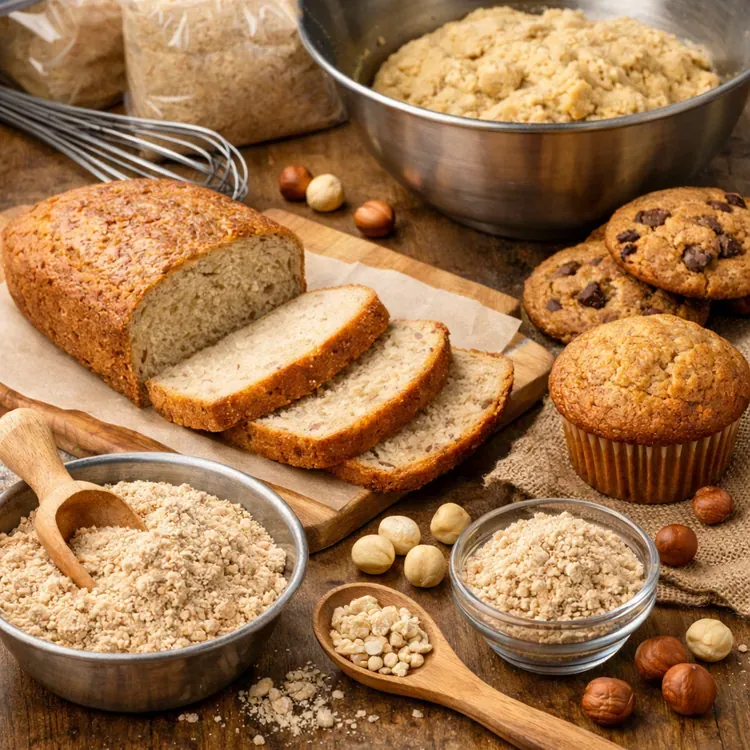
Gluten reduction programs aim to deliver a familiar bakery experience while lowering gluten content in the formula. Hazelnut flour is frequently used in these projects because it contributes natural sweetness, rich aroma, and a tender crumb—helping improve “premium” sensory cues that can be lost when wheat flour is partially replaced.
Unlike wheat flour, hazelnut meal/flour does not create a gluten network. In reduced-gluten systems, it behaves more like a flavor-and-texture ingredient: it can increase moisture perception, soften bite, and round out flavors, but it can also reduce structure and loaf volume if the formula lacks appropriate structure builders.
In this application, the main procurement drivers are flavor consistency, particle control, and shelf stability. Bakery outcomes are highly sensitive to grind distribution: the wrong balance of fines vs. coarse particles can change batter viscosity, gas retention, and the final crumb.
We support manufacturers by aligning hazelnut format and processing level to your product and process: whole kernels for in-house roasting and milling, blanched kernels for light color targets, and hazelnut meal/flour for controlled, homogeneous incorporation into mixes.
Export-ready documentation
Lot traceability
Particle control
Bulk & retail options
Practical tip: for “reduced gluten” bakery, define the hazelnut ingredient with particle distribution and fines limits, not only a single term like “flour.” This reduces batch-to-batch variability in volume and crumb.