Applications Library • Bakery

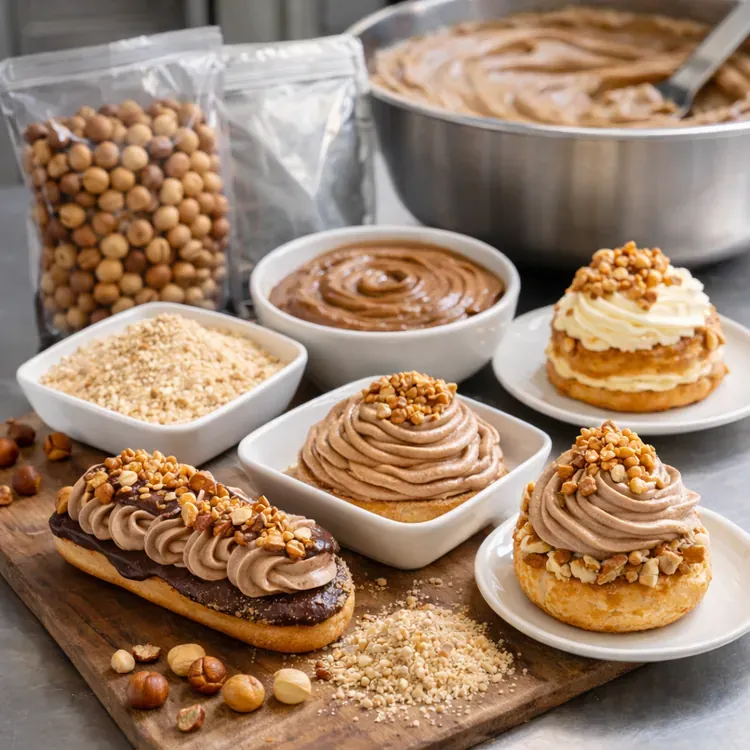
Hazelnut ingredients for pastry creams

A procurement-ready guide to using hazelnut ingredients in pastry creams and bakery fillings—from praliné-style creams and diplomat to mousseline, buttercreams and whipped ganaches. Learn which formats perform best, how to control fineness and emulsions, and how packaging and QA markers protect flavor, color and shelf stability.

Back to applications
Hazelnut ingredients for pastry creams illustration

Where it fits

Hazelnut-based pastry creams sit at the intersection of flavor, texture, and stability. In dairy and sugar systems, hazelnut fat and fine solids can elevate aroma and mouthfeel—but they also introduce technical risks such as oiling-off, graininess, and fat migration into shells, laminated dough, or sponge layers.

The most successful programs treat hazelnut ingredients like a “system”: choose the right format (paste, kernels, flour), match fineness to your texture target, and protect the product from oxygen and heat across production and storage. We support manufacturers by aligning hazelnut format and processing level to your recipes—whether you need light color (blanched inputs), stronger roast notes, or a smooth paste for high-shear dispersal.

  • Consistency: repeatable flavor and texture across batches and seasons.
  • Emulsion stability: controlled fineness and process support to reduce separation.
  • Shelf performance: oxygen and temperature management to preserve aroma.
  • Scalable supply: traceable lots and documented specifications for QA.
Emulsion-ready formats Lot traceability Fineness alignment Export-ready documentation
Recommended formats

Typical starting points for pilots and scale-up. We align roast level, fineness, and packaging to your process and texture goals.

  • Hazelnut paste / puree — fastest dispersion, consistent flavor and mouthfeel
  • Blanched kernels — light color targets; roast control in-house
  • Hazelnut meal / flour — structure and nut character in thicker creams and baked fillings
  • Roasted kernels — stronger aroma for infusions, inclusions, and garnish

Technical considerations

The variables that most often impact cream texture, stability, and shelf performance.

  • Fineness & particle profile to avoid graininess and ensure smooth piping
  • Emulsion management (temperature, shear, order of addition) to reduce oiling-off
  • Fat migration considerations for layered products and chocolate-coated items
  • Oxidation control to protect aroma and prevent stale notes
  • Allergen control and line segregation planning

Packaging approach

We can supply lined cartons, vacuum or MAP options and palletization suited to sea, road or air freight.

Pastry cream inputs are often used repeatedly from opened packs. Oxygen barrier materials and tight reseals help preserve aroma and reduce oxidation.

  • Barrier liners for kernels and meal/flour
  • Protected paste packaging to minimize headspace and surface oxidation
  • Export cartons and stable palletization for shipment integrity
See bulk supply details →

How hazelnut behaves in pastry cream systems

Hazelnuts contribute both fat and fine solids. That combination drives aroma and mouthfeel—while also changing viscosity, emulsions, and shelf stability. The practical goal is to keep the cream smooth, stable, and consistent through filling, storage, and service.

Texture and fineness

In pastry creams, “smooth” usually means the particle profile sits below the perception threshold and remains stable after chilling. Finer inputs disperse faster and pipe more cleanly.

  • Paste/puree supports smooth mouthfeel and consistent dosing
  • Meal/flour can add body, but granulation must match texture targets
  • For kernels, controlled grinding/in-house processing should be repeatable

Emulsion stability

Hazelnut fat can separate if the process is too cold, too hot, or insufficiently emulsified. Stable creams depend on temperature control, shear, and the right order of incorporation.

  • Match paste characteristics to your mixing equipment (high-shear vs. planetary)
  • Minimize oxygen exposure during mixing and holding
  • For chilled creams, consider how cooling impacts viscosity and stability

Flavor and color control

Roast level and blanching impact both taste and appearance. Light creams often require blanched inputs, while deeper roast profiles drive stronger praline-style notes.

  • Blanched kernels support lighter color targets
  • Roasted inputs provide stronger aroma and “toasted” character
  • Consistent roast targets improve batch-to-batch predictability

Processing checkpoints for reliable pastry creams

Whether you are producing a praliné cream, a hazelnut diplomat, or a whipped ganache-style filling, the same checkpoints reduce rework: align fineness, manage temperature, and protect the product from oxygen and cross-contact.

CheckpointWhy it mattersPractical target
Ingredient selection Defines flavor, color and smoothness Choose paste for smooth dosing; blanched inputs for light creams
Order of addition Impacts emulsion formation Incorporate paste gradually into the base with adequate shear
Temperature window Too cold = poor dispersion; too hot = aroma loss Maintain a controlled range consistent with your process
Shear / mixing Controls smoothness and stability Match fineness to equipment; avoid under-mixing that leaves grain
Holding & storage Oxidation and separation risk increases with time Minimize headspace; keep cool; use covered containers
Application interface Fat migration can soften shells/layers Use barrier layers where needed; validate shelf-life in packaging

If you share your base recipe type (custard, buttercream, whipped ganache, etc.) and target shelf life, we can propose a suitable format set and spec alignment for repeatable production.

Typical specification markers

A practical checklist used by procurement and QA teams for pastry cream inputs. We align each item to your destination market, your product type (fresh vs. shelf-stable), and your processing equipment.

ParameterHow we align it
Paste fineness / textureAligned to smooth mouthfeel and piping targets
Kernel calibrationFor consistent roasting, grinding or infusion performance
Roast levelLight/medium/dark targets matched to your flavor profile
Meal/flour granulationControlled to support viscosity and texture goals
MoistureControlled to reduce clumping and protect stability
Defect sortingScreened and optically sorted where required
Micro profileAligned to customer specifications and destination requirements
AflatoxinManaged through risk-based sourcing and partner controls
PackagingBarrier liners / vacuum / MAP and export cartons as required
TraceabilityLot documentation and COA flow with each shipment

Final values depend on product form and customer requirements. We share lot documentation with each shipment.

FAQ

Which hazelnut format is most common for pastry creams?

Most pastry cream applications start with hazelnut paste/puree (or praliné-style paste) because it disperses easily and gives consistent flavor and texture. Blanched kernels are used when you want to control roasting in-house for a specific profile, while meal/flour supports body and nut character in thicker creams and baked fillings.

How do you prevent graininess or separation in hazelnut creams?

Focus on fineness and emulsion control. Choose a paste with a particle profile that matches your smoothness target, manage temperature during mixing, and add paste gradually with sufficient shear. For longer holds, reduce oxygen exposure and protect the product with tight sealing and cool storage.

Can you match a target particle size or cut?

Yes. We can supply calibrated kernels and controlled cuts (sliced, diced or chopped) and align tolerance bands to your process. For paste and flour, we can align fineness and batch consistency to your texture and processing requirements.

Do you support long-term supply programs?

Yes. We structure annual and multi-shipment programs with consistent specifications, batch documentation and forecast-based planning.

Next step

Send your target pastry cream type (custard-based, buttercream, whipped ganache, etc.), expected batch size, and destination. We will propose suitable formats (paste/kernels/flour), fineness and roast targets, packaging, and a shipment plan aligned to your shelf-life goals.

  • Application: filling, piping, laminated products, layered desserts, confectionery creams
  • Texture target: smooth/pipable vs. thicker/spoonable
  • Color target: light (blanched) vs. roasted profile
  • Shelf life: fresh-chilled vs. longer distribution
  • Destination: country and delivery cadence
Review products