Applications Library • Nutrition

Hazelnut ingredients for trail mix packing

A procurement-ready guide for trail mix packers — recommended hazelnut formats for consistent blending, key controls for crunch and aroma, and packaging approaches that protect quality through distribution.

Back to applications
Hazelnut ingredients for trail mix packing illustration

Where it fits

Trail mix products live or die by blend consistency. Customers expect every pack to look and taste the same — with a predictable ratio of nuts, fruit, and inclusions. Hazelnuts are selected for their naturally sweet profile, satisfying crunch, and aroma development during roasting, making them a premium component in everyday and “better-for-you” mixes.

In this application, the main drivers are flavor consistency, particle and calibration control, low fines, and shelf stability. Because trail mix combines ingredients with different densities, shapes, and moisture behavior, the hazelnut specification often includes tighter limits on size spread, breakage, and dust than standard ingredient supply.

Common trail mix styles

  • Classic nut & fruit: roasted kernels paired with raisins, cranberries, apricots, or tropical mixes
  • Chocolate and confectionery: chopped kernels for even distribution with chips, pieces, and coated items
  • High-protein / low-sugar: calibrated kernels with seeds and minimal fruit for consistent bite
  • Granola-style mixes: chopped or meal/flour as part of clusters and crumble components
Low fines for clean packs Calibration for consistent blends Lot traceability Export-ready documentation

Practical note: dust and small fragments can settle during transport, changing the “top look” of packs and causing weight variability. Trail mix programs often specify both size range and a maximum fines percentage.
What trail mix packers typically optimize

Trail mix lines are designed for throughput, but the blend itself is sensitive to differences in size, shape, and density. These are the most common specification levers used to improve pack appearance and reduce rework.

Blend and packing performance

  • Calibration and shape: tighter kernel sizing supports uniform mixing and reduces segregation in hoppers.
  • Breakage control: lower breakage maintains premium appearance and prevents fines buildup in the bottom of bags.
  • Dust management: low fines improve seal cleanliness and help maintain accurate fill weights.
  • Compatibility with inclusions: roast level and surface condition can affect interactions with chocolate pieces and sticky fruits.

Shelf-life stability

  • Oxidation protection: roasted hazelnuts are aroma-sensitive; oxygen exposure drives flavor fade.
  • Moisture balance: moisture transfer from certain fruits can soften nuts over time.
  • Temperature handling: stable storage and transport conditions help preserve flavor and texture.

We can help align your incoming QC checks (size, fines, moisture, sensory) to the failure modes that matter most for your mix and packaging format.

Recommended formats

Typical starting points for trials and scale-up. We align roast level, calibration, and cut tolerances to your blend and packing equipment.

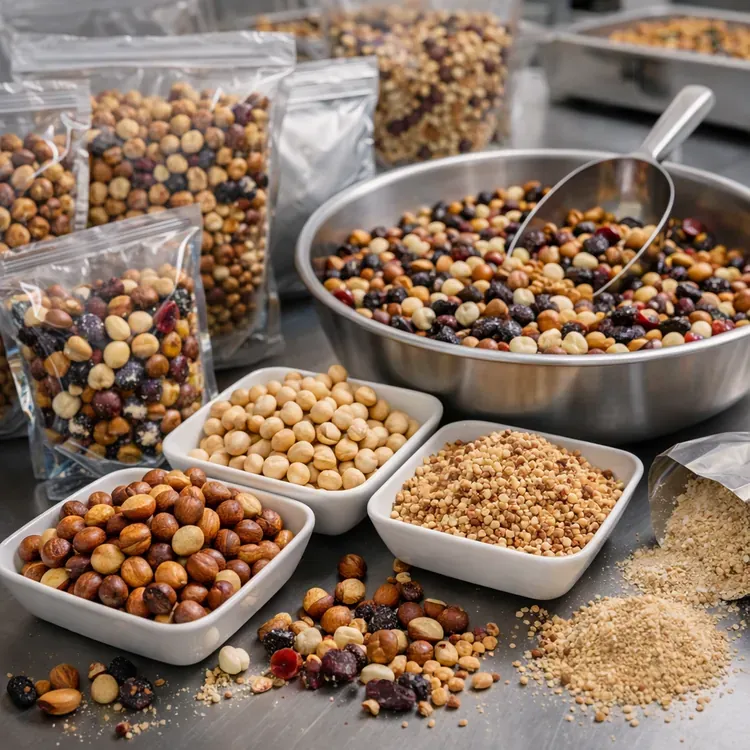
  • Roasted kernels (calibrated) — premium bite and aroma for core mixes
  • Chopped / diced kernels — better distribution with chips, pieces, and smaller inclusions
  • Blanched kernels — lighter appearance for “clean label” or light-color blends
  • Hazelnut meal / flour — for cluster mixes, granola systems, or seasoning adhesion support

If your mix includes small components (seeds, mini chips), chopped kernels can reduce segregation by improving size compatibility.

Technical considerations

The variables that most often impact throughput, pack appearance, and consumer experience.

  • Roast profile alignment to your flavor target and color expectation
  • Particle size & fines control for consistent dosing and clean pack presentation
  • Breakage limits to reduce settling and bottom-of-bag dusting
  • Traceable lots with documented specs and COA flow
  • Allergen control and line segregation planning

Trail mix specs often define both average size and maximum fines to stabilize blending behavior.

Packaging approach

We can supply bulk formats for in-house mixing, and packaging-compatible supply for co-packers and brand programs.

Bulk: lined cartons with high-integrity inner liners designed for export handling and warehouse stacking.

Shelf-life protection: oxygen and moisture management are key for roasted nuts. High-barrier packaging films, strong seals, and optional MAP (where required) help preserve aroma and crunch.

See bulk supply details →

Typical specification markers

Below is a practical checklist used by procurement and QA teams for trail mix ingredients. We align each item to your blend design, packing equipment, destination market, and shelf-life target.

ParameterHow we align it
FormatWhole roasted, chopped/diced, blanched, or meal/flour based on mix style
Calibration / size rangeDefined size ranges and tolerance bands to stabilize blend consistency
Fines / dustControlled to reduce settling, improve pack appearance, and support fill-weight accuracy
BreakageLimits set to protect “premium look” and reduce bottom-of-bag fragments
MoistureControlled to support crunch and reduce softening risk during shelf life
Roast profile (if roasted)Aligned to flavor target and color expectation; stabilized lot-to-lot
Defect sortingScreened and optically sorted where required
Micro profileAligned to customer specifications and destination requirements
AflatoxinManaged through risk-based sourcing and partner controls
Allergen documentationAllergen statements, traceability, and batch documentation flow
PackagingHigh-barrier liners, vacuum / MAP options, and export cartons as required

Final values depend on product form and customer requirements. We share lot documentation with each shipment and can align incoming QC tests to your highest-impact risks (fines, moisture, and sensory).

FAQ

Which hazelnut format is most common for hazelnut ingredients for trail mix packing?

Trail mix packers most commonly use roasted kernels (whole or chopped) because they deliver strong aroma, a premium bite, and good compatibility with dried fruit, chocolate, and other nuts. Calibration and low fines help maintain blend consistency and accurate fill weights.

How do you reduce softening and loss of crunch in trail mixes?

Crunch retention is typically managed by selecting an appropriate roast level, controlling moisture, and limiting moisture transfer from higher-moisture inclusions (such as certain dried fruits). Tight control of fines/dust and using high-barrier packaging also help maintain texture across shelf life.

How do you protect roasted hazelnuts from oxidation during shelf life?

For roasted ingredients, oxygen exposure is the main driver of aroma loss. High-barrier films, strong seals, and optional modified-atmosphere packaging (MAP) help reduce oxygen and protect flavor. Temperature management in storage and transport also supports stability.

Can you match a target particle size or cut for blending?

Yes. We can supply calibrated kernels and controlled cuts (sliced, diced or chopped) and align tolerance bands to your blend design. This supports uniform mixing and reduces segregation during packing and shipping.

Do you support long-term supply programs for seasonal trail mix volumes?

Yes. We structure annual and multi-shipment programs with consistent specifications, batch documentation and forecast-based planning, which helps stabilize quality across promotions and seasonal volume peaks.

Next step

Send your blend concept (ingredients list), target pack size, monthly volume, shelf-life target, and destination markets. We will propose suitable hazelnut formats (whole/chopped/blanched/meal), calibration and fines limits, packaging protection, and a shipment plan.

Review products