Applications Library • Foodservice

Hazelnut kernels for airline catering

A procurement-ready guide for airline and flight-catering use cases — recommended hazelnut formats for portion packs and menu items, key quality and allergen controls, and packaging approaches that protect crunch and aroma through multi-step logistics.

Back to applications
Hazelnut kernels for airline catering illustration

Where it fits

Airline catering demands repeatability across multiple kitchens, routes, and service classes. Hazelnuts are selected for their natural sweetness, satisfying bite, and aroma development during roasting — and they perform well as both a premium snack component and a versatile ingredient for desserts and bakery.

In this application, the main drivers are flavor consistency, portion control, food-safety documentation, and shelf stability. Programs often require long lead times, strict date coding, and packaging that withstands frequent handling from production to final service.

Portion-pack support Lot traceability COA & documentation flow Export-ready logistics

Common airline use cases

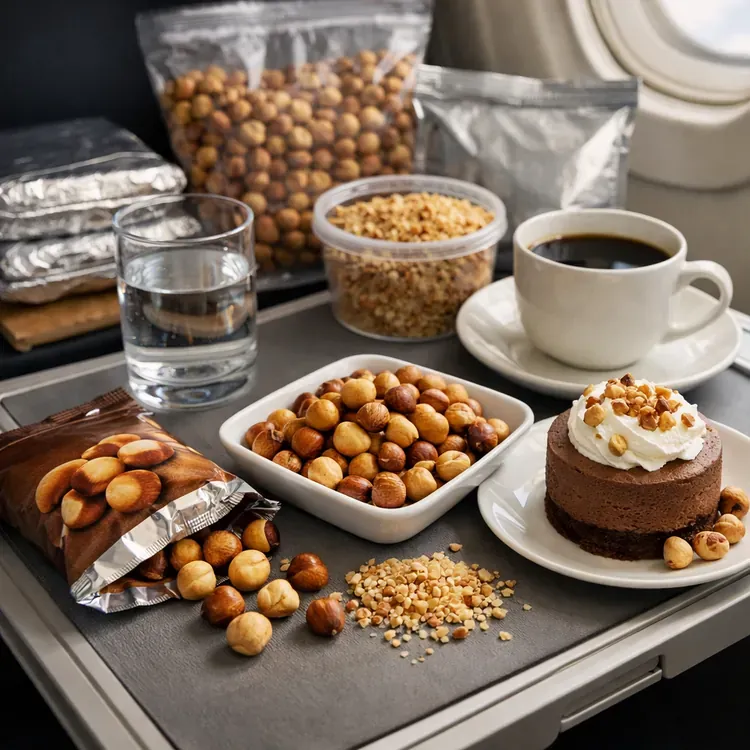
  • Single-serve snack packs (whole roasted kernels, lightly salted, or mixed-nut blends)
  • Premium dessert garnish (chopped kernels for cakes, mousses, creams, and plated desserts)
  • Bakery and pastry production (meal/flour for doughs, fillings, and crumble components)
  • Chocolate and confectionery inclusions (calibrated pieces for consistent bite)

Operational note: portion packs are especially sensitive to oxygen and moisture. Small pack sizes have a higher surface-area-to-volume ratio, so barrier packaging and good seal integrity make an outsized difference.
Airline-specific requirements that shape the spec

Compared to standard retail or industrial applications, airline catering has a few constraints that influence which hazelnut format performs best and how specifications are written.

What typically changes for airline programs

  • Portion accuracy: stable kernel size and low fines support consistent fill weights in small sachets.
  • Service environment: products may be opened and consumed in low-humidity cabins; crisp texture and clean aroma matter.
  • Multi-step logistics: frequent handling, varied storage stages, and mixed temperature exposure require resilient packaging.
  • Allergen governance: strict allergen labeling, traceability, and cross-contact controls are essential in catering kitchens.
  • Menu consistency: route changes and seasonal rotations benefit from long-term supply programs with stable specifications.

If you share your use case (snack pack vs ingredient), desired pack size, shelf-life target, and destination markets, we can propose the most suitable format and packaging protection.

Recommended formats

Typical starting points for trials and scaled airline programs. We adapt roast level, calibration, and packaging to your portioning and service needs.

  • Roasted kernels (calibrated) — best for snack packs and premium service
  • Diced / chopped kernels — best for garnish, toppings, and controlled inclusions
  • Hazelnut meal / flour — best for pastry, crumble, and filling systems

Blanched kernels are also used when a lighter visual profile is required (desserts and bakery). For snack packs, roasted kernels typically deliver the strongest perception of flavor.

Technical considerations

Variables that most often drive complaints or rework in airline catering environments.

  • Allergen control and segregation planning for multi-product catering sites
  • Traceable lots with consistent specification and COA flow
  • Particle size & fines control for portion accuracy and clean presentation
  • Moisture management to protect crunch and limit softening over shelf life
  • Oxidation control (especially for roasted products) to preserve aroma
  • Defect limits aligned to premium service expectations

Packaging approach

We support both bulk supply into catering kitchens and portion-pack programs via partners, depending on your setup.

Bulk: lined cartons and high-barrier inner liners designed for export handling.

Portion packs: high-barrier laminates, strong seals, tamper-evidence options, and clear date/batch coding. Where required, controlled headspace (e.g., nitrogen flushing) can improve aroma retention.

See bulk supply details →

Practical specification markers

Below is a procurement and QA checklist commonly used for airline catering programs. We align each parameter to the intended use (snack pack vs ingredient), destination markets, and your shelf-life target.

ParameterHow we align it
FormatWhole roasted kernels, chopped, blanched, or meal/flour based on application
Calibration / particle sizeDefined size ranges and tolerance bands to stabilize portioning and presentation
Fines / dustControlled to reduce weight drift and improve pack appearance
MoistureControlled to support crunch and reduce softening during storage
Roast profile (if roasted)Aligned to flavor target and color expectation; stabilized lot-to-lot
Defect sortingScreened and optically sorted where required
Micro profileAligned to customer specifications and destination requirements
AflatoxinManaged through risk-based sourcing and partner controls
Allergen documentationAllergen statements, traceability, and batch documentation flow
PackagingHigh-barrier liners, vacuum/MAP options, and export cartons as required

Final values depend on product form and customer requirements. We share lot documentation with each shipment and can help define incoming QC checks that match your program risk points.

FAQ

Which hazelnut format is most common for hazelnut kernels for airline catering?

Airline catering most commonly uses roasted kernels (whole or lightly chopped) for single-serve snack packs and premium inclusions. Blanched kernels are selected when a clean, light appearance is required for desserts or bakery, while meal/flour is typically used as an ingredient for pastries and fillings rather than as a stand-alone snack.

What packaging works best for airline catering programs?

High-barrier packaging that limits oxygen and moisture exposure is the most reliable choice. For portion packs, foil laminates with strong seals, optional controlled headspace (where required), tamper evidence, and clear date coding help protect crunch and aroma across complex logistics.

How do you manage allergen and documentation requirements?

We support programs with traceable lots, COA flow, and export-ready documentation. For airline and catering environments, allergen statements, batch traceability, and consistent specification control are key for audits and multi-site production.

Can you match a target particle size or cut?

Yes. We can supply calibrated kernels and controlled cuts (sliced, diced or chopped) and align tolerance bands to your process. For portion packs and garnish applications, tight control of fines/dust helps keep fill weights and appearance consistent.

Do you support long-term supply programs?

Yes. We structure annual and multi-shipment programs with consistent specifications, batch documentation and forecast-based planning, which is especially important for seasonal route changes and menu rotations.

Next step

Send your use case (snack packs or ingredient), target pack size, monthly volume, shelf-life target, and destination markets. We will propose suitable formats (whole/chopped/blanched/meal), packaging protection, and a shipment plan aligned to your catering calendar.

Review products