Applications Library • Bakery

Hazelnut meal for bread improvers

A practical, procurement-ready overview of how hazelnut meal and related formats are used in bread improvers and bakery premixes — including recommended product forms, functional and process considerations, oxidation control, and export packaging approaches.

Back to applications
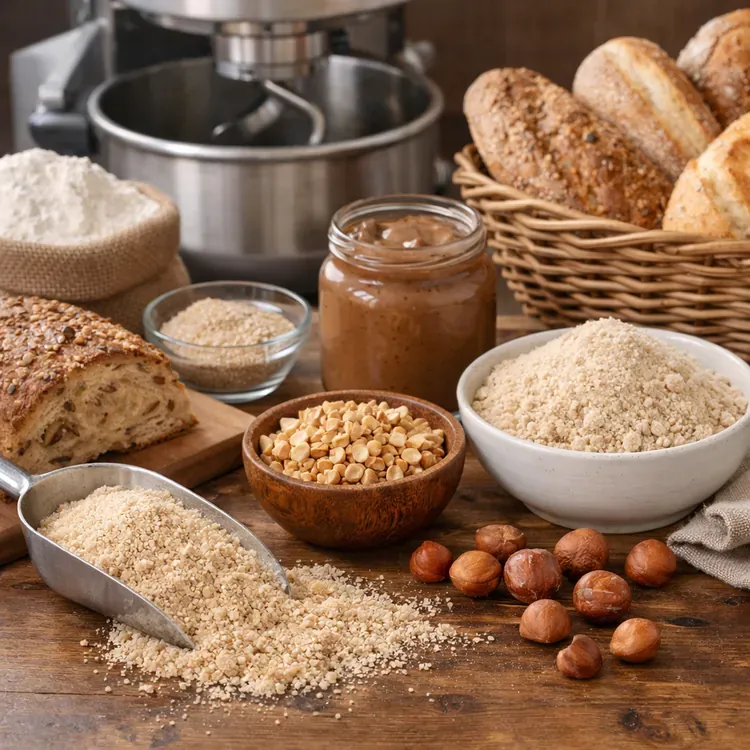
Hazelnut meal for bread improvers illustration

Where it fits

Bread improvers and bakery premixes are built to deliver repeatable results at scale: stable dough handling, predictable volume, consistent crumb, and controlled freshness. Hazelnut meal is used selectively in these systems when manufacturers want to add bakery aroma, richness, and a premium sensory signature while maintaining predictable performance.

In practice, hazelnut meal can be included as part of an improver or premix that targets:

  • Artisan-style loaves and specialty rolls where nut aroma and a warmer crumb perception are desired.
  • Sweet or enriched breads where hazelnut complements cocoa, dairy notes, spices, or caramelized profiles.
  • Inclusion breads where coarser particles create visible nut distribution and texture.
  • Frozen dough programs when the formulation and packaging plan are aligned to protect aroma and manage oxidation.

The key drivers are granulation consistency (for blending and dosing), flavor repeatability (roast and sensory), and shelf stability (oxidation management). We support manufacturers by aligning the hazelnut format and processing level to your line: kernels for in-house roasting/milling, controlled meal/flour for uniform blending, and chopped/diced formats for inclusion-style products.

Export-ready documentation Lot traceability Granulation control Bulk & retail options

Allergen note: Hazelnuts are a tree-nut allergen. Bread improver and premix plants typically require documented allergen statements, segregation, validated cleaning, and label review for finished goods.
Recommended formats

Typical starting points for pilot blends and scale-up. We align roast, granulation, and packaging to your blending system and finished bread profile.

  • Hazelnut meal / flour (controlled granulation for uniform premix distribution)
  • Diced / sliced / chopped (for inclusion-style breads and visible particulates)
  • Roasted kernels (for in-house milling and roast control)
  • Hazelnut paste / puree (for enriched dough systems or fillings; homogeneous mixing)

For improver blends, finer meal typically delivers the most consistent dosing. For artisan inclusions, coarser cuts are preferred—define the target cut and tolerance.

Technical considerations

Key variables that affect blend uniformity, dough handling, flavor carry-through, and shelf stability.

  • Moisture & flowability: lower, controlled moisture supports free-flowing blends and reduces caking risk.
  • Particle size & dust control: consistent granulation improves uniformity and reduces segregation during handling.
  • Oxidation protection: fine particles and roasted formats have high surface area—plan oxygen barrier packaging.
  • Roast profile alignment: roast level drives aroma strength, color, and baked-note perception in the finished crumb.
  • Process temperature sensitivity: extended mixing or warm environments can soften fats and change dough feel; align storage and handling.
  • Traceable lots: documented specs and COA flow support repeatability and audit readiness.

Procurement tip: define both a “safety spec” (micro/mycotoxin expectations, foreign matter controls) and a “performance spec” (granulation + roast/sensory) to keep finished bread outcomes consistent.

Packaging approach

We can supply lined cartons, vacuum or MAP options, and palletization suited to sea, road, or air freight. Packaging is selected based on fat level, particle size, and your expected warehousing duration.

For sensitive formats (meal/flour, roasted cuts, paste): oxygen protection and temperature management are key to preserving aroma and reducing rancidity risk. For longer routes or warm climates, specify barrier packaging and storage guidance aligned to your shelf-life goals.

See bulk supply details →

How hazelnut meal behaves in bakery premixes

When included in bread improvers or premixes, hazelnut meal primarily influences sensory perception and blend performance. The two most important controls are granulation (uniformity) and oxidation management (aroma stability).

Practical blending and handling guidance

  • Uniform distribution: tighter particle size distribution helps prevent segregation during transport and silo/bin discharge.
  • Dust and fines: controlling fines can improve operator experience and dosing accuracy.
  • Mix order: many plants pre-blend hazelnut meal with a carrier (e.g., flour component) before adding minor ingredients to improve dispersion.
  • Storage: cool, dry conditions protect aroma; FIFO and resealing after opening reduce quality drift.

Finished bread impact (what teams evaluate)

  • Aroma carry-through: roast level and dosage determine whether the note is subtle or prominent after baking.
  • Crumb perception: fine meal can add warmth and richness; coarser inclusions add bite and visual appeal.
  • Shelf-life perception: oxidation can dull aroma over time—packaging and storage are part of product design.

If your improver is positioned for consistent industrial output, start with controlled meal/flour. If the goal is artisan differentiation, include a defined chopped/diced component and specify roast level and cut tolerance.

Typical specification markers

Below is a practical checklist used by procurement and QA teams for bakery improvers and premixes. We align each item to your destination market, customer requirements, and processing level.

ParameterHow we align it
Particle size / granulationDefined range and tolerance bands to match blending uniformity and dosing performance
MoistureControlled to your target range to support flowability and reduce caking risk
Roast profile (if roasted)Aligned to your aroma/color target; consistent roast definitions across shipments
Defect sortingScreened and optically sorted where required; documented defect limits
Foreign matter controlsProcess controls (screens/magnets) and agreed inspection standards
Micro profileAligned to customer specifications and destination requirements; COA flow defined
Aflatoxin / risk managementManaged through risk-based sourcing and partner controls; documentation per lot as required
Oxidation-control planPackaging selection and handling guidance aligned to format sensitivity and shelf-life expectations
PackagingVacuum / MAP / liners and export cartons as required; palletization for your lane
TraceabilityLot ID structure and documentation pack aligned to audit and recall readiness

Final values depend on product form and customer requirements. We share lot documentation with each shipment and can align your incoming inspection plan to the agreed specification markers.

FAQ

Which hazelnut format is most common for hazelnut meal for bread improvers?

Most bread-improver and premix programs use hazelnut meal or fine flour in a controlled granulation for consistent blending and dosing. Diced/chopped roasted hazelnuts are used when the improver targets artisan breads or inclusions with visible particulates.

Can you match a target particle size or cut?

Yes. We can supply meal/flour with controlled granulation and align tolerance bands to your blending and processing equipment. We also provide calibrated kernels and controlled cuts (sliced, diced, chopped) for inclusion-style bread products.

What should QA focus on for hazelnut meal in bakery improvers?

Key markers are moisture (flow and anti-caking), granulation (blend uniformity), oxidation control (aroma and shelf-life), and documentation per lot (traceability and COA). Mycotoxin risk management and agreed micro targets are also common procurement requirements.

Do you support long-term supply programs?

Yes. We structure annual and multi-shipment programs with consistent specifications, batch documentation, lot traceability, and forecast-based planning to maintain stable incoming quality.

Next step

Send your target product type (industrial loaf, artisan roll, sweet bread), preferred format (meal/flour vs chopped), expected monthly volume, and destination. We will propose suitable hazelnut formats, granulation, packaging, and a shipment plan aligned to your shelf-life expectations.

Review products