Applications Library • Plant-Based

Hazelnut meal for nut-based meat alternatives

A practical, procurement-ready overview of how hazelnut meal and related formats are used in nut-forward meat alternatives — including recommended product forms, functional and process considerations, oxidation control, and export packaging approaches.

Back to applications
Hazelnut meal for nut-based meat alternatives illustration

Where it fits

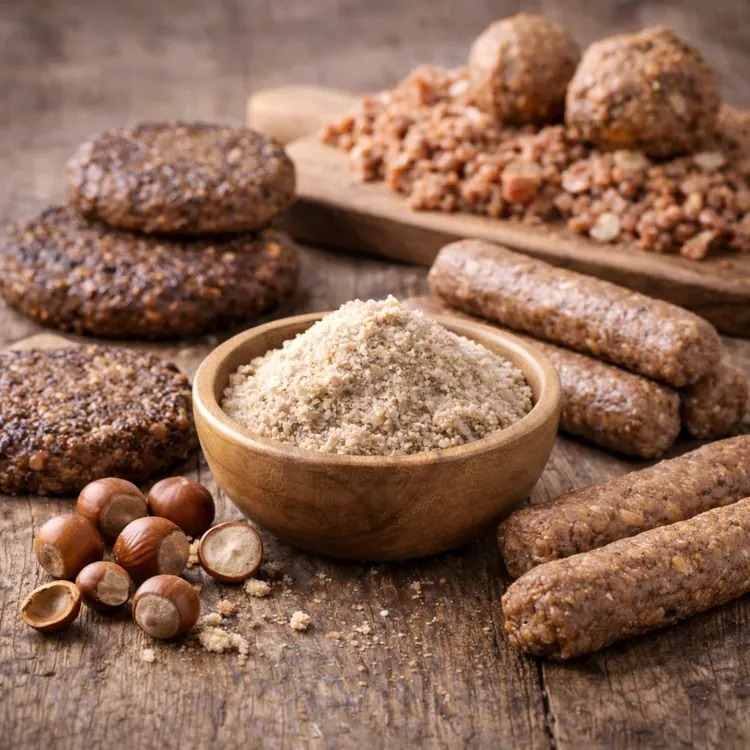
Nut-based meat alternatives rely on a careful balance of fat perception, structure, and savory flavor delivery. Hazelnut meal is used when product developers want a naturally derived ingredient that can contribute mouthfeel, a subtle toasted aroma (when roasted), and texture ranging from smooth to “ground-meat” style depending on granulation.

In this application, the main procurement drivers are granulation consistency, sensory repeatability (roast and aroma), and shelf stability (oxidation control). We support manufacturers by aligning the hazelnut format to your process: kernels for controlled in-house roasting/milling, meal/flour for repeatable dosing, paste for homogeneous emulsions, and controlled cuts for visible particulates.

Common roles in formulations

  • Texture builder: particle size selection helps mimic mince-like bite or deliver smoother patties and sausages.
  • Fat perception and juiciness: hazelnut’s natural lipids contribute richness; stability planning is essential for long shelf life.
  • Flavor carrier: roasted notes and nut aromatics can complement smoke/spice systems in premium, nut-forward profiles.
  • Label-friendly differentiation: supports “nut-based” positioning where relevant (and where allergen labeling is acceptable).
Export-ready documentation Lot traceability Granulation control Bulk & retail options

Important: Hazelnuts are a tree-nut allergen. Most manufacturers treat nut ingredients as allergen-controlled materials with defined segregation, validated cleaning, and clear label review.
Recommended formats

Typical starting points for pilots and scale-up. We adapt processing level, granulation, and packaging to match dosing, texture targets, and shelf-life expectations.

  • Hazelnut meal / flour (controlled granulation for repeatable texture and feeder performance)
  • Natural kernels (calibrated) (for in-house roasting and milling control)
  • Roasted kernels (for stronger aroma and simplified processing)
  • Hazelnut paste / puree (for homogeneous blends and fat distribution)
  • Hazelnut oil (optional: to tune fat perception; typically paired with strong oxidation controls)

If texture is your main driver, start by defining the target particle distribution and tolerances. If flavor is the driver, define roast level, sensory notes, and packaging protection.

Technical considerations

Key variables that impact throughput, binding behavior, sensory outcome, and shelf stability in nut-based “meat” systems.

  • Granulation & flow: particle distribution affects feeder accuracy, dusting, and mixing uniformity.
  • Hydration & binding strategy: hazelnut particles interact with water and binders; define the hydration step and mixing order.
  • Fat smearing and processing temperature: warmer processing can soften fats and change bite; align process conditions to target texture.
  • Roast profile alignment: roast level influences aroma strength, color, and perceived “savory depth.”
  • Oxidation protection: higher surface area (fine meal) and roasted formats can be more aroma-sensitive; plan oxygen barrier packaging.
  • Traceable lots: documented specs and COA flow support consistent outcomes and audit readiness.
  • Allergen and cross-contact controls: receiving, storage, and rework policies should match your allergen program.

Procurement tip: lock the “performance spec” (granulation + roast + sensory) in addition to the “safety spec” (micro, mycotoxin expectations, foreign matter controls) to avoid reformulation drift.

Packaging approach

We can supply lined cartons, vacuum or MAP options, and palletization suited to sea, road, or air freight. Packaging is chosen based on fat level, particle size, and transit time.

For sensitive formats (fine meal/flour, roasted kernels, paste, oil): oxygen protection and temperature management are key to preserving aroma and reducing rancidity risk. For long routes, specify barrier packaging and storage guidance aligned to your shelf-life goals.

See bulk supply details →

How hazelnut meal supports meat-alternative texture

Nut-based meat alternatives often aim for a familiar “meat-like” eating experience without relying solely on isolated proteins. Hazelnut meal helps teams tune the sensory profile by controlling particle size (bite), fat perception (juiciness), and roast-derived aromas (savory warmth).

Granulation guidance (practical)

  • Fine meal / flour: smoother bite and more uniform distribution; commonly used where a cohesive matrix is needed.
  • Medium meal: balanced bite and visual particulate; useful for “mince-style” products and rustic textures.
  • Coarser cuts: visible particulates and crunch; more common in premium or specialty SKUs where texture contrast is desirable.

Process compatibility

Process steps such as hydration, mixing intensity, and forming pressure can change final bite. For that reason, many manufacturers run trials by holding the base recipe constant while adjusting only format (meal vs paste), granulation, and roast level, then selecting a specification that gives consistent sensory results.

Texture repeatability Roast & aroma control Oxidation management COA per lot

If your target profile is “nut-forward,” roasted formats often perform best. If your target profile is “neutral base,” blanched or lightly processed formats may be more suitable (depending on your formulation strategy).

Typical specification markers

Below is a practical checklist used by procurement and QA teams for nut-based meat alternatives. We align each item to your destination market, customer requirements, and processing level (meal/flour, kernels, roasted, paste, oil).

ParameterHow we align it
Particle size / granulationDefined range and tolerance bands to match texture targets and feeder performance
MoistureControlled to your target range to reduce clumping and support stability
Roast profile (if roasted)Aligned to your aroma/color target; consistent roast definitions across shipments
Defect sortingScreened and optically sorted where required; documented defect limits
Micro profileAligned to customer specifications and destination requirements; COA flow defined
Aflatoxin / risk managementManaged through risk-based sourcing and partner controls; documentation per lot as required
Oxidation-control planPackaging selection and handling guidance aligned to format sensitivity and shelf-life expectations
PackagingVacuum / MAP / liners and export cartons as required; palletization for your lane
TraceabilityLot ID structure and documentation pack aligned to audit and recall readiness

Final values depend on product form and customer requirements. We share lot documentation with each shipment and can align your incoming inspection plan to the agreed specification markers.

FAQ

Which hazelnut format is most common for hazelnut meal for nut-based meat alternatives?

Most programs start with hazelnut meal or fine flour in a defined granulation so dosing and texture are repeatable. Roasted kernels (for in-house milling) or hazelnut paste are also used when the process needs stronger aroma or a more homogeneous fat distribution.

Can you match a target particle size or cut?

Yes. We can supply meal/flour in controlled granulations and align tolerance bands to your mixing and forming system. We also offer calibrated kernels, as well as chopped/diced formats, when your application needs a coarser bite.

How do you protect flavor and shelf life in high-fat hazelnut ingredients?

Oxidation control is the main focus. We use oxygen barrier packaging options (vacuum or MAP), appropriate liners and palletization, and we align storage and transit guidance to preserve aroma and reduce rancidity risk—especially for roasted and fine-particle formats.

Do you support long-term supply programs?

Yes. We structure annual and multi-shipment programs with consistent specifications, lot traceability, COA flow, and forecast-based planning so production teams can maintain stable input quality.

Next step

Send your target product type (patty, mince, sausage, filling), desired texture (fine/medium/coarse), expected monthly volume, and destination. We will propose suitable hazelnut formats, granulation, packaging, and a shipment plan aligned to your shelf-life expectations.

Review products