Applications Library • Pet

Hazelnut meal for pet food formulations

A practical, procurement-ready overview of how hazelnut meal and related formats are used in pet food — including recommended product forms, formulation and process considerations, stability controls, and export packaging approaches.

Back to applications
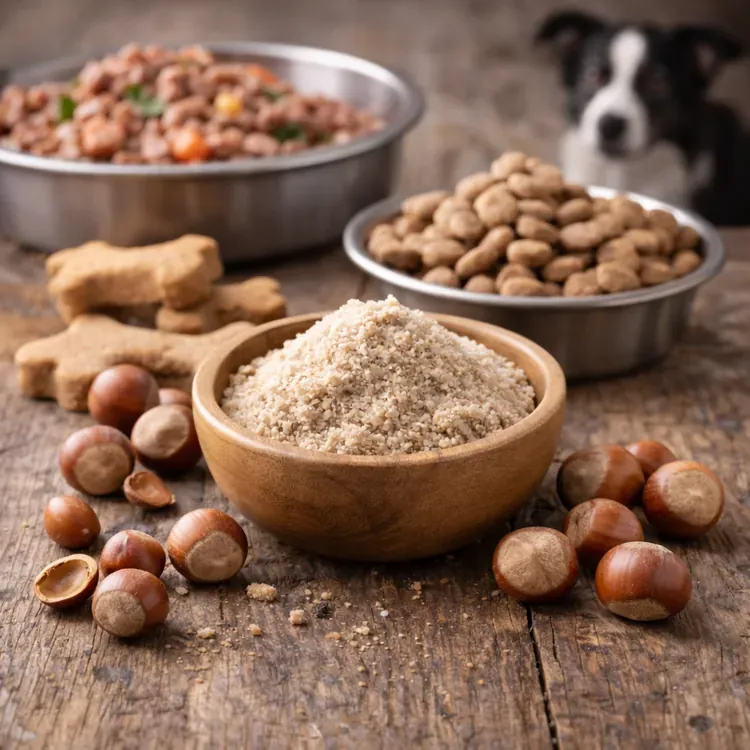
Hazelnut meal for pet food formulations illustration

Where it fits

Hazelnut meal is used as a palatability and texture ingredient in selected pet food and treat programs, particularly where manufacturers want a natural nut aroma, a warm roasted note, or a richer mouthfeel. It can be applied in both dry extruded recipes and baked/pressed treats when the process and shelf-life plan are aligned to oxidation control.

In practical terms, hazelnut ingredients can support:

  • Aroma and taste enhancement (roasted notes, “bakery” perception in treats)
  • Texture building (fine meal in dough systems; coarser meal for visible particulates)
  • Energy density via natural fats (managed carefully for stability and target analysis)
  • Label-friendly differentiation for premium lines when nut ingredients are appropriate for the program

For procurement and QA, the main drivers are particle control, incoming fat/moisture consistency, micro profile, and oxidative stability. We support manufacturers by aligning the hazelnut format and processing level to your line: kernels for controlled milling, meal/flour for consistent dosing, and paste for homogeneous systems.

Export-ready documentation Lot traceability Defined granulation Bulk & retail options

Note: Hazelnuts are a tree nut allergen. Most pet food plants treat nut ingredients as an allergen-controlled material with documented segregation, validated cleaning, and label review.
Recommended formats

Common starting points for pilots and scale-up. We adapt processing level, granulation, and packaging to match your mixer, feeder, and shelf-life requirements.

  • Hazelnut meal / flour (defined particle range for consistent dosing)
  • Natural kernels (calibrated) (for in-house roasting and milling control)
  • Roasted kernels (for stronger aroma and shorter processing steps)
  • Hazelnut paste / puree (for homogeneous blends and coatings)

If your formula is sensitive to fat variability, define the target analysis and select the format accordingly. Finer particles and higher fat typically require stronger oxygen protection.

Technical considerations

Variables that most directly impact throughput, palatability, and stability in pet food and treat manufacturing.

  • Allergen control: receiving, storage segregation, rework policy, and label alignment
  • Granulation & flow: particle distribution affects feeder accuracy, dusting, and mixing uniformity
  • Oxidation management: fat content + oxygen exposure can drive rancidity; define packaging and storage controls
  • Roast profile: roast level influences aroma strength, color, and flavor carry-through after extrusion/baking
  • Thermal process impact: extrusion and baking can mute delicate aromatics; dose and roast level should reflect this
  • Micro profile: align targets to destination and your internal specifications; define sampling and COA expectations
  • Foreign matter control: magnets, screens, and optical sorting as required for your risk assessment
  • Mycotoxin risk management: define aflatoxin expectations and documentation flow for each lot

Procurement tip: define a “must-haves” specification (food/feed safety markers) and a “performance” specification (granulation, roast, sensory) so QA can release lots faster.

Packaging approach

Packaging is selected based on fat level, particle size, transit time, and your warehouse conditions. We can supply lined cartons, vacuum or MAP options, and palletization suited to sea, road, or air freight.

For sensitive formats (meal/flour, roasted cuts, paste): oxygen protection and temperature management are key to preserving aroma and controlling oxidation. If your receiving warehouse is warm, specify insulation/reefers where needed.

See bulk supply details →

Formulation and processing notes

This section is designed to help R&D, QA, and procurement speak the same language. Hazelnut meal behaves differently depending on fat content and particle size, so your trial plan should tie format → process → shelf-life.

How it behaves in common processes

  • Extrusion (dry kibble): fine particles disperse well but can increase fat smearing and reduce aroma carry-through; define granulation and consider post-extrusion coating strategies if aroma is the key target.
  • Baked/pressed treats: coarser meal can provide visible particulates and texture; control moisture and storage to prevent staling and oxidation.
  • Coatings and fillings: paste delivers uniformity; oxygen protection is typically critical due to surface area and fat exposure.

Practical inclusion planning

Inclusion rates depend on the finished product type, target analysis (fat, fiber, calories), and regulatory/label constraints. Most manufacturers start with small pilot inclusions, then tune roast, particle size, and antioxidant strategy to achieve consistent sensory results.

We can provide a procurement-facing spec sheet for your trial (granulation, roast level, packaging, shelf-life expectations, COA markers) so your plant receives the same material used in development.

Granulation control Roast alignment Oxidation plan COA per lot

Typical specification markers

Below is a practical checklist commonly used by procurement and QA teams. We align each item to your destination market, customer requirements, and processing level (meal/flour, kernels, roasted, paste).

ParameterHow we align it
Particle size / granulationDefined range and tolerance bands to match dosing and mixing performance
MoistureControlled to your target range to support stability and prevent clumping
Fat level (format-dependent)Aligned to your target analysis and oxidation-control plan
Defect sortingScreening and optical sorting where required; documented defect limits
Foreign matter controlsProcess controls (screens/magnets) and agreed inspection standards
Micro profileAligned to customer specifications and destination requirements; COA flow defined
Aflatoxin / mycotoxin riskRisk-based sourcing and partner controls; documentation per lot as required
Allergen statementClear tree-nut allergen documentation for label and plant controls
PackagingVacuum / MAP / liners and export cartons as required; palletization for your lane
Shelf-life expectationsAgreed storage conditions and handling guidance, especially for high-fat or fine materials

Final values depend on product form and customer requirements. We share lot documentation with each shipment and can align your incoming inspection plan to the agreed specification markers.

Supply planning for pet programs

Pet food manufacturers typically require repeatability across batches and seasons. We support programs that need stable incoming quality and predictable logistics.

  • Annual or multi-shipment contracts with forecast-based planning
  • Pre-agreed specification and COA format for faster receiving
  • Lot traceability and documentation suited to audits

Documentation flow

A typical export documentation pack can be aligned to your destination and internal QA requirements.

  • COA per lot (agreed parameters)
  • Traceability / lot ID structure
  • Packaging and pallet specs
  • Optional: additional testing based on customer requirements
See quality overview →

Handling guidance

Simple receiving and storage discipline protects aroma and helps prevent oxidation-driven quality drift.

  • Store cool, dry, and away from strong odors
  • Minimize oxygen exposure after opening; reseal properly
  • Use FIFO with clear lot segregation and allergen controls

For higher-fat or fine meal, specify packaging that reduces oxygen ingress and consider temperature controls on longer routes.

FAQ

Which hazelnut format is most common for hazelnut meal for pet food formulations?

For most dry and semi-moist programs, customers start with hazelnut meal/flour in a defined particle range (for consistent dosing) or natural kernels for in-house milling. The final choice depends on your process (extrusion/baking), target fat level, and oxidation-control plan.

Can you match a target particle size or cut?

Yes. We supply controlled granulations for meal/flour and can align tolerance bands to your feeder and mixing system. We can also provide kernels, chopped/diced formats, or paste depending on your formula design.

What are the key stability risks with hazelnut meal in pet food?

The main risks are oxidation (rancidity) and aroma loss, especially in higher-fat materials or fine particles. Oxygen protection (vacuum/MAP), cool and dry storage, and clear shelf-life expectations help protect flavor and quality.

Do you support long-term supply programs?

Yes. We structure annual and multi-shipment programs with consistent specifications, lot documentation (COA/traceability), and forecast-based planning so plants can maintain steady incoming quality.

Next step

Send your target application (kibble, baked treat, coating), expected monthly volume, and destination. We will propose the best hazelnut format, granulation, packaging, and a shipment plan aligned to your shelf-life expectations.

Review products