Applications Library • Industrial

Hazelnut pieces for chocolate bars (inclusion dosing)

A practical, procurement-ready overview of dosing hazelnut pieces into chocolate bars — including recommended formats, particle size guidance, line considerations, shelf-life controls and packaging approaches.

Back to applications
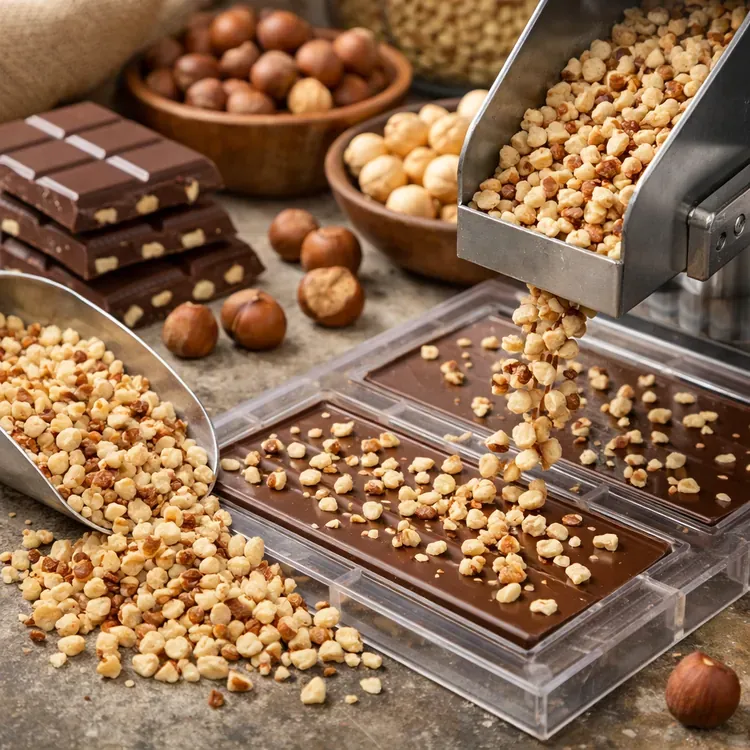
Hazelnut pieces for chocolate bars (inclusion dosing) illustration

Where it fits

Hazelnut inclusions are used in chocolate bars to add distinct aroma, natural sweetness, and a crisp bite that contrasts with the chocolate matrix. For production teams, the key success factors are consistent dosing, controlled particle size, and stability against oxidation (which protects flavor over shelf life).

Inclusion dosing sits at the intersection of ingredient control (cut, roast, moisture, and fines) and process capability (feeder accuracy, mixing/dispersion, mold filling, and vibration/deaeration). We help manufacturers select the right hazelnut format and define a spec that supports repeatable line performance from pilot runs through full scale production.

Particle size control Stable roast & aroma Low fines option Lot traceability Export-ready documentation

Typical users include mass-market bars, premium “visible inclusion” bars, wafer/filled bars that need controlled crunch, and mixed-inclusion concepts (nuts + crispies, fruit, biscuit).

Recommended formats

Typical starting points for pilots and scale-up. We adapt roast level, cut tolerance, fines control and packaging to your dosing method and sensory target.

  • Roasted hazelnut pieces (diced / chopped; calibrated)
  • Natural or blanched pieces (for light color targets or in-house roasting)
  • Hazelnut meal / flour (micro-inclusion, texture, or fat phase integration)

For bars where “nut identity” is critical, roasted calibrated pieces are the most common choice because they deliver immediate aroma and consistent crunch.

Technical considerations

Variables that most often impact throughput, taste repeatability, and shelf stability.

  • Particle distribution to prevent “bottoming” or clustering in molds
  • Fines control (dust) to maintain feeder accuracy and reduce fat bloom risk
  • Roast profile alignment with your chocolate notes (milk/dark/white)
  • Moisture management to protect crunch and avoid texture softening
  • Oxidation protection with oxygen barrier packaging and controlled headspace

A robust inclusion spec typically defines size band, max fines, moisture, sensory notes (roast), and packaging/oxygen parameters.

Packaging approach

We supply lined cartons, vacuum or MAP options and palletization suited to sea, road or air freight. The goal is to deliver pieces that dose well and keep their roasted aroma.

For roasted pieces, oxygen protection and temperature management are key to preserving aroma and reducing rancidity risk. For natural/blanched pieces shipped for in-house roasting, humidity protection and clean handling are the priority.

See bulk supply details →

Inclusion dosing: practical guidance

Chocolate bars are sensitive to inclusion geometry. The “right” hazelnut piece is the one that flows consistently through your dosing system, remains visibly distributed in the cross section, and survives mixing/vibration without excessive breakage.

Decision pointWhat to specify
Bar style Standard bars, thick bars, filled/wafer bars, or “premium visible inclusions” (affects size and % dosage).
Piece size band Fine (1–3 mm), Medium (2–4 mm), Coarse (3–6 mm) — selected to match bar thickness and target crunch.
Inclusion rate Common pilot ranges are 3–12% by weight; premium concepts may go higher depending on mold fill and viscosity.
Fines (dust) Define a max fines level (process-dependent). Lower fines improves feeder accuracy and reduces oil migration risk.
Roast & cooling Specify roast intensity (light/medium/dark), cooling method, and sensory markers (aroma, bitterness, color).
Temperature window Agree storage and transport guidance to reduce oxidation and preserve crunch (cool, dry, stable conditions).

If your line uses volumetric dosing, piece flowability and bulk density consistency become even more important. For gravimetric dosing, size/fines control drives weight accuracy and repeatability.

How we help QA & procurement

A clear, measurable specification reduces trial cycles and avoids surprises at scale.

  • Defined size band and allowable tolerance
  • Declared processing level (natural / blanched / roasted)
  • Documented lot traceability and COA flow
  • Change control for crop/season and roast adjustments

Common production risks

Typical issues we plan for when aligning pieces to a bar line.

  • Clustering in molds (size mix or insufficient dispersion)
  • Bottoming during vibration (piece density vs chocolate viscosity)
  • Breakage (too fragile for mixing/transport)
  • Oxidation leading to off-notes over shelf life

These are usually solved with tighter calibration, roast/cooling control, and oxygen-protective packaging.

Options beyond standard cuts

When you need a distinct signature or a specific processing behavior.

  • Low fines cuts for high-accuracy feeders
  • Blanched roasted pieces for lighter inclusion color
  • Custom blend of two size bands for optimized distribution
  • Meal / micro-inclusion to boost nut perception without large pieces

Typical specification markers

Below is a practical checklist commonly used by confectionery procurement and QA teams. We align each item to your destination market, internal standards, and the chosen processing level (natural/blanched/roasted pieces).

ParameterHow we align it
Particle size bandDefined cut (e.g., fine/medium/coarse) with tolerance limits and controlled distribution
Fines (dust)Specified maximum fines; optional low-fines preparation for dosing stability
MoistureControlled to your target range to protect crunch and reduce texture softening
Roast profileAligned to your flavor target (light/medium/dark), with sensory markers and color expectations
Defect sortingScreened and optically sorted where required; foreign matter controls defined by risk profile
Micro profileAligned to customer specifications and destination requirements, based on product form
AflatoxinManaged through risk-based sourcing, partner controls, and lot testing aligned to destination limits
PackagingVacuum / MAP / high-barrier liners and export cartons as required; palletization for your route

Final values depend on the cut, processing level, and your customer requirements. We provide lot documentation with each shipment and can support specification matching for multi-site factories.

Operational notes for stable shelf life

Storage & handling

Hazelnut pieces are a high-value ingredient and benefit from simple, disciplined controls to protect aroma and texture:

  • Cool, dry storage with stable temperature; avoid heat sources and direct sunlight.
  • FIFO rotation and closed-pack handling to limit oxygen exposure after opening.
  • Odor control (nuts can absorb strong smells) and clean-zone practices to reduce foreign odor risks.
  • Short open-time on the line: staged feeding helps maintain consistent flow and freshness.

If you are targeting extended shelf life, ask us about oxygen protection options and recommended storage guidance for your route and warehouse conditions.

FAQ

Which hazelnut format is most common for chocolate bar inclusions?

The most common starting point is roasted, calibrated hazelnut pieces (diced or chopped) with a controlled particle size range. This format delivers consistent dosing, crunch, and a clear hazelnut aroma across production batches.

What particle size is typical for inclusion dosing?

Many bars use calibrated cuts such as 1–3 mm (fine), 2–4 mm (medium), or 3–6 mm (coarse). The right band depends on bar thickness, target crunch, and the dosing method. We align the band and tolerance limits to your line and quality expectations.

How do you protect roasted aroma and crunch during shelf life?

Stability is managed through roast profile control, low moisture targets, rapid cooling, and oxygen protection (vacuum or MAP) using high-barrier packaging. Temperature control in storage and transit further reduces oxidation risk.

Can you match a target cut, tolerance band, or flow behavior for dosing?

Yes. We can supply calibrated kernels and controlled cuts (sliced, diced or chopped) and align tolerance bands and fines limits to your feeder performance, weight accuracy, and visual distribution requirements.

Do you support long-term supply programs for confectionery factories?

Yes. We structure annual and multi-shipment programs with consistent specifications, lot traceability, batch documentation/COAs, and forecast-based planning to support stable production and predictable change control.

Next step

Send your target bar type, inclusion size band, required roast level, annual volume and destination. We will propose suitable formats, packaging options, and a shipment plan aligned to your dosing process and shelf-life goals.

Review products

Tip: If you already have a dosing spec (size band, max fines, moisture, roast), share it and we’ll map it to available formats and documentation.