Applications Library • Confectionery

Hazelnut pieces for chocolate chip alternatives

A practical, procurement-ready overview of how hazelnut formats can replace or complement chocolate chips — including recommended cuts, roast profiles, process variables and packaging options designed for consistent dosing and shelf stability.

Back to applications
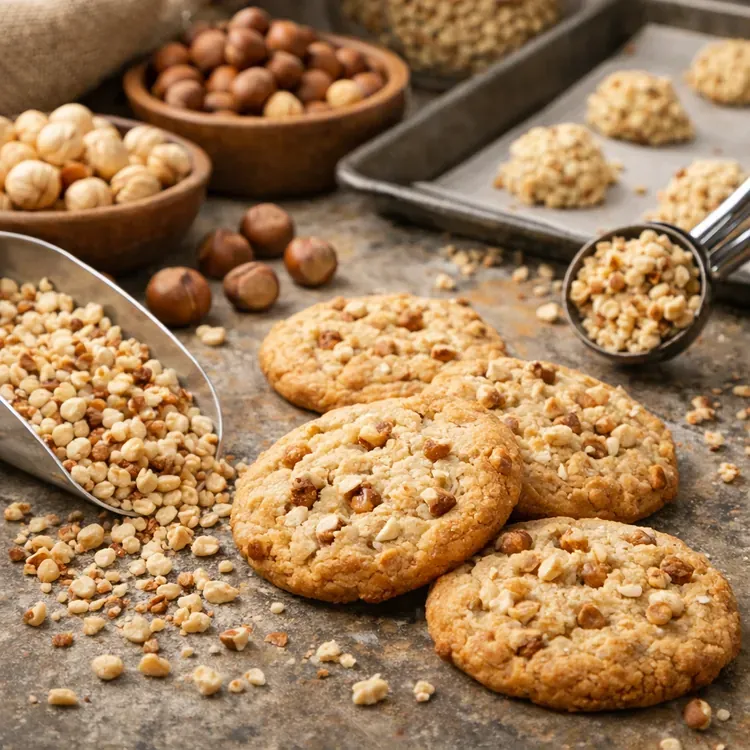
Hazelnut pieces for chocolate chip alternatives illustration

Where it fits

Hazelnut pieces deliver a natural, cocoa-free “chip-like” bite with a roasted aroma and a clean sweetness that performs well in bakery, cereal and snack systems. They’re used to create differentiated texture, reduce reliance on cocoa ingredients, and support “real nut” positioning in premium recipes.

In practice, the main success factors are particle control (for even distribution and predictable dosing), roast alignment (to match your flavor target and bake profile), and oxidation management (to protect crunch and aroma during storage and transit).

We support manufacturers by matching the right processing level to your line: whole kernels for in-house roasting, blanched kernels for lighter color targets, calibrated cuts for inclusion and depositor performance, and meal/flour for homogeneous mixes where a “chip” effect is not required.

Export-ready documentation Lot traceability Calibrated cuts Roast profile alignment Bulk & retail options

Recommended formats

Common starting points for pilots and scale-up. We can adapt roast level, size distribution and packaging to your processing conditions and shelf-life goals.

  • Roasted kernels (for cutting in-house or for applications where whole-kernel identity matters)
  • Chopped / diced (chip-like bite; predictable inclusion with controlled size ranges)
  • Sliced (visual impact on top-decor and laminated products)
  • Meal / flour (homogeneous mixes, protein-style inclusions, and cost-optimized nut flavoring)

Typical cut ranges can be aligned to your dosing equipment (screens/sieves). Ask for suggested bands (fine / medium / coarse) based on your product.

Technical considerations

Key variables that determine flavor consistency, crunch retention, and line efficiency.

  • Roast profile: light/medium/dark alignment with your bake temperature, aroma target and color requirements
  • Particle distribution: controlling fines improves dosing stability, reduces dusting, and supports consistent bite
  • Moisture & water activity: critical for crunch retention and limiting microbial risk in inclusions
  • Oxidation control: roasted pieces are more aroma-sensitive; oxygen, heat and time drive quality loss
  • Fat migration: consider for layered products (bars, filled cookies, coated snacks) to protect crispness
  • Allergen control: segregation planning, labeling needs, and clean changeover expectations

Packaging approach

Export packaging options are selected based on the format (kernel vs. cut), the route (sea/road/air), and the shelf-life you need to protect.

For roasted cuts, oxygen protection and temperature discipline are the primary levers for preserving aroma. Options can include food-grade liners, vacuum or MAP (nitrogen), and pallet protection aligned to freight conditions.

  • Bulk: lined cartons, bags-in-box, or sacks with inner liners (format-dependent)
  • Protection: vacuum / MAP options for aroma-sensitive roasted cuts
  • Logistics: palletization, corner boards, stretch, and documentation for export lanes
See bulk supply details →

Product design goals

Define what “chip alternative” means in your recipe so the specification stays stable through scale-up.

  • Texture target: crunchy bite vs. softer nut inclusion after baking
  • Flavor target: mild toasted vs. deep roasted, caramel-like notes
  • Visual target: light/medium color, surface coverage, inclusion visibility
  • Cost & positioning: premium “real nut pieces” vs. blended inclusions

Process fit

Match the cut and packaging to your equipment and handling points to prevent breakage and fines.

  • Mixing order: add late to reduce breakage (especially for coarse cuts)
  • Depositors: specify consistent size to avoid nozzle bridging and inconsistent portioning
  • Dust control: manage fines to reduce line contamination and improve weight accuracy
  • Top-decor: prefer slices or calibrated coarse cuts for visual consistency

Typical use levels

Indicative inclusion bands used in R&D. Final use rate depends on base fat phase, sweetness, and target bite.

  • Cookies & biscuits: 3–10% (w/w) chopped/diced inclusions
  • Bars & clusters: 5–20% (w/w) depending on binder strength
  • Granola & cereals: 2–8% (w/w) for crunch and aroma
  • Fillings: prefer controlled particles or meal to manage viscosity and migration

For “chip-like” perception, size and distribution can matter as much as the inclusion percentage.

Typical specification markers

Below is a practical checklist used by procurement, QA and operations teams. We align each parameter to your product form (kernel/cut/meal), destination market, customer audit needs and shelf-life expectations.

ParameterHow we align it
Cut / particle distribution Defined screen bands and tolerance ranges to support stable dosing and consistent bite
Moisture & water activity Managed to protect crunch and reduce quality drift during storage and transport
Roast profile Aligned to aroma target, color preference, and your bake/process temperatures
Defect sorting Screening and optical/hand sorting options where required for appearance and consistency
Micro profile Aligned to customer specifications and destination requirements; COA shared per lot
Aflatoxin management Risk-based sourcing, partner controls, and testing approach aligned to destination compliance needs
Oxidation indicators For roasted pieces, packaging and handling are selected to slow aroma loss and rancidity development
Packaging Food-grade liners, export cartons, vacuum/MAP options, and pallet protection for your route
Traceability Lot coding and documentation to support recalls, audits, and multi-shipment programs

Final values depend on the format and your customer requirements. We provide lot documentation with each shipment and can propose a pilot specification for trials.

Storage & shelf-life guidance

Hazelnuts are naturally rich in oils that carry flavor, but those same oils are sensitive to oxygen, heat and prolonged exposure after roasting. The most stable programs combine a clear specification with disciplined storage and freight handling.

  • Temperature: store cool and away from heat sources; avoid warm warehouses and sun exposure during loading
  • Odor protection: keep away from strong-smelling products; nuts can absorb external odors
  • Oxygen control: choose vacuum or MAP for roasted cuts when shelf-life sensitivity is high
  • Handling: minimize drops and repeated transfers to reduce fines and breakage

If your application is highly aroma-driven (premium cookies, coated snacks, top-decor), let us know your expected shelf-life and route so we can recommend the most suitable packaging approach.

Troubleshooting in production

We see too many fines/dust. What changes help?

Fines typically increase with aggressive mixing, multiple transfers, or insufficient cut calibration. Solutions include tightening the screen band (reducing undersize), adding inclusions later in the mix, improving drop heights/transfer points, and selecting packaging that reduces compression during transit.

Inclusions soften after baking or during storage. Why?

Softening is usually driven by moisture migration from the base matrix into the nut pieces, and sometimes by fat migration in layered systems. Consider a slightly larger cut, review bake/water activity targets, and ensure storage conditions are stable. For layered products, we can help evaluate migration risk and suggest format adjustments.

Flavor varies between lots. How do we tighten it?

Flavor consistency improves when roast endpoint, kernel selection, and oxidation controls are defined clearly. We recommend locking the roast profile (light/medium/dark), adding a sensory checkpoint (aroma/color), and selecting packaging aligned to your shelf-life and route.

Pieces bridge in depositors or clog dosing equipment. What should we specify?

Bridging can occur when the top-size is too large for nozzle geometry or when distribution is broad. A tighter size band, reduced oversize fraction, and controlled fines typically improve flow and repeatability. Share your equipment constraints and we will propose a target cut range.

FAQ

Which hazelnut format is most common for hazelnut pieces for chocolate chip alternatives?

Most manufacturers start with roasted kernels and a calibrated chopped/diced cut that delivers a chip-like bite. From there, we align roast level, size distribution, and packaging to match your dosing method, bake profile, and shelf-life expectations.

Can you match a target particle size or cut?

Yes. We can supply controlled cuts (sliced, diced or chopped) and align tolerance bands (for example, the percentage retained on key screens) so your operators see consistent dosing, distribution, and bite across runs.

How do you protect crunch and prevent rancidity in roasted hazelnut pieces?

Crunch and aroma depend on managing moisture, oxygen, and temperature. We control the roast endpoint and recommend packaging options such as liners plus vacuum or MAP (nitrogen) for roasted cuts when shelf-life sensitivity is high. Storage and handling guidance is provided with shipments.

What should we consider for baking stability and fat migration?

Baking stability depends on the roast profile, particle size, and the fat/water phase of your base recipe. Smaller pieces warm faster and can soften sooner; larger pieces preserve bite but may require tighter dosing control. For layered and filled products, we review fat migration risk and can recommend formats and packaging that help protect crispness.

Do you support long-term supply programs?

Yes. We structure annual and multi-shipment programs with consistent specifications, batch documentation, and forecast-based planning. This helps stabilize availability, performance and procurement workflows across the year.

What documentation can be included for export and customer audits?

We can provide lot traceability, certificates of analysis, packing lists, and origin/export documents. For customer audits, we coordinate specification sheets and supporting records aligned to your destination market and internal QA requirements.

Next step

Send your target application, expected inclusion size, annual volume (or pilot quantity), and destination. We will propose suitable formats, a pilot specification, packaging options, and a shipment plan aligned to your route and shelf-life goals.

Review products