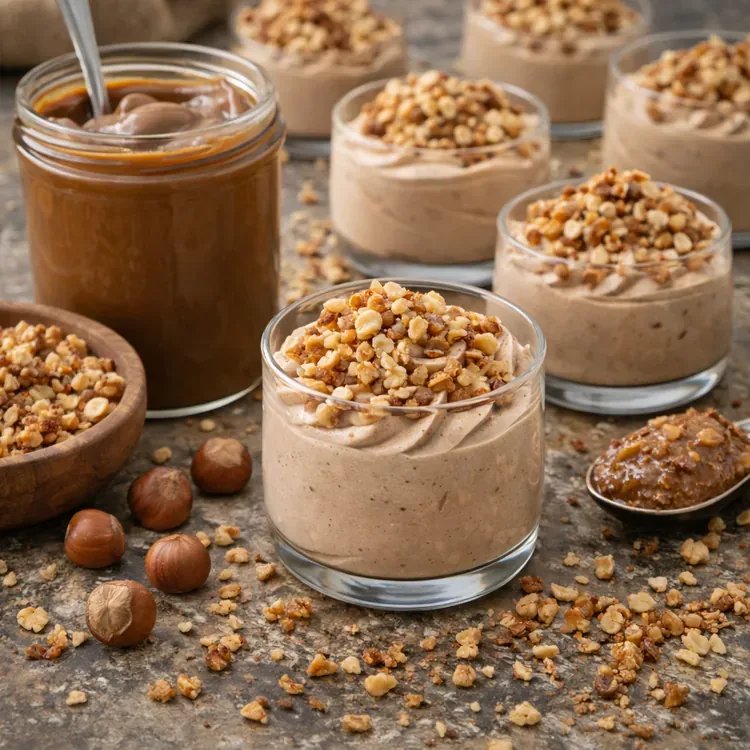
How hazelnut praline behaves in mousse systems
Mousse is a balance of fat phase, water phase, and air. Hazelnut praline contributes
roasted hazelnut solids and fat (plus caramelized sugars in praline), which can influence viscosity, emulsification, and how stable the foam remains over time.
Getting the ingredient format right reduces defects and makes production more forgiving.
1) Dispersion and smoothness
Smooth praline paste is preferred when you need a uniform mousse with no grit. Texture is primarily driven by particle size and how the paste is incorporated.
If a mousse base is too cool or too warm during mixing, you can see poor dispersion (specks) or destabilization (separation).
2) Emulsion stability (separation control)
Separation typically shows up as a shiny oil film or “weeping” around inserts/layers. Teams reduce this risk by specifying a stable praline paste texture,
controlling handling temperatures, and choosing packaging that protects fat quality from oxidation. For consistent results, many operations define a target viscosity window.
3) Aeration and structure
Mousse structure is sensitive to shear and temperature swings. A praline component that is too thick can overwork the mix during folding and reduce volume;
too thin can loosen structure and cause slump. Aligning paste flow to your working temperature helps protect both volume and set.
4) Crunch in mousse (when you want it)
Crunchy praline inclusions are usually used as a separate layer, insert, or base rather than mixed directly into mousse (where moisture can soften the crunch).
Controlled piece size and moisture management are key to keeping texture through shelf life.
Practical trial tip: test at your warm-season and cool-season room temperatures. A praline paste that performs in both conditions is easier to scale and standardize.