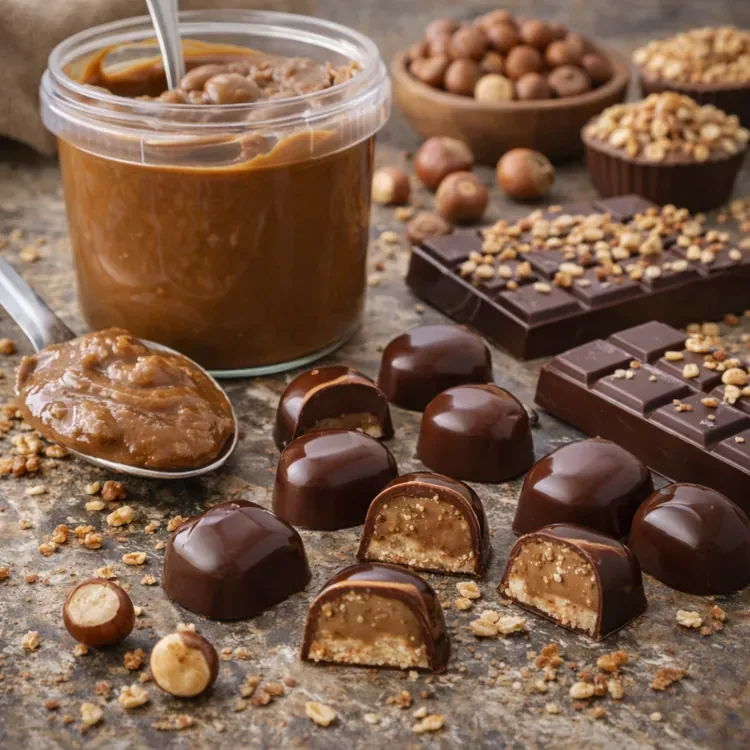
How praline paste behaves in confectionery
Hazelnut praline paste is both a flavor ingredient and a structural component. In filled chocolates and layered bars,
it contributes fat and solids that influence set, cut, and mouthfeel.
Understanding how it interacts with chocolate, dairy, and syrups helps you lock in a stable product.
Texture: smooth vs. lightly textured
Smooth praline paste is often selected for molded bonbon fillings, enrobing centers, and fine ganache-style applications where a clean cut and uniform bite matter.
Lightly textured praline can provide a more “artisan” character and can enhance perception in thicker fillings, bars, and cookies—provided the particle profile is controlled.
Viscosity and depositor performance
Viscosity affects everything from piping speed to how well a layer stays put before capping or enrobing. Many producers specify a viscosity window
so the paste performs consistently across seasons and kitchen temperatures. If you are blending with chocolate, cocoa butter, or neutral oils,
we can align base paste behavior to your target flow and set time.
Stability: separation and bloom risk
Natural oil separation can occur over time, especially with temperature swings. Bloom and fat migration risk increase in chocolate systems when the fat phase
is not balanced for your recipe and storage conditions. The practical approach is to define a paste specification (fat/sugar/PSD/viscosity)
and match packaging and storage SOPs so the ingredient behaves predictably from delivery through production.
Trial tip: Evaluate a “worst-case” scenario—warm kitchen handling + chilled storage + return to ambient—then check for separation, bloom, texture drift, and aroma loss.