Applications Library • Nutrition

Hazelnut protein enrichment blends

A practical, procurement-ready overview of using hazelnut ingredients to enrich formulations — including recommended formats (meal, flour, paste), key processing considerations (texture, oxidation, water binding), and packaging approaches for stable, repeatable industrial supply.

Back to applications
Hazelnut protein enrichment blends illustration

Where it fits

Hazelnuts naturally contribute plant protein alongside healthy fats, fiber, and a recognizable “nutty” taste profile. For nutrition-focused products, hazelnut ingredients are often used in two ways: (1) as a nutritive base that improves mouthfeel and flavor while adding protein, and (2) as a blend component that works with other proteins (e.g., pea, rice, dairy, or cocoa-based systems) to improve taste, texture, and consumer acceptance.

Unlike isolated proteins, hazelnut meal and flour are whole-ingredient style inputs. That means success depends on managing the real-world formulation variables: fat level, particle size, water activity, and oxidation control. For many customers, the goal is not only “more protein” but also a better sensory profile — a smoother texture, reduced off-notes in plant-protein blends, and a clean label positioning.

Common product categories:

  • Protein bars and bites (structure, flavor, and macro support)
  • Bakery mixes (high-protein cookies, muffins, cakes, and pancake blends)
  • Spreads and fillings (protein-forward nut spreads, cream fillings)
  • Granola & cereals (nutrition + sensory upgrade)
  • RTD / powdered beverages where nut flavor is desirable (process-dependent)

Hazelnut is a tree nut allergen. Any enrichment program must be aligned to your allergen segregation and labeling requirements.

Nutrition positioning Particle control Oxidation management Lot traceability
Recommended formats

Typical starting points for pilots and scale-up. We align grind, roast, and packaging to your texture and stability targets.

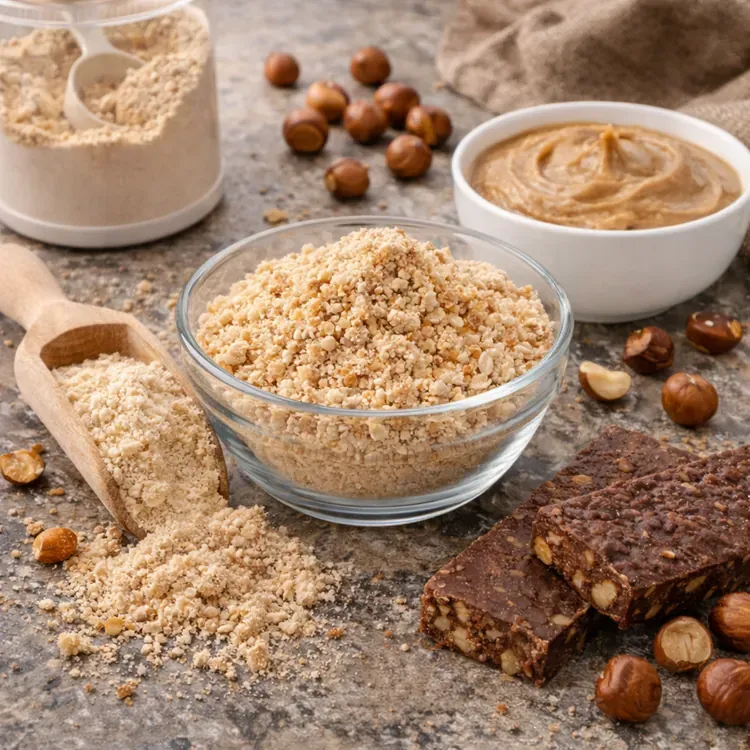
  • Hazelnut meal / flour (fine grind for homogeneous blends)
  • Defatted-style meal (lower fat approach where supported by your specification)
  • Hazelnut paste (for spreads, fillings, and bars requiring a smooth binder)

The “best” format depends on whether you need a powder that disperses, or a paste that binds and improves mouthfeel.

Technical considerations

The most common variables that affect protein positioning, processing behavior, and shelf stability in enrichment blends.

  • Particle size & mouthfeel: fine grinds reduce grittiness and improve drinkability in powdered mixes
  • Fat level & oxidation: higher fat supports flavor and texture but requires stronger oxygen management
  • Water binding: meal/flour can change dough viscosity, bar firmness, and staling behavior
  • Heat processing: baking and extrusion impact aroma; roast profile should match your finished product
  • Emulsion stability: paste-based systems require shear and emulsifier strategy (application-dependent)
  • Allergen management: segregation, cleaning validation, and labeling must be planned end-to-end
  • Color targets: blanched vs. natural inputs affect appearance of “vanilla” or light-colored products

If you share the target macros (protein per serving) and the processing method, we can recommend an inclusion-friendly format and grind.

Packaging approach

Protein enrichment blends are sensitive to oxygen, temperature, and moisture pickup. Packaging is selected to protect flavor and prevent clumping.

  • Multiwall bags with liners for meal/flour to limit moisture absorption
  • Vacuum or MAP options for oxidation-sensitive formats where appropriate
  • Export cartons & pallet wrap to reduce transit damage and contamination risk
  • Cold-chain guidance for paste when destination climate and transit time require it

For protein blends targeting long shelf life, oxygen barrier and consistent storage temperatures help preserve fresh nut aroma.

See bulk supply details →

Typical specification markers

Below is a practical checklist used by procurement and QA teams for hazelnut ingredients used in nutrition blends. We align each marker to your application type and the destination market’s compliance expectations.

ParameterHow we align it
Particle sizeDefined grind and sieve profile (fine to reduce grittiness; controlled to your process)
Fat level (as specified)Aligned to your texture and macro targets; paste vs meal selection supports the goal
Moisture / water activityControlled to reduce clumping and support shelf stability
Oxidation protectionPackaging and handling aligned to preserve aroma and minimize rancidity risk
Micro profileAligned to customer specifications and destination requirements
AflatoxinManaged through risk-based sourcing and partner controls
Allergen documentationClear allergen status and labeling support for integration into your HACCP/allergen plan
PackagingLiners / vacuum / MAP / export cartons as required

Final values depend on product form (meal, flour, paste) and customer requirements. We share lot documentation with each shipment.

Formulation guidance (practical, pilot-friendly)

Protein enrichment programs move fastest when the trial plan is designed around the two biggest levers: inclusion rate and texture control. Below are practical considerations to speed up scale-up.

  1. Start with a texture target: bars need cohesion; bakery needs predictable dough rheology; beverages need low grittiness.
  2. Select the format that fits the system: meal/flour for dry mixes; paste for binding and mouthfeel; blanched inputs for light color.
  3. Manage oxidation early: choose oxygen-protective packaging and avoid excessive warm storage during trials.
  4. Balance protein sources: hazelnut ingredients can soften harsh notes from some plant proteins and improve taste acceptance.
  5. Lock a repeatable grind: consistency of particle size is often the difference between “great pilot” and “stable production.”

Share your target application and macro claim (e.g., protein per serving), and we can propose a suitable format and a procurement spec checklist.

FAQ

Which hazelnut format is most common for hazelnut protein enrichment blends?

Most customers start with hazelnut meal or flour because it integrates easily into dry mixes and allows controlled dosing. For spreads, fillings, and some bar systems, hazelnut paste is preferred for smoother texture and binding performance.

Can you match a target particle size for smooth texture?

Yes. We can align grind and screening so you receive a repeatable particle profile. This helps reduce grittiness in beverages and improves uniformity in bakery and bar applications.

How do you manage shelf stability for protein enrichment ingredients?

Shelf stability is primarily managed through oxygen and temperature control. For meal/flour, moisture protection prevents clumping. For paste, oxygen barrier packaging and appropriate temperature management protect aroma and reduce oxidation risk.

Do you support long-term supply programs?

Yes. We structure annual and multi-shipment programs with consistent specifications, batch documentation, and forecast-based planning to keep formulation performance stable across lots.

Next step

Send your target application (bar, bakery, beverage, filling), preferred format (meal/flour/paste), inclusion rate, quantity and destination. We will propose suitable specifications, packaging and a shipment plan.

Review products