Applications Library • Industrial

Hazelnut shells as filtration media

A practical, procurement-ready overview of using screened hazelnut shell granules as a bio-based filtration medium — including recommended size bands, performance-critical specification markers, and packaging approaches for reliable industrial supply.

Back to applications
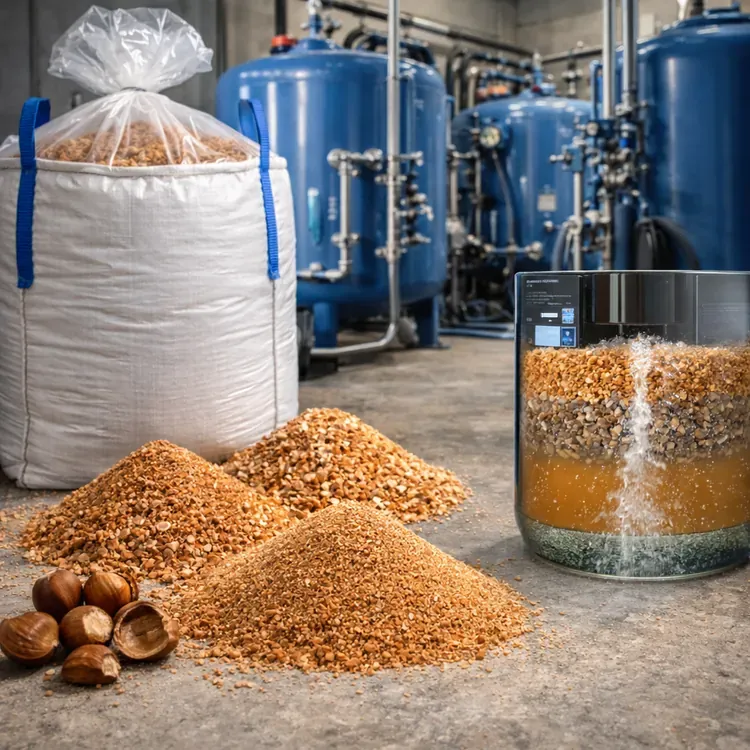
Hazelnut shells as filtration media illustration

Where it fits

Hazelnut shells are a dense, hard, lignocellulosic by-product that can be processed into calibrated granules. In filtration, these granules are typically used as a packed-bed media or as a component within multi-layer systems where particle capture, flow stability and media integrity matter.

Compared with mineral media, nutshell-based media can offer a useful balance of mechanical resilience and low density (relative to sand), while providing a natural, renewable alternative in applications that value bio-based inputs. In practice, successful use depends far less on the “shell” label and far more on controlling the variables that drive filtration behavior: particle size distribution, fines content, bulk density, and foreign matter control.

Typical use cases include:

  • Pre-filtration / polishing to reduce suspended solids before downstream membranes or carbon stages
  • Multi-media beds where a nutshell layer complements sand/anthracite or other media
  • Process filtration where washable media and repeatable pressure drop are required
  • Specialty media programs where a bio-based media is requested for sustainability or sourcing reasons

Important: shells as filtration media are not a “one size fits all” substitute. Media selection must be validated on your system (flow, solids load, backwash method, and target effluent).

Screened size fractions Lot traceability Fines control Export-ready documentation
Recommended formats

Most projects start with screened granules. We match your target cut, limit fines, and pack for handling and storage stability.

  • Screened shell granules (common bands: 0.5–1 mm, 1–2 mm, 2–4 mm, 4–6 mm)
  • Dedusted media for systems sensitive to initial turbidity spikes
  • Carbonized shell granules (where an adsorptive component is desired; supplied on request/spec)

Your ideal size depends on the solids you’re removing and the allowable pressure drop. Smaller particles can capture finer solids but generally increase resistance to flow and may require tighter fines control.

Technical considerations

The variables that most often determine whether a shell media performs consistently in a filtration vessel.

  • Particle size distribution: narrow, repeatable sieve bands reduce variability in pressure drop
  • Fines and dust: excess fines can cause turbidity on start-up and accelerate bed compaction
  • Bulk density & bed depth: influence media loading (kg) per vessel and hydraulic behavior
  • Attrition resistance: low attrition reduces media loss and downstream carryover over time
  • Foreign matter control: stones, metal, fiber and other contaminants must be controlled before packing
  • Commissioning / rinsing: initial rinse/backwash planning is critical for stable operation
  • Backwash strategy: set expansion and flow to avoid channeling while preventing media carryout
  • Compatibility: confirm temperature, pH, oxidizers and cleaning agents with your process requirements

If you share your vessel dimensions, target flow, differential pressure limit, and solids load, we can propose an initial media band and a practical acceptance checklist for incoming lots.

Packaging approach

Filtration media logistics are about keeping the media clean, dry, and consistent from origin to commissioning.

  • 25 kg / 50 lb sacks with inner liner (common for warehouse handling)
  • Big bags (FIBC) for plant-scale programs and bulk unloading
  • Moisture protection to reduce clumping and protect sieve integrity
  • Dust-managed loading options for sites sensitive to airborne particles

For export shipments, we align palletization, labeling, and documentation (packing list, COO, COA, lot ID) to your import and QA workflow.

See bulk supply details →

Typical specification markers

Below is a practical checklist used by procurement and QA teams when qualifying shell-based filtration media. We align each item to your system sensitivity (pressure drop, turbidity, backwash) and to your destination market requirements.

ParameterHow we align it
Particle size (sieve band) Defined size fraction with agreed tolerance; sieve report available on request
Fines content Screening/dedusting approach to limit dust and improve start-up clarity
Moisture Controlled to reduce clumping and maintain stable bulk handling
Bulk density Measured to support vessel loading calculations and repeatable bed depth
Foreign matter Sorting and magnets where applicable; visual inspection criteria defined
Attrition / durability Media handling plan aligned to minimize breakage and carryover during use
Ash / mineral content (optional) Specified when low ash is important for your process or downstream equipment
Odor / extractables (optional) Controlled via cleaning and storage practices; validated by your commissioning rinse
Packaging Lined sacks or FIBC; palletized and labeled with lot IDs for traceability
Documentation COA, packing list, origin documents, and batch identifiers per shipment

Final values depend on your vessel design and filtration target. For many installations, the acceptance criteria are set around sieve band + fines threshold + foreign matter control, then verified during commissioning (rinse/backwash protocol).

How to qualify shell media quickly (practical workflow)

If you’re evaluating hazelnut shells as a filtration medium, a structured qualification avoids costly trial-and-error. Below is a simple, plant-friendly workflow used in many media approvals.

  1. Define the operating window: flow rate, allowable differential pressure, solids load, and whether you will backwash.
  2. Select an initial size band: choose a screened fraction aligned to your capture target and pressure drop tolerance. (If unsure, start mid-range and adjust after trial.)
  3. Set incoming acceptance checks: sieve band verification, fines/dust check, foreign matter inspection, moisture and bulk density.
  4. Commission with a rinse plan: rinse/backwash until clarity stabilizes; record time-to-clear and initial media loss (if any).
  5. Run a controlled trial: track effluent clarity, pressure drop trend, and backwash effectiveness over a defined run time.
  6. Lock the specification: finalize the size band and fines limit, then move to scheduled lots with lot-to-lot documentation.

We can support this process by proposing a starting size band and providing consistent, screened lots for pilot and scale-up.

FAQ

Which hazelnut shell format is most common for filtration media?

Most filtration projects start with screened hazelnut shell granules supplied in a defined sieve band. The best band depends on your flow rate and pressure-drop limits: smaller particles can improve capture of finer solids, while larger particles generally support higher flow with lower resistance.

Can you match a target particle size and limit fines?

Yes. We can supply calibrated size fractions and manage fines through screening and dedusting. If you share your target range (or vessel details and process goal), we can recommend a practical starting band and tolerance.

How do you minimize foreign matter for filtration media programs?

Media programs are managed with a procurement and QA checklist focused on screening, visual inspection, and (where appropriate) magnetic separation. Lots are labeled and documented to maintain traceability.

How should hazelnut shells be packed for export and storage stability?

We commonly ship in lined sacks or FIBC big bags to protect the media from moisture pickup and contamination. Packaging is selected to support clean handling, dust control, and stable storage until commissioning.

Do you support long-term supply programs?

Yes. We can structure annual or multi-shipment programs with consistent size bands, lot documentation, and forecast-based planning, helping you keep bed performance stable across replenishment cycles.

Next step

Send your application details (vessel type/size, target flow, solids to remove, backwash method, quantity and destination). We will propose suitable shell size fractions, packaging and a shipment plan for trials or steady supply.

Review products