Applications Library • Industrial

Hazelnut shells for activated carbon precursors

A practical, procurement-ready overview of how hazelnut shells are supplied as a carbon precursor — including recommended shell formats, specification markers, handling requirements and export packaging options for consistent carbonization and activation performance.

Back to applications
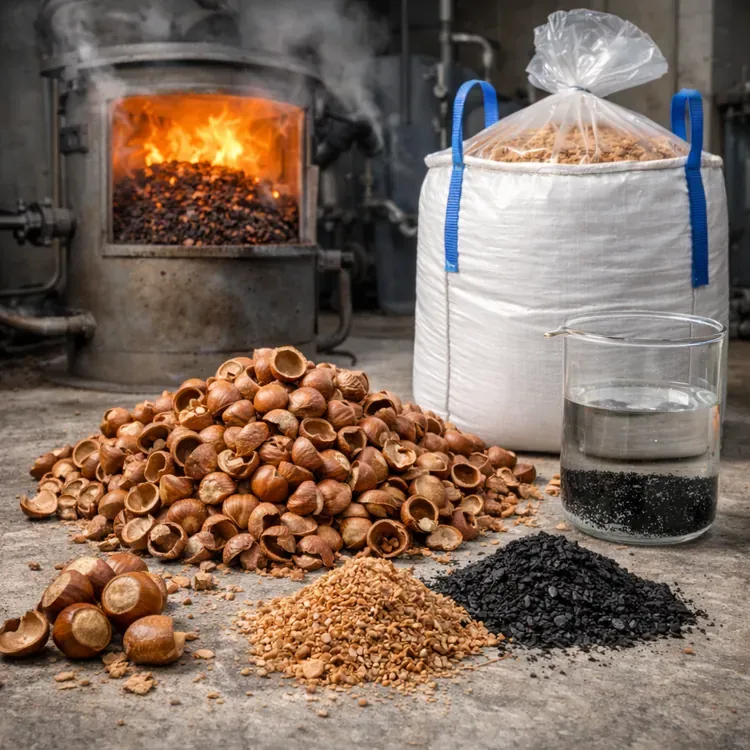
Hazelnut shells for activated carbon precursors illustration

Where it fits

Hazelnut shells are a hard, lignocellulosic biomass stream commonly used as an activated carbon precursor. Their dense structure makes them suitable for producing durable char that can be activated into high-surface-area carbon for water treatment, air and gas purification, solvent vapor capture, and other adsorption-driven uses.

In precursor supply programs, the main drivers are feedstock consistency (stable moisture, ash and size distribution), low contamination risk (metals, stones, soil, plastics), and predictable processing behavior during drying, milling, carbonization and activation. We support this by aligning shell preparation, screening and packaging to your process.

If you are targeting a specific performance outcome (e.g., BET surface area, iodine number, pore size distribution, or adsorption of a defined contaminant), share your activation route (steam/CO2/chemical), reactor type and milling constraints. We can propose a shell format and control points that reduce variability.

Industrial by-product stream Screened particle sizes Contamination control Export-ready logistics

Recommended formats

Typical starting points for pilot runs and scale-up. We can supply cleaned shells as-is, crushed, milled, or screened into defined size bands.

  • Whole dried shells (cleaned)
  • Crushed shells (screened fractions, e.g., coarse/medium)
  • Milled shells (fine feedstock for compact reactors or briquetting/pelletizing)

Choosing the format depends on your front-end: direct carbonization (whole/coarse), pre-milling systems (crushed), or densification (milled for pellets/briquettes). Particle control also helps avoid dust losses and improves stable feed rates.

Technical considerations

The most common variables that influence yield, reactivity and final carbon performance.

  • Moisture stability: consistent drying reduces energy load and improves carbonization repeatability
  • Ash and mineral profile: impacts activation behavior, pore development and downstream washing needs
  • Foreign matter control: metals/stones/soil damage mills and contaminate char; magnets and screening help
  • Size distribution: stable fractions improve residence time control and reduce fines carryover
  • Storage conditions: keep shells dry and ventilated to avoid mold, odor pickup and moisture regain
  • Traceability: lot ID and documentation support long-term programs and performance tracking

For sensitive adsorption applications, buyers often specify additional checks (chlorides, sulfur, heavy metals, bulk density) based on the target market and end use.

Packaging approach

Packaging and loading options are selected to protect moisture targets, limit contamination and move efficiently by road or sea.

Common export configurations include FIBC big bags with liners (for bulk handling), 25 kg bags (for controlled dosing and smaller plants), or container bulk loading where appropriate. For long transit routes, moisture barrier liners and desiccants can be used to reduce moisture regain.

See bulk supply details →

Typical specification markers

Below is a practical checklist used by procurement and QA teams when purchasing hazelnut shells for carbon precursor use. Final targets depend on your equipment, activation route and end market. We align each item to your requirements and provide lot documentation with shipment.

ParameterHow we align it
MoistureDefined target range; controlled drying and moisture-protective packaging if required
Particle size / screeningWhole, crushed or milled; screened fractions with agreed tolerance bands
Foreign matterControls for stones, metals, plastics and soil; screening and magnetic separation where applicable
Ash (indicative)Measured and reported; used to manage activation behavior and downstream washing expectations
Bulk density (optional)Reported for dosing, storage and shipping efficiency planning
Proximate analysis (optional)Volatile matter / fixed carbon as agreed for process benchmarking
Elemental/impurity checks (optional)Chloride, sulfur, heavy metals as required by your end application and destination market
PackagingFIBC with liner, 25 kg bags, or bulk container loading; palletization and labeling to spec
TraceabilityLot ID, batch documentation and shipment-level reporting for long-term consistency

If you share your target carbon KPIs (e.g., iodine number, methylene blue, BET, pore size distribution, hardness), we can recommend precursor controls that typically move those results in the right direction and reduce variability between lots.

Process pathway (how shells become activated carbon)

Most activated carbon programs using hazelnut shells follow a similar sequence. Understanding your pathway helps us propose the right feedstock format.

  • Pre-processing: cleaning, drying and screening to remove contaminants and stabilize moisture
  • Size reduction: crushing or milling to match feeder, kiln/reactor, and residence time requirements
  • Carbonization: thermal conversion to char under controlled atmosphere (yield and char strength depend on feedstock consistency)
  • Activation: steam/CO2 activation (physical) or chemical activation (process-dependent) to develop porosity
  • Post-processing: washing (if needed), drying, grading and packaging to final product specifications

Key procurement insight: precursor variability (moisture, ash, fines, contaminants) often shows up as variability in yield, reactivity, pressure drop, and final adsorption performance. Tightening precursor controls is frequently the fastest way to stabilize the finished carbon.

FAQ

Which hazelnut shell format is most common for activated carbon precursor programs?

Most buyers start with dried, cleaned shells in whole or crushed form and then optimize particle size (screened fractions) to match their milling, carbonization and activation equipment. Whole/coarse shells suit direct carbonization lines, while crushed or milled shells suit controlled feeders, compact reactors, or densification (pellets/briquettes).

Can you supply screened particle sizes and moisture targets?

Yes. We can provide whole, crushed or milled shells with defined size bands, plus moisture control and export-ready packaging. This supports stable feed rates, reduces fines carryover, and improves repeatability in carbonization.

What documentation is typically provided for industrial shell shipments?

Typical documentation includes commercial invoice, packing list, certificate of origin, lot/batch identification, and an agreed quality report (commonly moisture, size distribution and foreign matter). Additional reporting (ash, bulk density, impurity checks) can be included based on your specification.

Next step

Send your target monthly volume, destination, preferred shell format (whole/crushed/milled) and any must-have controls (moisture, ash, size band, contamination limits). We will propose suitable preparation, packaging and a shipment plan aligned to your process.

Review products