Where it fits
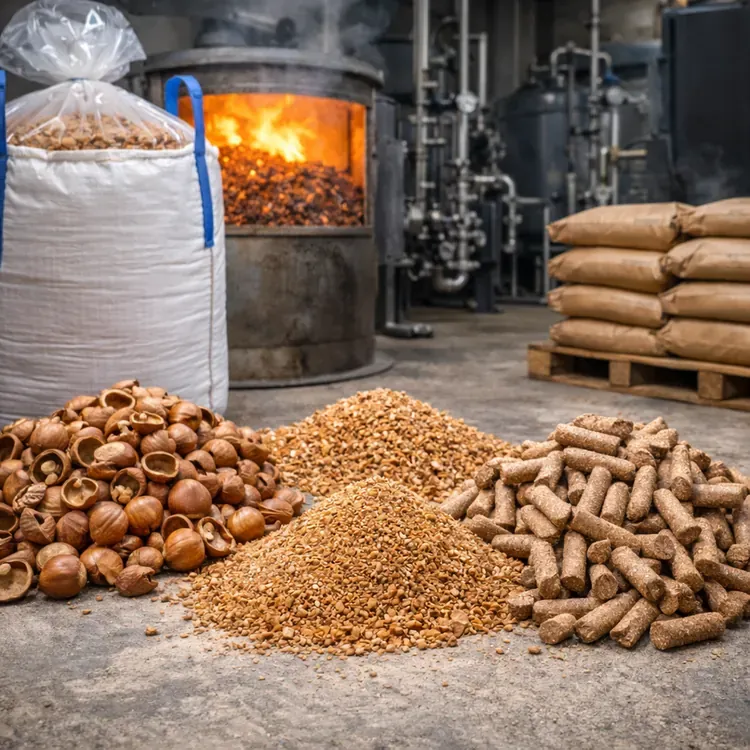
Hazelnut shells are a valuable by-product of hazelnut processing and can be used as a biomass fuel for heat generation.
In industrial settings, shells are typically combusted in biomass boilers or burners designed for agricultural residues. The key value
proposition is practical: shells can help reduce reliance on fossil fuels while supporting circular use of processing residues.
Unlike food-grade ingredients, shell fuel performance is driven less by taste and more by consistency. Procurement teams
usually focus on: moisture control (for stable combustion), ash behavior (to manage maintenance and slagging),
particle size distribution (for feeding systems), and contamination control (to protect equipment).
These variables are the difference between a fuel that runs smoothly and one that causes feed bridging, excessive ash, or unplanned downtime.
We support industrial users by aligning the shell format to your equipment: loose shells for simple conveyance, crushed shells for more uniform
feeding, and densified formats (pellets/briquettes) where higher bulk density and automated handling are required. For long-term programs, we
align packaging, documentation, and shipment cadence to your consumption profile and storage capacity.
Industrial supply programs
Lot traceability
Contamination control
Bulk logistics options
What “good” looks like for shell fuel
A strong shell fuel spec reads like an operations document: it defines the format, cleanliness expectations, moisture range,
particle size distribution, and a delivery/handling plan that fits your receiving and storage reality.
- Stable combustion: moisture managed for consistent flame and reduced smoke/soot risk.
- Predictable ash: ash level and behavior aligned to your boiler’s cleaning schedule.
- Feed reliability: particle size and fines controlled to reduce bridging or dust issues.
- Cleanliness: minimized foreign material to protect screws, conveyors, and grates.
- Logistics fit: packaging and transport aligned to unloading method and storage.