Where it fits
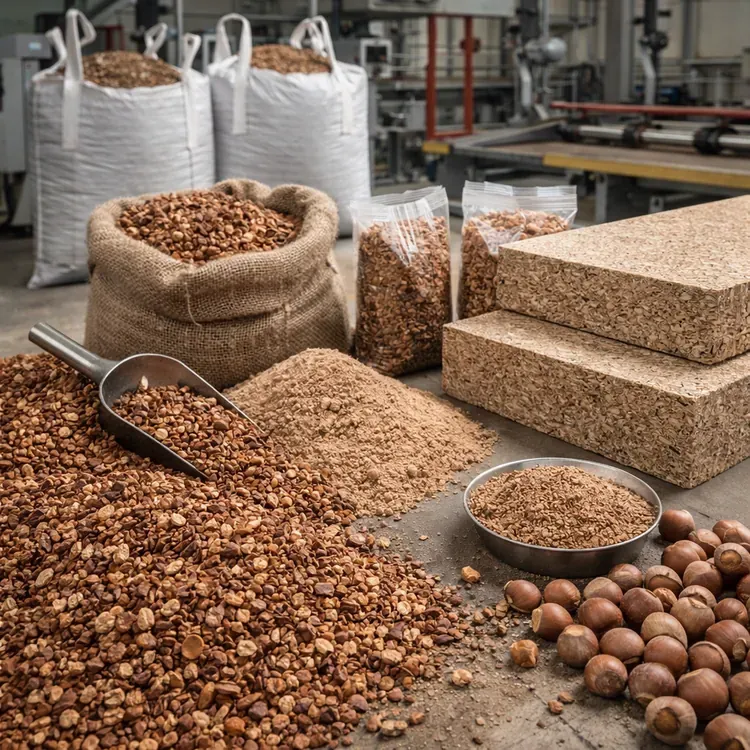
Hazelnut shells are a hard agricultural byproduct that can be cleaned, crushed and screened into controlled particle ranges.
In composite boards, shells are evaluated as a partial substitute for conventional wood particles or as a
performance-tuning filler—especially in programs focused on upcycled feedstocks and supply stability.
In particleboard manufacturing, the main drivers are consistent particle size distribution, predictable moisture,
and compatibility with your binder system. Shell particles behave differently than softwood/hardwood particles due to hardness,
surface chemistry and ash/mineral content—so successful programs align the shell fraction to the layer (core vs surface), board density target,
and press strategy.
We support manufacturers by aligning shell processing to your line: screened shell grit for bulk blending, finer fractions for surface layers,
and milled powder when tight packing or specific rheology/feeding behavior is required. We also align packaging for dust control and moisture protection.
Controlled screening
Moisture management
Foreign matter control
Program supply
How shells change composite behavior (what teams look for)
Most development programs start by defining the role of shells in the panel, then choosing the right fraction. Typical evaluation points include:
- Mat formation & flow — particle shape and fines content affect conveying, blending and mat uniformity.
- Press permeability — too many fines can slow venting; too coarse can reduce packing and bond area.
- Bonding efficiency — shells may require resin level/process tuning to maintain internal bond and bending properties.
- Dimensional stability — moisture profile and particle engineering influence thickness swelling and water uptake behavior.
- Tooling wear — mineral/ash content and hardness can influence wear; good cleaning and screening reduces risk.
Practical note: this page is sourcing guidance for shell inputs. Final panel performance depends on resin system, wax/coupling choices, density profile and press parameters.