Applications Library • Nutrition

Nut butter bases for snack bars

A detailed, procurement-ready guide to hazelnut-based nut butter binders for snack bars — including the best starting formats, how roast and grind influence texture, how to manage oil separation and fat migration, and how packaging protects shelf-life in real retail distribution.

Back to applications

Best for: protein bars, granola bars, “clean label” snack bars, layered bars (base + topping), and filled/coated bars where binder consistency and oxidation control are critical.

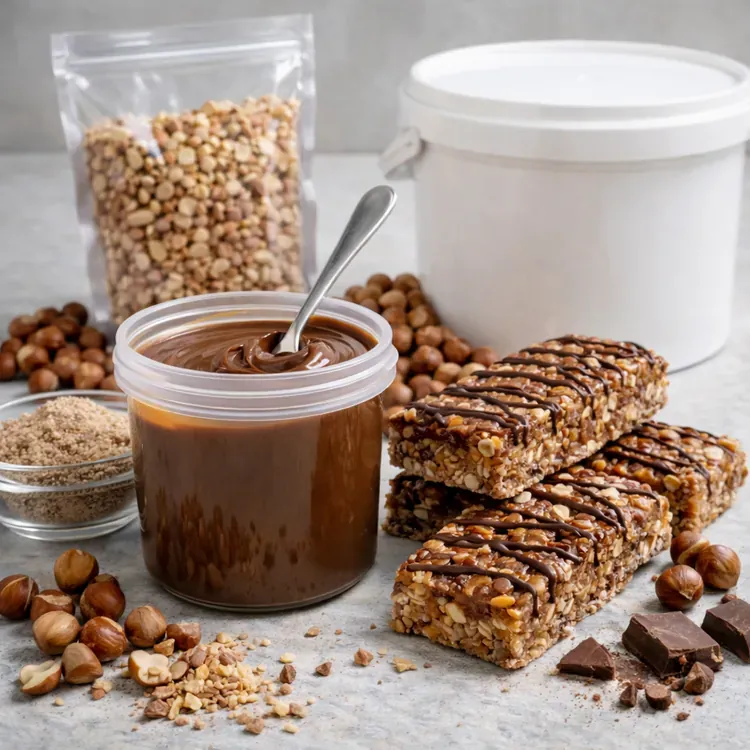
Nut butter bases for snack bars illustration

Where it fits

Nut butter bases are used in snack bars as both a binder and a flavor carrier. Hazelnuts are selected for their naturally sweet, rounded profile and aroma development during roasting. In practical terms, the nut butter phase helps hold particulates (oats, crisps, seeds, inclusions), contributes to mouthfeel, and supports bar cohesion without requiring high levels of syrup.

In this application, the main procurement and technical drivers are flavor consistency, texture/viscosity control, and shelf stability. Retail bars experience temperature cycling (warehouse → truck → shelf), which can accelerate oxidation and cause oiling-off if the formulation or nut butter spec is not aligned. A strong ingredient strategy anticipates these conditions: roast target, grind, oil behavior, packaging barrier and documentation flow are defined up front.

We support snack bar manufacturers by aligning the hazelnut ingredient to your process: calibrated kernels for in-house roast/grind, roasted kernels for consistent aroma, hazelnut paste for pumpable binder systems, meal/flour for texture building, and hazelnut oil where controlled fat phase adjustment is needed. Programs can be built for both pilot scale and stable annual supply.

Export-ready documentation Lot traceability Roast & grind targets Bulk & retail options Shelf-life protection

What “good” looks like for bar binders

The best-performing nut butter bases behave like a process ingredient: they dose cleanly, hold texture over time, and maintain aroma through distribution. A good spec ties measurable controls to real production outcomes.

  • Consistent viscosity: repeatable mixing and depositing without line rework.
  • Balanced oil behavior: reduced oiling-off during storage and temperature cycling.
  • Stable flavor: roast-aligned aroma, protected from oxidation.
  • Predictable mouthfeel: grind fineness aligned to “smooth” vs “crunchy” positioning.
  • Clear QA release: lot-level documents that reduce hold time at receiving.
Recommended formats

Typical starting points for pilots and scale-up. We align roast profile, grind, viscosity expectations and packaging to your bar texture and shelf-life goals.

  • Hazelnut paste (roasted) — most common binder base; consistent aroma and easy dosing.
  • Natural kernels (calibrated) — for in-house roasting/grinding with full flavor control.
  • Roasted kernels — consistent aroma input for grinding lines and reduced in-house variability.
  • Meal / flour — texture building and solids control for “firm” bar structures.
  • Diced / chopped — inclusions for bite; can be paired with paste for a “crunchy” style.
  • Hazelnut oil — used to tune fat phase and improve mixing/pumpability where appropriate.

Technical considerations

The main variables that impact throughput, bar texture, and shelf stability — especially in high-protein or layered formats.

  • Oxidation protection: high-barrier packaging, headspace control; vacuum/MAP when needed.
  • Roast level: drives aroma and perceived sweetness; needs repeatable target for stable sensory.
  • Grind fineness: affects mouthfeel and binder behavior; too coarse can cause weak cohesion.
  • Oil separation: managed via solids balance, process conditions and packaging/temperature discipline.
  • Fat migration: critical in layered/coated bars; can soften adjacent layers over time.
  • Allergen control: line segregation, labeling support, and documentation consistency.

Packaging approach

Nut butter is highly aroma-sensitive. Packaging is designed to protect the fat phase from oxygen and limit temperature stress during storage and transit.

We can supply lined cartons, pails or drums depending on format. For sensitive bases (roasted paste, high-surface-area meals), oxygen protection and temperature management are key to preserving aroma and preventing early flavor fade.

See bulk supply details →

How roast, grind and solids balance affect bar performance

Snack bar binders live at the intersection of sensory and mechanics. Roast level affects aroma and perceived sweetness, while grind fineness and solids balance determine how well the binder holds inclusions and resists oiling-off. A “smooth” nut butter base typically requires a tighter grind and stable viscosity; a “crunchy” base often pairs paste with diced nuts for controlled bite without sacrificing cohesion.

Many modern bars include proteins, fibers, and low-sugar syrups that can interact with the fat phase. This can change how the binder sets, how it feels at bite temperature, and how it ages over time. The practical takeaway: the nut butter spec should not exist in isolation — it should reflect your full formula, process temperatures, and the distribution environment your bars will actually experience.

Common bar challenges (and what to specify)

  • Too soft / greasy on shelf: review oil behavior, solids ratio, and temperature exposure.
  • Crumbly bite: ensure viscosity and grind support inclusion binding; adjust paste-to-particulate balance.
  • Flavor fade: strengthen oxygen barrier; review roast target and storage temperatures.
  • Layer slippage or softening: manage fat migration with the right base format and packaging discipline.
  • Deposit inconsistency: align viscosity expectations and reduce particle variability.

Typical specification markers

Below is a practical checklist used by procurement and QA teams for nut butter bases in snack bars. We align each item to your destination market, customer requirements, and processing level (kernels → roasted → paste/meal).

ParameterHow we align it
Product formPaste (roasted), kernels (natural/roasted), meal/flour, oil — matched to your binder concept
Roast targetAligned to sensory and color profile; repeatable target for consistent aroma
Grind / textureAligned to “smooth” vs “crunchy”; particle feel controlled to your requirements
MoistureControlled to support shelf stability and reduce texture drift
Oil behaviorAssessed for separation tendency; managed through process alignment and packaging protection
Fat migration riskConsidered for layered/coated bars; guidance aligned to your format
Defect sortingScreened and optically sorted where required
Micro profileAligned to customer specifications and destination requirements
AflatoxinManaged through risk-based sourcing and partner controls
PackagingHigh barrier liners; vacuum/MAP options for sensitive roasted formats
TraceabilityLot coding and COA flow aligned to your receiving and QA release process

Final values depend on product form and customer requirements. We share lot documentation with each shipment and align release procedures to your QA workflow.

Formulation & process notes

Most bar issues show up during scale-up: mixing energy, temperature, and inclusion load can change viscosity and the way the binder “sets.” A stable spec is one that supports manufacturing reality.

  • Inclusion load: higher particulates require stronger binder cohesion and consistent paste behavior.
  • Mix temperature: impacts flow and deposit; align ingredient handling to avoid viscosity swings.
  • Crunch positioning: use controlled diced nuts for bite while keeping binder stable.
  • Protein-heavy formulas: watch interactions that change firmness over time.

Shelf-life protection

Nut butter oxidizes faster than whole kernels due to increased surface area. Packaging and storage discipline are essential for maintaining the intended flavor through retail shelf life.

  • Oxygen barrier: select packaging matched to sensitivity (paste > meal > kernels).
  • Headspace: controlled to reduce oxidation risk; vacuum/MAP when needed.
  • Temperature: avoid unnecessary heat exposure in transit and storage.
  • FIFO & lot control: supports consistent aroma across production runs.

Documentation & brand needs

Snack bar brands often have tight claims and labeling requirements. A clean, repeatable documentation pack makes compliance easier.

  • COA flow aligned to your QA release process.
  • Lot traceability and shipment documentation pack.
  • Allergen declarations aligned to destination market expectations.
  • Stable program planning for consistent retail performance.

FAQ

Which hazelnut format is most common for nut butter bases for snack bars?

Most snack bar binders start with roasted hazelnut paste (or a paste + oil blend) because it supports consistent flavor, stable texture, and efficient dosing. Some manufacturers begin with calibrated natural kernels for in-house roasting and grinding, then standardize roast target, grind fineness, and packaging to meet shelf-life goals.

Can you match a target particle size or cut?

Yes. We can supply calibrated kernels and controlled cuts (sliced, diced or chopped) and align tolerance bands to your process. For “crunchy” bar styles, controlled diced nuts help keep inclusion texture consistent without disrupting binder cohesion.

What are the biggest shelf-life risks for nut butter bases?

The main risks are oxidation (flavor fade/rancidity) and oil separation, which can be worsened by temperature cycling. High-barrier packaging, headspace control, and good storage discipline reduce risk. For layered/coated bars, fat migration is also important because it can soften adjacent layers over time.

Do you support long-term supply programs?

Yes. We structure annual and multi-shipment programs with consistent specifications, batch documentation and forecast-based planning. Programs can include agreed roast and grind targets, packaging standards, and lot documentation aligned to your QA release workflow.

Next step

Share your bar type (protein, granola, layered/coated), target nut percentage, expected annual volume, and destination country. We’ll propose the right base format (kernels vs paste), roast/grind approach, packaging barrier options, and a shipment plan aligned to shelf-life and process needs.

  • For trials: a practical starting spec that is easy to procure and validate on line.
  • For scale-up: align viscosity expectations, packaging barrier, and documentation flow for stable runs.
  • For retail: focus on oxidation protection and temperature-resilient performance.
Review products