Applications Library • Sustainability

Organic hazelnut ingredient programs

A practical, procurement-ready guide to building a repeatable organic hazelnut ingredient supply—covering recommended formats, technical considerations, specification markers and packaging approaches used to protect flavor and shelf life.

Back to applications
Organic hazelnut ingredient programs illustration

Where it fits

Organic hazelnut ingredient programs are designed for manufacturers who need repeatable flavor, controlled particle behavior and documented, audit-ready compliance across multiple shipments. In practice, this means selecting the right hazelnut format (kernel, cut, flour or paste), defining a consistent specification, and choosing packaging that slows oxidation and preserves aroma during storage and transport.

Hazelnuts are selected for their naturally sweet profile and the aroma that develops during roasting. In bakery, confectionery and snack applications, the main drivers are usually: flavor consistency, clean label positioning, dose accuracy, and shelf stability. Organic programs add a further layer: tighter documentation flow, certificate management and traceable lots.

We support manufacturers by aligning the hazelnut format and processing level to your line. Whole kernels can be supplied for in-house roasting and coating; blanched kernels help when light color targets matter; controlled cuts support volumetric or gravimetric dosing; and paste/flour is used where a homogeneous distribution is critical.

Export-ready documentation Lot traceability Custom cuts Bulk & retail options

What a “program” includes

A supply program is not just a product—it's the repeatable operating model around it. Most customers align on:

  • Specification (format, sizing, roast profile, moisture, defect limits, micro targets and packaging).
  • Documentation flow (COA + traceability and certificate set per shipment).
  • Cadence (annual contract or seasonal planning, with multiple deliveries).
  • Change control (how any spec changes are handled, including pilot approval before scale).
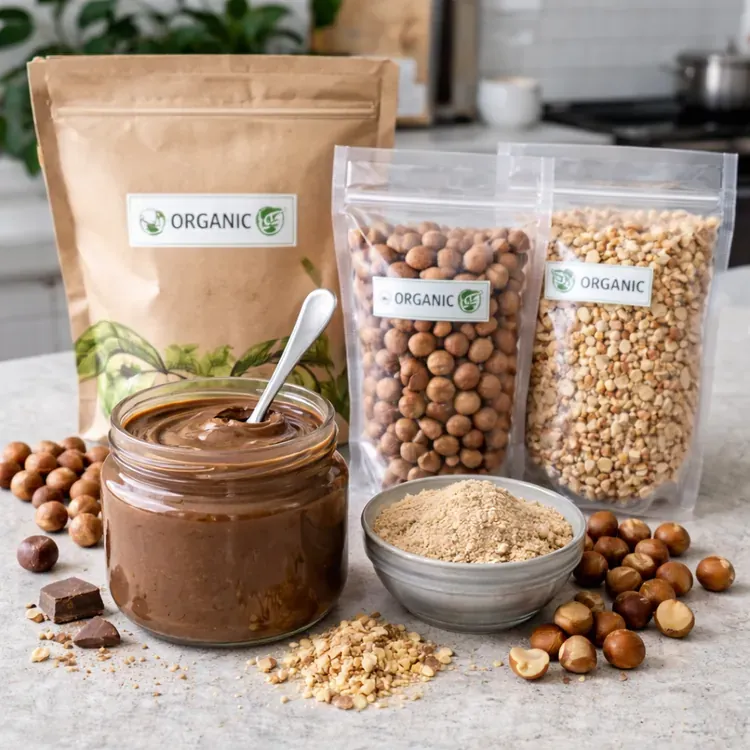
Recommended formats

Typical starting points for pilots and scale-up. Format selection usually depends on how you dose (by volume, weight or slurry), your desired sensory impact, and the shelf life you need after opening.

  • Diced / sliced / chopped — used for inclusion, topping and visible nut identity; can be calibrated to reduce fines.
  • Roasted kernels — used for premium aroma and finished sensory; roast level can be matched to target notes.
  • Natural kernels (calibrated) — preferred when customers roast in-house and want control over final flavor.
  • Blanched kernels — supports light color systems where skin flecks are not desired.
  • Meal / flour — improves distribution in doughs and fillings; can contribute to texture and nutty background.
  • Paste / puree — for pralines, spreads, creams and fillings; provides a stable, homogeneous nut base.

Technical considerations

The most common variables that impact throughput, flavor and stability—especially when scaling from pilot runs to continuous production.

  • Allergen control — line segregation planning, cleaning validation expectations and inbound labeling flow.
  • Particle size & fines — impacts dosing accuracy, hopper bridging and dust; specify maximum fines where critical.
  • Oxidation management — oxygen exposure is the primary driver of flavor degradation in roasted formats.
  • Moisture & water activity — influences texture and microbial risk; targets should match your downstream process.
  • Roast profile consistency — roast drives aroma and color; define roast level and tolerances for repeatability.
  • Foreign matter control — screening + sorting expectations should be aligned to your product risk assessment.
  • COA & traceability — consistent lot coding, batch documentation and retention samples for complaint handling.

Tip: for high-speed inclusion lines, the fastest wins are usually tightening cut tolerances and reducing fines, which stabilizes dosing and reduces product variability.

Packaging approach

Packaging choices should be driven by oxidation sensitivity, storage duration and your receiving operations. We can supply lined cartons, vacuum or MAP options and palletization suited to sea, road or air freight.

A practical packaging decision tree

  • Natural kernels: export cartons with liners are common; choose based on handling and humidity protection needs.
  • Roasted cuts: prioritize oxygen barrier liners; vacuum or MAP can be considered where it fits your process.
  • Paste / puree: protect from oxygen and temperature; manage headspace and consider pails/drums based on throughput.
  • Flour/meal: focus on moisture protection and sifting behavior; avoid crushing that creates excess fines.

For sensitive formats (roasted cuts, paste), oxygen protection and temperature management are key to preserving aroma and slowing rancidity.

See bulk supply details →

How procurement and QA typically structure an organic program

Organic ingredient supply works best when procurement and QA align on a single, reusable specification and a predictable documentation packet. Below is a practical approach used by many food manufacturers to reduce surprises at receiving and keep production stable across seasons.

1) Define the use-case before the spec

“Hazelnuts” is not a single requirement. A topping inclusion line, a cookie dough mix and a praline paste each need different behavior. Most teams start by documenting:

  • Application (inclusion, topping, paste base, flour blend, coating).
  • Dosing method (volumetric cups, multihead weigher, screw feeder, slurry/pump).
  • Sensory target (light vs deep roast notes, visual identity, crunch level).
  • Shelf life expectation (unopened and once opened in your facility).

2) Translate needs into measurable parameters

Once the use-case is clear, turn it into measurable limits and tolerances so your line doesn’t absorb variability. The highest-impact parameters are usually sizing, fines, roast profile and packaging barrier performance.

  • Cut definition (target range + maximum overs/unders + maximum fines).
  • Roast level (light/medium/dark with agreed reference, color expectations where applicable).
  • Moisture target (aligned to your downstream process and storage conditions).
  • Defect limits (visual defects and any customer-specific exclusions).

3) Align documentation and receiving workflow

For long-term programs, teams often standardize a “shipment pack” so every delivery looks the same to receiving:

  • COA packet tied to lot code(s) and date.
  • Traceability linking processing lots and packaging units.
  • Certificate handling planned to match the destination market’s expectations.
  • Retention sample plan (if used by your QA system).

Typical specification markers

Below is a procurement/QA checklist used to reduce ambiguity during sourcing. We align each item to your destination market, customer requirements and processing level. If you already have an internal spec, we can map to it directly.

ParameterHow we align it
Format & sizing Calibrated kernels or controlled cuts; define target range, tolerance bands and maximum fines.
Moisture Controlled to a target range that matches your process and storage needs.
Defect sorting Screening and optical sorting options aligned to your quality expectations and risk assessment.
Micro profile Aligned to customer specifications and destination requirements; define the test panel and frequency.
Aflatoxin risk Managed through risk-based sourcing and partner controls; align testing expectations where required.
Foreign matter Specify controls and acceptance criteria; align to your line protection and product risk.
Oxidation protection Oxygen-barrier packaging, headspace control, and appropriate vacuum/MAP options for sensitive formats.
Packaging Liners, cartons, pails/drums as required; palletization to match handling and freight method.
Traceability Lot codes and shipment documentation aligned to your QA system and recall-readiness requirements.

Final values depend on product form and customer requirements. We share lot documentation with each shipment and can standardize the pack for repeat orders.

Practical guidance by format

Controlled cuts (diced / chopped / sliced)

Best when you need visible nut identity and consistent dosing. Most production issues come from excess fines (dust) and wide cut distribution (over/unders), which can cause weight variability, bridging in hoppers or inconsistent bake performance.

  • Define target cut range + tolerance.
  • Set a maximum fines percentage where dosing is sensitive.
  • Use oxygen-protective packaging for roasted cuts.
  • Consider pre-blanching where color is critical.

Kernels (natural / blanched / roasted)

Kernels are used for roasting, coating, inclusions and premium snack lines. Consistency comes from calibrating size and aligning roast reference points. If you roast in-house, natural kernels are typically the most flexible option.

  • Calibrate kernel sizing to stabilize roast uniformity.
  • For roasted supply, define roast level and sensory reference.
  • Blanched kernels support light products and reduce skin flecks.
  • Specify handling expectations to reduce breakage.

Flour / meal / paste

These formats are selected when you need homogeneous distribution (fillings, creams, spreads, doughs). The main technical risks are oxidation (especially for paste), moisture pickup, and batch-to-batch sensory drift.

  • For paste, protect from oxygen and temperature; manage headspace.
  • For flour/meal, define fineness and sifting behavior expectations.
  • Align packaging size to your batch size to minimize open-time exposure.
  • Confirm storage conditions and rotation targets at your facility.

FAQ

Which hazelnut format is most common for organic hazelnut ingredient programs?

Most customers start with diced / sliced / chopped because it is easy to evaluate in pilot runs and directly maps to inclusion and topping use cases. After the first trials, teams usually refine: (1) target cut range, (2) maximum fines, (3) roast level (if roasted), and (4) packaging barrier/handling requirements to hit dosing stability and shelf life goals.

Can you match a target particle size or cut?

Yes. We can supply calibrated kernels and controlled cuts (sliced, diced or chopped) and align tolerance bands to your process. If you share your dosing method and whether fines cause issues (dust, bridging, variability), we can recommend a practical cut spec that balances performance and cost.

Do you support long-term supply programs?

Yes. We structure annual and multi-shipment programs with consistent specifications, batch documentation and forecast-based planning. For stable operations, many customers also define a standard packaging configuration and a documentation checklist that repeats every shipment.

How should we think about shelf life for organic hazelnut ingredients?

Shelf life is strongly influenced by format and oxygen exposure. Natural kernels are generally more stable than roasted cuts, and paste is among the most sensitive. Most teams protect shelf life by controlling oxygen exposure (barrier packaging and headspace), avoiding heat stress in transport, and sizing pack formats to reduce time spent open on the production floor.

What information should we include when requesting a specification or quote?

The fastest way to scope the right offer is to share: product format (kernel/cut/flour/paste), target sizing (or your current spec), roast level preference (if roasted), annual volume and shipment cadence, destination country, and your preferred packaging unit size. If you have micro or defect targets, include those as well so QA alignment happens up front.

Next step

Send your target product format, quantity, destination and any existing specification. We will propose suitable hazelnut formats, packaging options and a shipment plan—plus a short checklist of decision points to finalize a repeatable program.

Review products

If you are early-stage, share a sample target (photo/spec) and your first trial quantity—we can recommend a pilot cut and packaging that scales cleanly into full production.