Hazelnut Oil
Turkey-origin hazelnut oil for culinary, food manufacturing and cosmetic blends — offered as aromatic cold-pressed oil or neutral refined oil, with analytical targets and oxidation protection aligned to shelf-life.
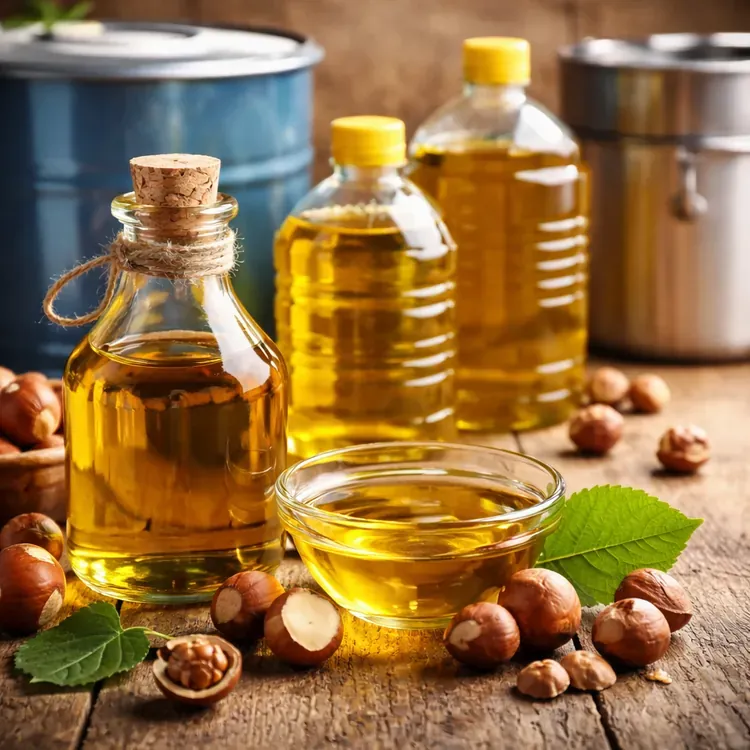
What this format is built for
Hazelnut oil is typically selected for three reasons: (1) a clean, high-oleic lipid profile that performs well as a carrier, (2) an aromatic “nutty” top note in cold-pressed formats, and (3) a neutral, process-stable base in refined formats.
We supply through Turkey-based partners with export-ready documentation and packaging programs designed to protect against oxidation during storage and transit.
Share your target application (food / cosmetics), processing conditions, and shelf-life goals. We’ll map them to a spec sheet with measurable targets and acceptance bands.
Product variants you can specify
| Variant | Best for | Typical profile |
|---|---|---|
| Cold-pressed (virgin) | Premium culinary oils, finishing, dressings, gourmet sauces, aroma-forward recipes; also suitable for certain cosmetic blends | Golden color; distinct hazelnut aroma; oxidation protection becomes critical in light/heat exposure |
| Crude (mechanically obtained) | Further processing programs where the buyer controls refining stages | Higher natural variability; can be specified by incoming crude parameters |
| Refined (neutral) | Industrial food manufacturing (spreads, fillings, chocolate systems), consistent carrier oil, neutral sensory requirement | Neutral odor/taste; tighter acidity targets; stable behavior in blends |
| Optional polishing steps | Sensitive applications (long shelf-life, cosmetic base oils, light-colored emulsions) | Deodorization, winterization, filtration, and inert-gas headspace where required |
Programs can be built around mechanical pressing (expeller) without solvent extraction, and aligned to your destination-market compliance and documentation flow.
Typical specification points
The table below lists common parameters used in procurement specs. Targets can be tightened or expanded depending on your application and shelf-life expectations.
| Parameter | Typical options / targets | Why it matters |
|---|---|---|
| Free fatty acidity (as oleic) | Refined programs commonly specify low acidity; many buyers set explicit max limits for refined oil. (Example target: ≤0.30% as oleic for refined.) | Indicator of hydrolysis / raw material condition; impacts taste stability and shelf-life |
| Peroxide value (PV) | Defined maximum PV on loading; optional stricter limits for long shelf-life or cosmetic base programs | Primary oxidation marker; predicts rancidity risk under transport/storage |
| Moisture & volatile matter | Controlled to reduce hydrolysis and improve storage stability | Lower moisture reduces FFA drift and microbial risk in residues |
| Insoluble impurities | Specified maximum; filtration/clarification matched to your use | Protects pumps, filters, and final product texture |
| Iodine value | Specified range for identity/consistency; useful in authenticity and stability programs | Degree of unsaturation; influences oxidative stability and formulation behavior |
| Color | Natural golden (cold-pressed) or lighter neutral (refined) targets; optional Lovibond targets | Appearance control for light-colored creams, emulsions, and premium retail oils |
| Odor & taste | Cold-pressed: characteristic hazelnut aroma; refined: neutral sensory | Defines where the oil can be used (aroma carrier vs neutral lipid base) |
| Fatty acid profile | High-oleic profile; optional acceptance bands by key fatty acids (C18:1, C18:2) | Predicts oxidation resistance, texture behavior, and nutritional positioning |
| Contaminants & compliance | Aligned to destination market requirements (e.g., residues, heavy metals as applicable) | Import clearance and brand protection |
Standard documentation package can include: product spec sheet, COA per lot, traceability identifiers, and packaging/pallet plan. Cosmetic channel programs can add safety data and INCI naming support where required.
Reference analytical ranges (typical)
These values are provided as reference ranges from published studies and are useful for benchmarking procurement specs. Final limits should always be defined in your own specification sheet and validated by COA.
| Property | Typical reference values | Notes for procurement |
|---|---|---|
| Acidity (as oleic) | Can vary by refining stage; crude higher, deodorized lower | Use a max limit aligned to your application (refined programs often set very low limits) |
| Peroxide value (PV) | Varies by stage and storage; set loading maximums | Consider adding secondary oxidation indices for sensitive products |
| Iodine value | Typically mid-80s range in published industrial refining data | Useful as an identity/consistency checkpoint |
| Oleic acid (C18:1) | High-oleic; commonly ~80%+ (variety-dependent) | Higher oleic generally supports better oxidation resistance |
| Linoleic acid (C18:2) | Often single-digits to low-teens (variety-dependent) | Higher linoleic can increase oxidation risk; set acceptance bands if needed |
If your QA program includes authenticity screening, you can specify sterol profile review and/or additional markers in line with your internal risk model and the channel you sell into.
Typical fatty acid profile (benchmark)
Hazelnut oil is commonly described as “olive-oil-like” due to its high oleic acid share. Exact numbers depend on cultivar, crop year and processing.
| Fatty acid | Common benchmark range | Functional impact |
|---|---|---|
| Oleic (C18:1) | ~72–85%+ | Oxidation resistance, smooth mouthfeel, stable carrier behavior |
| Linoleic (C18:2) | ~7–16% | Nutrition positioning; higher values can reduce oxidative stability |
| Palmitic (C16:0) | ~4–6% | Minor effect on structure and melting behavior |
| Stearic (C18:0) | ~2–3% | Minor effect on structure and melting behavior |
Where it’s used
Common industrial usage patterns (food and cosmetic) plus process notes:
Food: select cold-pressed oil when you want aroma contribution; select refined oil for neutral taste and manufacturing stability in spreads, creams, and chocolate systems.
Cosmetics: often used as an emollient oil in blends; define odor/color limits tightly for light emulsions and premium face oils.
Packaging, oxidation protection and logistics
Hazelnut oil is oxidation-sensitive compared to many saturated fats, so packaging is a core part of the specification. We align packaging to your channel (industrial vs retail) and your shelf-life target.
- Industrial: food-grade drums / barrels; optional IBC for high-volume programs; pallet plan for sea/road freight
- Retail: glass bottle programs for premium positioning; PET for cost/weight optimization where appropriate
- Oxidation controls: light protection, sealed headspace, and optional inert-gas practices depending on the program
- Storage guidance: cool, dry storage; avoid heat and direct light; align “best before” to the agreed oxidation limits
Tell us destination, incoterm and discharge port — we’ll propose a packaging + pallet spec that protects quality in transit.
Quality, safety and consistency
Our role is to coordinate supply and documentation so your QA team receives consistent shipment-to-shipment performance: measured analytical parameters, traceability identifiers, and controlled packaging that protects oxidation-sensitive oils.
- Lot-based traceability and export documentation support
- Specification mapping: food manufacturing vs retail vs cosmetic programs
- Optional pre-shipment sampling aligned to your approval workflow
Hazelnut oil is derived from hazelnut (tree nut). Labeling and allergen handling should follow your destination-market requirements and your internal policy.
FAQ
Do you supply cold-pressed oil?
Yes. Cold-pressed programs are commonly used when aroma contribution is desired. We align packaging to reduce oxidation and protect shelf-life.
What does “refined hazelnut oil” mean in specifications?
Refined oil is processed to reduce free fatty acidity and remove unwanted volatiles while keeping the triglyceride structure stable. Refined programs typically set low acidity limits and neutral sensory targets.
Can you provide bottles for retail or private label?
Yes. Retail packaging can be developed under private label programs, including bottle type, labeling, case configuration and pallet plan.
Can you align the oil to cosmetic formulation needs?
Yes. Cosmetic programs often require tighter odor/color control and clear documentation. Share your intended use (leave-on vs rinse-off, fragrance, emulsions) and we’ll map the spec.
Request a specification & quote
Tell us: variant (cold-pressed / refined), annual volume, packaging (drum/IBC/bottle), destination country, and your target analytical limits (FFA/PV and any additional indices). We’ll respond with a spec-aligned offer and a packaging/pallet plan.