Hazelnut Paste / Puree
100% hazelnut paste (puree) engineered for stable high-shear mixing, consistent flavor carry and repeatable depositor/pump performance — widely used in chocolate, fillings, spreads, wafers and frozen desserts.
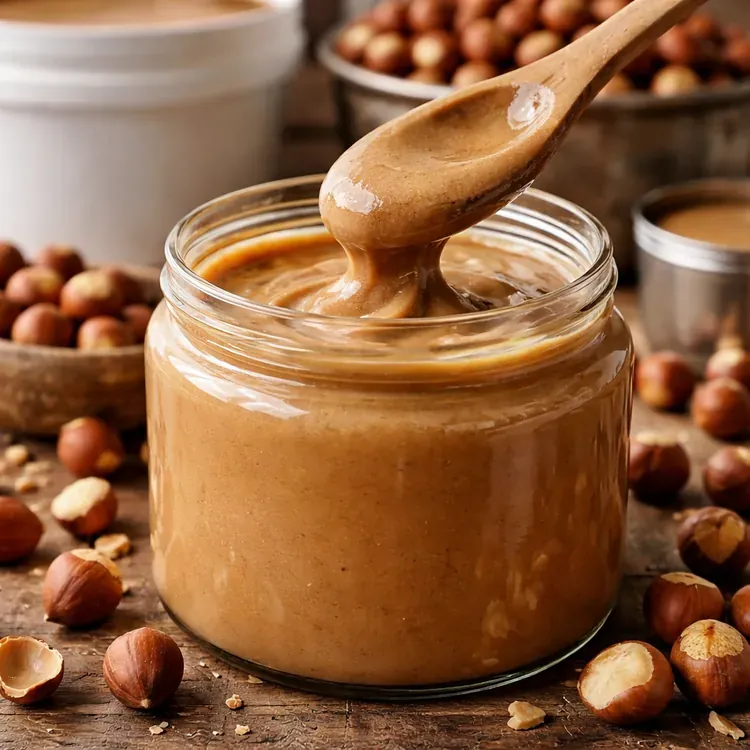
What this format is built for
Hazelnut paste (often called puree) is produced by roasting and finely milling hazelnuts into a homogeneous mass. Industrial buyers select paste when they need maximum flavor density, clean label (100% hazelnut), and stable dispersion in fat-based systems such as chocolate and creams.
- High-shear mixing stability: designed to disperse into cocoa butter, dairy fat, vegetable fats, and nut-fat systems.
- Controlled fineness: defined micron ranges to match mouthfeel and processing (pumping, injecting, depositing).
- Roast tuning: light/medium/dark roast for aroma and color alignment.
- Oxidation management: limits and packaging options set to your shelf-life target.
Share your internal paste spec (fineness, oxidation limits, micro limits, packaging format, destination) and we’ll map it to a stable, repeatable product definition.
Product variants we can supply
| Variant | What it is | Best for |
|---|---|---|
| 100% Hazelnut Paste / Puree | Pure hazelnut mass with no added sugar or emulsifiers; roast and fineness defined per program. | Chocolate, creams, fillings, bakery injectors, ice cream variegates, spreads base |
| Roast profiles | Light / medium / dark roast (and tuned in-between) to match aroma and color targets. | Brand-locked flavor profiles and consistent finished color |
| Fineness options | Typical industrial fineness ranges include 20–25 µm, 25–40 µm, 40–80 µm; other targets on request. | Mouthfeel control, pump/depositor compatibility, chocolate viscosity management |
| Praline paste (optional program) | Hazelnut paste blended with sugar to customer spec (sweetened “praline-style” ingredient). | Confectionery fillings, gelato bases, bakery creams where sweetness/body is desired |
Many Turkish producers use “hazelnut puree” and “hazelnut paste” interchangeably for 100% hazelnut mass. We lock the definition using: roast degree + fineness (µm) + oxidation/micro limits + packaging and storage requirements.
Technical specification framework
Typical paste/puree specification points
| Parameter | Typical options / targets | Why it matters |
|---|---|---|
| Ingredients | 100% hazelnut | Clean label; maximum flavor density and fat-phase compatibility |
| Roast degree | Light / medium / dark (tunable) | Controls aroma, bitterness balance and finished color |
| Fineness / particle size | 20–25 µm • 25–40 µm • 40–80 µm (or 20–80 µm upon request) | Defines mouthfeel, chocolate viscosity, pumpability and depositor performance |
| Appearance & texture | Homogeneous paste; typical hazelnut flavor; free from foreign odours | Reduces texture defects in fillings, creams and frozen dessert bases |
| Packaging program | 5–25 kg buckets • 20–220 kg drums/barrels • 1,000 kg IBC • bulk tanker | Optimizes handling, oxygen exposure, unloading method and cost |
Chemical & oxidation controls (typical contract fields)
The ranges below reflect common producer specification sheets for hazelnut paste. Final limits are aligned to your QA program and destination market rules.
| Parameter | Typical target / max | Notes |
|---|---|---|
| Moisture | ≤ 2% max | Lower moisture supports stability and reduces microbial risk :contentReference[oaicite:4]{index=4} |
| Fat content | ~55–68% (natural fat in paste) | Key driver of mouthfeel and fat-phase performance :contentReference[oaicite:5]{index=5} |
| Free Fatty Acids (FFA) | ≤ 1% max | Hydrolytic rancidity control :contentReference[oaicite:6]{index=6} |
| Peroxide value | ≤ 1.0 meq/kg max | Oxidative rancidity control :contentReference[oaicite:7]{index=7} |
| Aflatoxin B1 | ≤ 5 ppb max | Food safety; align to destination market :contentReference[oaicite:8]{index=8} |
| Total aflatoxin (B1+B2+G1+G2) | ≤ 10 ppb max | Food safety; align to destination market :contentReference[oaicite:9]{index=9} |
Microbiological controls (typical contract fields)
| Test | Typical limit | Notes |
|---|---|---|
| Total Plate Count | ≤ 2,000 / g | Lot-based monitoring :contentReference[oaicite:10]{index=10} |
| Mould & Yeast | ≤ 100 cfu / g | Moisture and storage are key drivers :contentReference[oaicite:11]{index=11} |
| Enterobacteriaceae | ≤ 100 cfu / g | Hygiene indicator :contentReference[oaicite:12]{index=12} |
| Total coliform | ≤ 10 cfu / g | Hygiene indicator :contentReference[oaicite:13]{index=13} |
| E. coli | Absent / g | Food safety requirement :contentReference[oaicite:14]{index=14} |
| Salmonella | Absent / 25 g | Food safety requirement :contentReference[oaicite:15]{index=15} |
Producers commonly reference Turkish standards for processed hazelnut products (e.g., hazelnut paste standards) or supply to customer specifications, and can provide program statements such as GMO-free / no irradiation / no nanotechnology where supported by producer documentation. :contentReference[oaicite:16]{index=16}
Packaging & logistics programs
Hazelnut paste is typically shipped in sealed industrial packaging formats that match your unloading method (manual scoop, pump-out, heated jacket, IBC discharge). Common formats include drums/barrels, buckets, IBCs and bulk tanker options. :contentReference[oaicite:17]{index=17}
| Format | Typical sizes | When to use |
|---|---|---|
| Plastic buckets | 10 / 12.5 / 15 / 20 / 25 kg (common) • 5 / 10 / 20 kg also used | Small–mid volume users, pilot lines, easier handling and partial use programs :contentReference[oaicite:18]{index=18} |
| Drums / barrels | 20 / 25 / 30 / 55 / 60 / 200 / 220 kg (varies by producer) | Standard industrial use; stable palletization for export :contentReference[oaicite:19]{index=19} |
| IBC | 1,000 kg | High volume users with dedicated discharge and reduced packaging waste :contentReference[oaicite:20]{index=20} |
| Bulk tanker / container | Bulk program by agreement | Large users with controlled unloading and dedicated QA programs :contentReference[oaicite:21]{index=21} |
A common reference shelf life is 12 months under cool storage (e.g., 10–15 °C) with controlled humidity. Final shelf life depends on roast profile, oxygen exposure, packaging selection, and your QA release limits. :contentReference[oaicite:22]{index=22}
For pump/depositor lines, paste behavior is typically stabilized by (1) selecting the correct fineness band, (2) managing temperature during use (to reduce viscosity spikes), and (3) minimizing air/oxygen pickup during rework and transfer. We can align packaging (bucket/drum/IBC/bulk) to your plant handling to reduce oil separation and texture drift.
Where it’s used
Industrial hazelnut paste/puree is widely used in chocolate, bakery and frozen dessert applications. Typical usage includes chocolate, bakery, biscuits, wafers and ice cream. :contentReference[oaicite:23]{index=23}
| Category | Applications | What paste delivers |
|---|---|---|
| Chocolate & confectionery | Chocolate flavor base, gianduja-style systems, praline/filling bases, compound coatings | Strong nut flavor, richness, protein contribution; can influence melt and mouthfeel :contentReference[oaicite:24]{index=24} |
| Bakery, biscuits & wafers | Cream fillings, wafer creams, injected pastries, croissant fillings, cookie inclusions | Homogeneous texture, stable dispersion and predictable depositor behavior :contentReference[oaicite:25]{index=25} |
| Ice cream & frozen desserts | Variegates, gelato bases, ripple fillings, inclusions systems | Flavor density without added water; smooth mouthfeel tuned via fineness :contentReference[oaicite:26]{index=26} |
| Spreads & creams | Hazelnut creams/spreads, nut butter-style products, flavored dairy and dessert creams | Clean-label “nut base” enabling flexible sweetener/fat/emulsifier design |
For most industrial RFQs, the three “must-lock” parameters are roast degree (color/aroma), fineness band (µm), and oxidation limits (peroxide/FFA) at ship date. Packaging choice (bucket/drum/IBC/bulk) is then selected to protect those targets through your logistics and storage.
Quality, safety and consistency
We coordinate with established Turkish processors to deliver repeatable paste performance lot-to-lot, with documentation and sampling aligned to your procurement SOP. On the producer side, common industrial controls include optical/laser sorting, X-ray, sortex, sieving, metal detectors and magnets, supported by GMP and HACCP programs. :contentReference[oaicite:27]{index=27}
- Lot-based traceability: lot IDs, best-before, origin and standard markings on industrial packaging :contentReference[oaicite:28]{index=28}
- COA fields: moisture, peroxide, FFA, aflatoxins and micro limits aligned to your acceptance plan :contentReference[oaicite:29]{index=29}
- Process controls: sorting/foreign matter reduction and metal detection prior to pack-out :contentReference[oaicite:30]{index=30}
FAQ
Can you align viscosity for dosing and pumping?
Yes. In practice, paste “viscosity” is managed by selecting the correct fineness band (µm), controlling temperature during use, and matching packaging/unloading to your equipment. We can align product definition and COA fields to your line requirements.
Is the paste suitable for fillings and variegates?
Yes. Hazelnut paste/puree is widely used in fillings, creams/spreads, wafers and frozen dessert systems (including variegates). :contentReference[oaicite:31]{index=31}
Do you offer roasted paste?
Yes. Roast profile can be supplied as light, medium or dark (and tuned in-between) to match your aroma and color targets. :contentReference[oaicite:32]{index=32}
What fineness options are available?
Common industrial targets include 20–25 µm, 25–40 µm and 40–80 µm (or 20–80 µm on request), selected based on mouthfeel and process behavior. :contentReference[oaicite:33]{index=33}
What packaging formats do you support?
Typical formats include plastic buckets (5–25 kg), drums/barrels (20–220 kg), 1,000 kg IBCs and bulk tanker programs depending on volume and handling. :contentReference[oaicite:34]{index=34}
Request a specification & quote
Tell us your roast target (light/medium/dark), fineness (e.g., 25–40 µm), oxidation limits (peroxide/FFA), micro limits, quantity and destination. We’ll respond with a spec-aligned offer and packaging program (bucket/drum/IBC/bulk).