Roasting lines
Uniform size band improves roast evenness (color + aroma), reduces scorching and helps achieve consistent crunch. Moisture and peroxide control support aroma stability.
Whole, natural hazelnut kernels supplied to defined calibration, defect tolerance and chemical limits — built for roasting lines, inclusions, repacking and downstream ingredient processing.
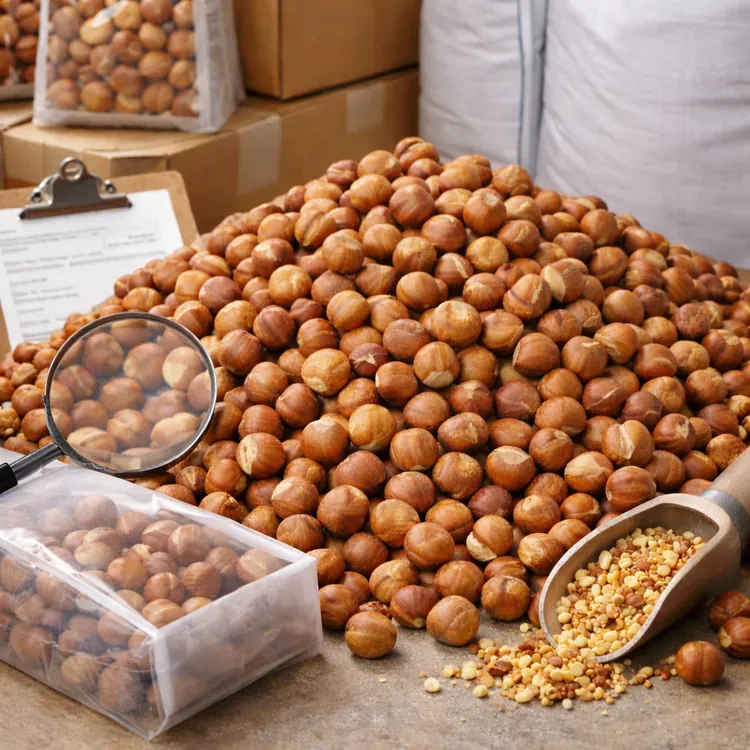
Natural kernels are the raw material for most processed hazelnut ingredients: roasted kernels, cuts (diced/sliced/chopped), meal/flour, paste/purée and praline systems. For industrial users, performance depends on repeatable calibration and controlled defect bands.
Send your internal spec sheet (limits + test methods) and we’ll map it to a stable product definition: size band, grade/class target, defect tolerances, packaging, sampling and documentation flow.
Common usage patterns, why buyers specify them, and what to watch on the line.
Uniform size band improves roast evenness (color + aroma), reduces scorching and helps achieve consistent crunch. Moisture and peroxide control support aroma stability.
Whole kernels for premium visual identity in chocolate and bakery; defect bands tuned to reduce customer complaints and line stops. Optional optical sorting for foreign material risk reduction.
Caliber + appearance targets aligned to merchandising and pack-window aesthetics. Labeling and lot traceability structured for export compliance.
Natural kernels are commonly pre-cleaned and size-classified, then passed through optical/laser selection stages with in-process lab monitoring. This supports stable shipment-to-shipment performance and reduces foreign material risk on sensitive brands and high-speed lines.
The table below reflects a spec-style format commonly used by large processors/exporters and can be adapted to your internal limits and destination requirements (methods, sampling plans, and class targets).
| Category | Parameter | Typical spec point / options |
|---|---|---|
| Identity | Ingredient statement | 100% hazelnut |
| Origin | Origin / type | Turkey (TR). Common types include Levant/Ordu, Giresun, Akçakoca. |
| Calibration | Kernel size | 9–15+ mm with 1–2 mm size differences. Single sizes (10–11 / 11–12 / 12–13 / 13–14 / 14–15 mm) or mixed bands (9–11 / 11–13 / 13–15 / 9–15 mm). |
| Sensory | Appearance / taste / texture / color | Uniform, whole and sound kernels; typical fresh hazelnut taste, free of foreign odors; firm and crispy; typical brown color. |
| Chemical | Moisture | ≤ 6.0% (natural formats are often managed around the 4–6% band depending on buyer spec and product form) |
| Chemical | Fat content | 55–68% (typical range) |
| Chemical | Free fatty acids (as oleic) | ≤ 1.0% |
| Chemical | Peroxide value | ≤ 1.0 mEq/kg |
| Contaminants | Aflatoxin B1 | ≤ 5 ppb (buyer / destination aligned) |
| Contaminants | Total aflatoxin (B1+B2+G1+G2) | ≤ 10 ppb (buyer / destination aligned) |
| Physical | Foreign matter | ≤ 0.05% |
| Physical | Defectuous | ≤ 2.0% (inner/visible rotten, inner/visible mouldy, rancid) |
| Physical | Broken & mechanically damaged | ≤ 8.0% (broken ≤ 1.0% max) |
| Physical | Shrivelled | ≤ 4.0% |
| Physical | Other group ratio | ≤ 10% |
| Physical | Under / over calibre | ± 5% max (sizing in 1 mm intervals; each class 10% max) |
Natural kernels typically sit within broad compositional ranges (moisture, protein and oil vary by origin/season). This is why industrial buyers lock moisture + oxidation indicators (FFA/peroxide) for consistent shelf-life and flavor performance.
Many procurement specs reference TS-style classing. If you use an internal class definition, we map limits and sampling to your system and document it as part of the product definition.
| Parameter | Extra (% max) | 1st class (% max) | 2nd class (% max) |
|---|---|---|---|
| Shrivelled | 2 | 4 | 8 |
| Rotten, mouldy | 1 | 2 | 3 |
| Mechanically damaged + broken | 3 | 8 | 10 |
| Over size + under size | 10 | 10 | 10 |
| Foreign material | 0.05 | 0.05 | 0.05 |
If your brand uses stricter limits (e.g., foreign matter, broken, rancid), we can tighten bands and align optical/laser sorting and manual inspection workflows accordingly.
Packaging is selected based on oxidation sensitivity, handling (manual vs. automated), and freight mode. For long routes or high aroma sensitivity, barrier materials and vacuum formats reduce oxygen exposure.
We align pallet labeling, pallet patterns, container loading and humidity exposure mitigation to your warehouse process and destination requirements.
Natural hazelnuts are fat-rich and sensitive to oxidation. Storage and packaging choices matter as much as the incoming quality.
| Topic | Guidance |
|---|---|
| Shelf life | 12 months (typical reference) under controlled storage conditions |
| Storage temperature | 10–15 °C (typical reference for quality retention) |
| Relative humidity | ≤ 65% RH max (typical reference) |
| Odor control | Store away from strong odors; use clean, dry warehouses and sealed packaging |
| Rotation | FIFO/FEFO, with lot-based traceability and COA/inspection alignment |
Peroxide value and free fatty acids are leading indicators for oxidation and rancidity risk. Industrial users often lock these limits to protect flavor in chocolate, dairy inclusions, and baked goods.
Documentation and declarations can be aligned to destination market and customer requirements as part of the RFQ.
Typical declarations are GMO-free and not irradiated. (Declarations and wording can be aligned to your regulatory market.)
Common exporter specs reference compliance to EU legal limits for heavy metals and pesticides. Testing plans can be aligned to your importer or retailer requirements.
Hazelnut is the relevant allergen. Cross-contact statements can be aligned to the processing environment and your labeling policy.
Pre-cleaning, stone separation, size classification, and optical/laser selection steps—supported by in-process lab monitoring— are commonly used by large-scale processors to reduce foreign material and stabilize physical/chemical performance.
Downstream products made from natural kernels, with specs aligned to your line.
Roast degree aligned to aroma/color; moisture targets tightened for crunch and shelf life.
View roasted kernels →Controlled particle sizes for dosing, bars, biscuits, chocolate and cereals.
View cuts →Particle size control (mm/µm) for texture, binding and high-shear mixing performance.
View meal/flour →Yes. Common options include single sizes (10–11, 11–12, 12–13, 13–14, 14–15 mm) and mixed bands (9–11, 11–13, 13–15, 9–15 mm). We align under/over tolerances to your dosing and visual requirements.
Moisture, free fatty acids and peroxide value are key leading indicators for oxidation and rancidity risk. For high-sensitivity applications (chocolate, dairy inclusions), buyers often lock these limits and pair them with barrier packaging.
Yes. Aflatoxin limits, sampling plans, and COA presentation can be aligned to your customer and destination market expectations.
Vacuum packs (0.5–25 kg) with cartons, 20–25 kg cartons with liners, 25 kg kraft/paper or jute bags, 50–80 kg jute bags, and 500–1000 kg big bags. Selection depends on oxidation sensitivity, handling, and freight mode.
Share calibration, class/defect limits, packaging format, quantity and destination. We’ll respond with a spec mapping summary, packing proposal and documentation checklist.