Hazelnut Flour / Meal
Ground hazelnut formats (roasted, blanched or natural) with particle-size control, moisture targets and oxidation management — engineered for stable dosing, predictable texture and consistent industrial performance.
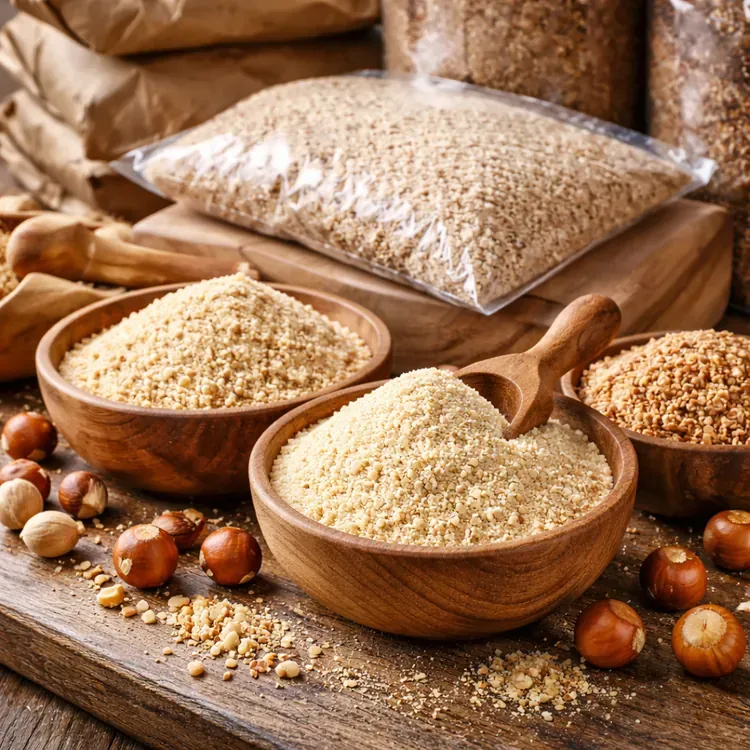
What this format is built for
Hazelnut flour/meal is a high-fat, aromatic nut ingredient used to replace part of cereal flour, build texture, and deliver a clean “hazelnut” flavor in both sweet and savory applications. Industrial users typically choose this format when they need:
- Texture engineering: crunchy bite (coarser meal), smooth crumb (finer flour/powder), controlled mouthfeel.
- Moisture and binding behavior: helps structure in cookies, cakes and gluten-free matrices; supports cohesion in coatings.
- Flavor delivery: roasted notes (light/medium/dark) without adding liquids (vs paste).
- Process stability: consistent flowability, dosing and mixing when particle distribution is controlled.
Share your internal spec sheet (sieve targets, moisture/oxidation limits, micro limits, packaging format, destination) — we’ll map it to a repeatable product definition and sampling plan.
Available product types
Made from roasted kernels, then ground. Selected when you want pronounced roasted aroma and lower moisture targets for stability.
- Typical moisture target: ~0.8–3% (aligned to your spec)
- Common calibrations: 0–1.5 mm, 0–2 mm, 0–3 mm
- Best for: biscuits, wafers, fillings, ice cream inclusions, bakery mixes
Made from skinned kernels. Chosen when you need lighter color, cleaner appearance and less “skin speckling.”
- Typical moisture target: ~3–5% (aligned to your spec)
- Common calibrations: 0–1.5 mm, 0–2 mm, 0–3 mm
- Best for: light-colored bakery, creams, premium confectionery visuals
Made from natural kernels (skin-on). Selected when you want “whole nut” character and a more rustic color profile.
- Typical moisture target: ~4.5–6% (aligned to your spec)
- Common calibrations: 0–2 mm, 0–3 mm (other sieves on request)
- Best for: nutrition formats, bakery, cereals, “wholefood” positioning
Terminology varies by buyer and market. We define it operationally using your sieve/particle distribution targets (and, where relevant, bulk density and flow behavior). If you don’t have targets, we can propose an acceptance profile for your application (e.g., mixing, sheeting, extrusion, enrobing).
Industrial specification framework
We supply with a procurement-ready specification that connects what you measure (sieve, moisture, oxidation, micro) to how the ingredient behaves (mixing, texture, shelf life). Below are typical points used in industrial hazelnut meal/flour contracts.
1) Physical / particle controls
| Parameter | How it is defined | Typical options |
|---|---|---|
| Calibration (nominal) | Primary target range by sieve / calibration declaration | 0–1.5 mm, 0–2 mm, 0–3 mm (other ranges by request) |
| Particle distribution (PSD) | Sieve stack or laser diffraction targets (D10/D50/D90 if requested) | Buyer-defined; controls texture, deposition and mixing |
| Overs / fines | % retained above top sieve; % passing bottom sieve | Set to prevent gritty bite (overs) or pasty behavior (excess fines) |
| Bulk density | g/L (tapped and/or loose) | Used to stabilize dosing, volumetric filling and feeder behavior |
| Color | Visual standard or L*a*b* target by roast level | Natural (skin-on), blanched (lighter), roasted (light/med/dark) |
| Flowability | Qualitative (free-flowing / bridging) or quantitative (angle of repose) | Improved via consistent PSD and moisture control |
2) Chemical & oxidation controls
Example limits below reflect common producer spec sheets for roasted hazelnut meal/powder. Final limits are aligned to your internal QA and destination market.
| Parameter | Typical target / limit | Why it matters |
|---|---|---|
| Moisture | Roasted: ~0.8–3% • Blanched: ~3–5% • Natural: ~4.5–6% | Drives shelf life, flowability, clumping risk and micro stability |
| Fat content (natural) | Typically in the mid-to-high range (e.g., ~55–68% in some producer specs) | Impacts flavor release, mouthfeel, dough rheology and fat migration |
| Free Fatty Acids (FFA) | Common contract control point (example: ≤1% in some producer specs) | Indicator of hydrolytic rancidity and storage/handling stress |
| Peroxide value | Common contract control point (example: ≤1.0 meq/kg in some producer specs) | Indicator of oxidative rancidity; managed via oxygen/light/heat exposure |
| Foreign matter | Example: ≤0.05% in some producer specs | Supports food safety and customer complaint reduction |
| Aflatoxins | Typically controlled by B1 and Total limits (example: B1 ≤5 ppb; Total ≤10 ppb in some producer specs) | Critical food safety parameter; aligned to destination market requirements |
3) Microbiological controls
| Test | Typical limit example | Notes |
|---|---|---|
| Total Plate Count | Example: ≤10,000 cfu/g | Lot-based monitoring and trend control |
| Yeast & mould | Example: ≤100 cfu/g | Moisture and storage are key drivers |
| Enterobacteriaceae | Example: ≤100 cfu/g | Process hygiene / environment control |
| Total coliform | Example: ≤10 cfu/g | Indicator test per buyer program |
| E. coli | Example: Absent / g | Food safety requirement |
| Salmonella | Example: Absent / 25 g | Food safety requirement |
4) Allergen, GMO & process statements
Contains hazelnut. Cross-contamination risk is assessed per facility program and can be documented for your approval. GMO-free statements and “no irradiation / no nanotechnology” statements are available where supported by producer documentation.
Producers commonly align processed hazelnut products to Turkish standards (e.g., TS references for processed nuts) or to customer specifications. Where relevant, product specs can reference TS 10937 for roasted meal/powder and related processed product standards, alongside your own QA protocol.
Process design & contamination controls
For industrial buyers, “spec” only works if the process consistently delivers it. Typical producer flow for roasted meal/powder includes:
- Roasting to spec: kernels roasted to defined degree (light/medium/dark) per customer requirements.
- Skin removal & cleaning: mechanical skin removal and cleaning steps reduce extraneous material.
- Optical sorting: Sortex and optical/laser sorting stages remove foreign materials and defects.
- Manual inspection: inspection tables as an additional control point for defects/foreign matter.
- Grinding & milling: controlled milling with sieve classification to meet calibration targets.
- Metal detection: post-mill metal detection prior to packaging silos.
- Continuous QC: physical/chemical/micro monitoring at multiple stages, not only at final pack-out.
We can align sampling, COA fields and hold/release logic to your procurement workflow (pre-shipment samples, retain samples, and lot traceability).
Packaging & logistics options
We offer packaging formats commonly used by large Turkish processors, selected based on oxidation sensitivity, handling equipment, and destination market requirements.
| Packaging | Typical formats | When to use |
|---|---|---|
| Industrial sacks / bags | 25–50 kg lined sacks (jute/PP/nylon depending on producer) • 25 kg kraft/paper bags | Standard industrial handling; suitable for controlled dry storage |
| Vacuum packs | 5 / 10 / 12.5 / 20 / 25 kg vacuum options (carton or palletized) | When oxidation control and aroma retention are priority |
| Cartoned liners | Polylined cartons for certain formats and customer preferences | Cleaner warehouse handling; retail line compatibility |
| Big bags | 500–1000 kg big bags (where applicable) | High-volume users with silo/IBC compatible unloading |
Pallet patterns, liner selection, container loading plans and export documentation (lot IDs, net weights, origin, best-before) can be configured to match your receiving SOP.
Where it’s used
Hazelnut flour/meal is used across bakery, confectionery and “better-for-you” categories. Common industrial uses include:
Partial flour replacement to add fat richness, flavor and structure in gluten-free matrices.
- Cookies, cakes, brownies, muffins
- Macaron-style and nut-based batters
- Protein/energy bites and bars
Controlled grind delivers consistent bite and reduces “grit” variability across lots.
- Wafer creams, cookie doughs
- Chocolate inclusions and layers
- Sprinkles/toppings blends
Adds nut flavor without introducing paste viscosity; supports dry blending in inclusions.
- Ice cream variegates and mix-ins
- Frozen dessert inclusions
- Breakfast cereal clusters
Common functional positioning includes flour replacer, binding agent, and flavoring agent. We can recommend a particle profile based on whether your process needs “crumb structure,” “crunch,” or “smooth dispersion.”
Buyer guidance: how to specify flour/meal correctly
Many quality issues come from specifying “hazelnut flour” without defining performance drivers. A robust industrial spec usually includes:
| Spec element | What to define | Practical tip |
|---|---|---|
| Particle distribution | Calibration + max overs + max fines | Match to your process: finer for batters/creams, coarser for crunchy bite and inclusions |
| Roast level | Light / medium / dark target and acceptable color window | Roast is a “flavor ingredient.” Align sensory panel with color reference |
| Oxidation limits | Peroxide and/or FFA maximum at ship date | Pair limits with packaging choice (vacuum/MAP) and storage expectations |
| Micro limits | TPC, yeast/mould, Salmonella/E. coli requirements | Define method and reporting units so COAs are comparable |
| Foreign matter | Maximum tolerance and detection controls | Ask for sorting/metal detection steps + complaint handling protocol |
If you want, we can provide a one-page “spec template” you can paste into your RFQ and supplier scorecard.
FAQ
Is flour different from meal?
“Flour/powder” usually means a finer grind and “meal” a slightly coarser grind. In industrial procurement, the correct way to define the difference is your sieve/PSD targets (and overs/fines limits), not the name alone.
Can you control particle size?
Yes. We can supply defined calibrations (e.g., 0–1.5 mm, 0–2 mm, 0–3 mm) and align acceptance limits to your mixing, texture and deposition requirements. We can also propose a PSD profile if you provide your process description.
Is this suitable for gluten-free recipes?
Yes. Hazelnut flour/meal is naturally gluten-free and widely used as a partial flour replacer for flavor, fat richness and structure. It’s common in cookies, cakes, biscuits and nutrition formats.
What roast levels are available?
Roasted formats can be supplied as light/medium/dark targets depending on your sensory and color requirements. If you use multiple SKUs, we can help you lock a roast/color window for repeatability.
What packaging is best for shelf life?
For maximum aroma retention and oxidation control, buyers often choose vacuum formats (5–25 kg) or high-barrier solutions. For standard dry storage and fast consumption, 25–50 kg lined sacks or kraft/paper bags may be suitable. We match packaging to your shelf-life target and handling.
Request a specification & quote
Tell us your product type (roasted/blanched/natural), particle target (e.g., 0–2 mm), quality limits (moisture/oxidation/micro), quantity and destination. We’ll respond with a spec-aligned offer, COA fields and packaging options.