Blanched Hazelnut Kernels
Skin-removed kernels engineered for premium appearance, light color targets and clean texture. Supplied with calibre control and spec discipline for confectionery, bakery and chocolate manufacturing.
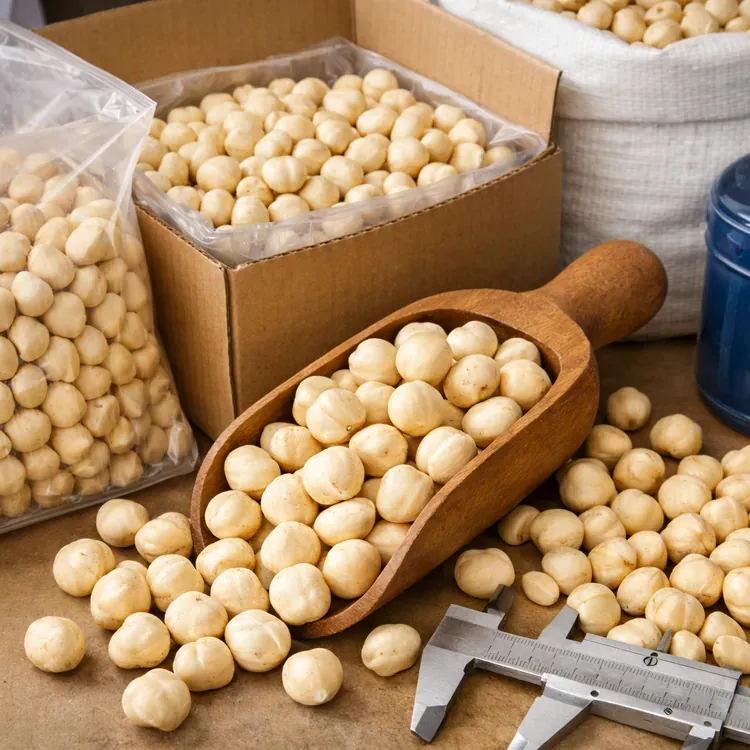
What “blanched” means in industrial terms
Blanched kernels are hazelnut kernels that undergo controlled heat treatment to loosen the skin, followed by mechanical skin removal and post-processing steps (grading, cleaning, sorting) to meet defined quality targets.
- Lighter visual profile: supports cream, praline, ganache and bakery fillings where dark specks are undesirable.
- Smoother texture & mouthfeel: particularly relevant for enrobed products, inclusions and premium toppings.
- Calibre control: supports dosing, enrobing coverage, and consistent distribution in bars, cookies and cereals.
Share your internal specification or end-use (chocolate inclusion, garnish, snack, bakery line), and we’ll match it to a stable, repeatable product definition including tolerances, documentation, and packaging.
Technical specification (typical program)
Specification points below are typical for industrial blanched kernel programs. Final values and tolerances can be aligned to customer specs and destination market compliance requirements.
| Parameter | Typical value / options | Why it matters in production |
|---|---|---|
| Ingredient | 100% hazelnut | Single-ingredient control supports clean labeling and predictable functionality. |
| Calibration (whole kernels) | Common ranges: 9–11 mm, 11–13 mm, 13–15 mm, 15+ mm (single or mixed sizes) | Controls enrobing coverage, appearance, deposit weight and inclusion distribution. |
| Moisture | 3–5% (program-dependent) | Impacts crispness, shelf stability, chocolate viscosity interaction and microbial risk. |
| Fat content | Typically 55–68% | Drives flavor carry, mouthfeel and fat migration behavior in chocolate & fillings. |
| FFA (Free Fatty Acids) | ≤ 1.0% (as agreed) | Key freshness indicator; helps manage rancidity risk and sensory consistency. |
| Peroxide value | ≤ 1.0 meq/kg (as agreed) | Oxidation control; supports clean aroma and stable storage in warm chains. |
| Residual skin (membrane) | Target aligned to program; typical low-skin appearance with agreed max tolerance | Reduces visual specking and bitterness contribution in high-fat systems. |
| Color / appearance | Light beige to light yellow tones; uniform, sound kernels | Important for premium decorations, cream systems and light-colored fillings. |
| Shelf life | Typically 12 months (storage conditions apply) | Supports annual programs and inventory planning with defined stability targets. |
Store in a cool, dry environment away from strong odors. Typical control targets include ~10–15°C storage and controlled humidity to maintain crispness and oxidation stability. (Exact conditions can be aligned to your QA program and packaging choice.)
Defect tolerances & foreign matter control
For industrial buyers, defect tolerances are often the difference between “usable” and “line-stopping.” We can map your defect definitions (visual, sieve-based, or customer-specific) to a procurement-ready spec with sampling and COA structure.
| Parameter | Typical max (example program) | Notes |
|---|---|---|
| Foreign matter | ≤ 0.05% | Supports safety and downstream equipment protection. |
| Rotten / mouldy / rancid | ≤ 1% | Driven by raw selection + sorting + supplier QC discipline. |
| Broken | ≤ 2% | Impacts appearance; also affects dosing accuracy for whole-kernel programs. |
| Mechanically damaged | ≤ 10% | Can increase oxidation surface area and reduce visual grade. |
| Shrivelled | ≤ 2% | Relates to kernel soundness and texture perception. |
| Other group ratio | ≤ 10% | Used for mixed-defect category alignment (program-dependent). |
| Under + over calibre | ≤ 10% | Controls size distribution; critical for enrobing and garnish uniformity. |
Microbiological targets (typical industrial specification)
Micro targets depend on destination market and product use (ready-to-eat snack vs. further processing). Below is a common reference-style set used in industrial supply programs.
| Parameter | Typical requirement | Why it’s used |
|---|---|---|
| Total mesophilic aerobic bacteria | ≤ 2000 / g | General hygiene indicator for processed kernels. |
| Salmonella | Absent / 25 g | Critical safety criterion for ready-to-eat or snack formats. |
| E. coli | Absent / g | Indicator for post-process contamination control. |
| Yeast & mould | ≤ 100 cfu / g | Helps manage spoilage and off-notes over shelf life. |
| Enterobacteriaceae | ≤ 100 cfu / g | Process hygiene indicator used in many QA systems. |
| Coliform | ≤ 10 cfu / g | Supports hygiene verification and buyer specifications. |
Contaminant management & compliance documentation
Hazelnut procurement frequently requires a documentation bundle beyond a basic spec: lot traceability, contaminant statements, and destination-market compliance support.
- Aflatoxin control targets: program limits can include B1 and Total Aflatoxin thresholds aligned to your market and QA plan.
- GMO: typically supplied as GMO-free statements for hazelnut kernels.
- Irradiation / nanotechnology statements: available as required for compliance files.
- Pesticides & heavy metals: aligned to applicable legal limits and customer compliance expectations.
- Allergen statement: hazelnut is a tree nut allergen; cross-contact statements aligned to facility profiles and program requirements.
- COA / lot traceability: lot-based documentation and sampling workflows can be matched to your procurement process.
Typical markings include product description, size/calibre, crop/season (where applicable), origin, net weight, lot number, and best-before date—plus any customer-specific coding structure.
Packaging & logistics options
Packaging is selected to match oxidation control, handling efficiency, and your receiving line. Vacuum and barrier options are commonly used where aroma protection and extended stability are critical.
| Format | Typical options | Best for |
|---|---|---|
| Vacuum / barrier bags | 5 / 10 / 12.5 / 15 / 20 / 25 kg (with cartons where applicable) | Oxidation management, clean handling, premium applications and longer supply chains. |
| Paper / kraft bags | 25 / 50 kg | Dry warehouse programs where barrier is not the primary requirement. |
| Jute / nylon sacks | 25 / 50 / 80 kg (program-dependent) | Bulk commodity-style handling with established receiving lines. |
| Big bags | 500–1000 kg | High-volume industrial programs and automated unloading setups. |
| Palletization | Sea/road freight pallet build aligned to destination and packaging format | Export stability, reduced damage risk, improved warehouse efficiency. |
If your line is sensitive to breakage, we can help define packaging, stacking, and unloading parameters to reduce mechanical damage in transit.
Where it’s used
Common industrial usage patterns and process notes from our applications library:
Blanched kernels are frequently selected where color uniformity matters (light creams/fillings), or where skin specking affects the finished look. For high-speed lines, calibre control helps maintain consistent dosing and appearance across runs.
FAQ
Why choose blanched kernels?
Blanching removes the skin to support light color targets and smooth visual appearance. This is often important in premium chocolate, praline, creams and bakery toppings.
What calibre ranges do you supply?
Common whole-kernel ranges include 9–11 mm, 11–13 mm, 13–15 mm and 15+ mm. Mixed or single-size programs can be aligned to your line and finished product.
Can you align residual skin and color targets?
Yes. Residual skin (membrane) and appearance tolerances can be set per program. We can map your internal spec to a repeatable supplier-side definition.
Do you provide aflatoxin and microbiological documentation?
Yes. Lot-based documentation and COA bundles can include aflatoxin and microbiological results, aligned to your destination market and procurement requirements.
Can blanched kernels also be supplied roasted?
Yes. Roasted blanched options are available, with roast profile aligned to aroma, color and moisture targets—especially important for chocolate flavor release.
Request a specification & quote
Tell us your target application, calibre, quantity and destination market. We’ll respond with a spec-aligned offer, packaging options and documentation scope.